
Multiplying and Dividing Exponents - Math
Card 1 of 24
Simplify the following expression.

Simplify the following expression.
Tap to reveal answer
When dividing with exponents, the exponent in the denominator is subtracted from the exponent in the numerator. For example: 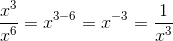 .
.
In our problem, each term can be treated in this manner. Remember that a negative exponent can be moved to the denominator.

Now, simplifly the numerals.
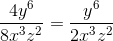
When dividing with exponents, the exponent in the denominator is subtracted from the exponent in the numerator. For example:
In our problem, each term can be treated in this manner. Remember that a negative exponent can be moved to the denominator.
Now, simplifly the numerals.
← Didn't Know|Knew It →
Solve for  :
: 
Solve for
Tap to reveal answer
Rewrite each side of the equation to only use a base 2:


The only way this equation can be true is if the exponents are equal.
So:

The  on each side cancel, and moving the
  to the left side, we get:

Rewrite each side of the equation to only use a base 2:
The only way this equation can be true is if the exponents are equal.
So:
The
← Didn't Know|Knew It →
Simplify the expression:

Simplify the expression:
Tap to reveal answer
First simplify the second term, and then combine the two:

First simplify the second term, and then combine the two:
← Didn't Know|Knew It →
Simplify the following expression.

Simplify the following expression.
Tap to reveal answer
We are given:  .
.
Recall that when we are multiplying exponents with the same base, we keep the base the same and add the exponents.
Thus, we have  .
.
We are given:
Recall that when we are multiplying exponents with the same base, we keep the base the same and add the exponents.
Thus, we have
← Didn't Know|Knew It →
Simplify the following expression.

Simplify the following expression.
Tap to reveal answer
Recall that when we are dividing exponents with the same base, we keep the base the same and subtract the exponents.
Thus, we have 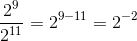 .
.
We also recall that for negative exponents,
 .
.
Thus,  .
.
Recall that when we are dividing exponents with the same base, we keep the base the same and subtract the exponents.
Thus, we have
We also recall that for negative exponents,
Thus,
← Didn't Know|Knew It →
Simplify the following exponent expression:

Simplify the following exponent expression:
Tap to reveal answer
Begin by rearranging the terms in the numerator and denominator so that the exponents are positive:


Multiply the exponents:

Simplify:

Begin by rearranging the terms in the numerator and denominator so that the exponents are positive:
Multiply the exponents:
Simplify:
← Didn't Know|Knew It →
Simplify the following expression.
Simplify the following expression.
Tap to reveal answer
When dividing with exponents, the exponent in the denominator is subtracted from the exponent in the numerator. For example: .
In our problem, each term can be treated in this manner. Remember that a negative exponent can be moved to the denominator.
Now, simplifly the numerals.
When dividing with exponents, the exponent in the denominator is subtracted from the exponent in the numerator. For example:
In our problem, each term can be treated in this manner. Remember that a negative exponent can be moved to the denominator.
Now, simplifly the numerals.
← Didn't Know|Knew It →
Solve for :
Solve for
Tap to reveal answer
Rewrite each side of the equation to only use a base 2:
The only way this equation can be true is if the exponents are equal.
So:
The on each side cancel, and moving the to the left side, we get:
Rewrite each side of the equation to only use a base 2:
The only way this equation can be true is if the exponents are equal.
So:
The
← Didn't Know|Knew It →
Simplify the expression:
Simplify the expression:
Tap to reveal answer
First simplify the second term, and then combine the two:
First simplify the second term, and then combine the two:
← Didn't Know|Knew It →
Simplify the following expression.
Simplify the following expression.
Tap to reveal answer
We are given: .
Recall that when we are multiplying exponents with the same base, we keep the base the same and add the exponents.
Thus, we have .
We are given:
Recall that when we are multiplying exponents with the same base, we keep the base the same and add the exponents.
Thus, we have
← Didn't Know|Knew It →
Simplify the following expression.
Simplify the following expression.
Tap to reveal answer
Recall that when we are dividing exponents with the same base, we keep the base the same and subtract the exponents.
Thus, we have .
We also recall that for negative exponents,
.
Thus, .
Recall that when we are dividing exponents with the same base, we keep the base the same and subtract the exponents.
Thus, we have
We also recall that for negative exponents,
Thus,
← Didn't Know|Knew It →
Simplify the following exponent expression:
Simplify the following exponent expression:
Tap to reveal answer
Begin by rearranging the terms in the numerator and denominator so that the exponents are positive:
Multiply the exponents:
Simplify:
Begin by rearranging the terms in the numerator and denominator so that the exponents are positive:
Multiply the exponents:
Simplify:
← Didn't Know|Knew It →
Simplify the following expression.
Simplify the following expression.
Tap to reveal answer
When dividing with exponents, the exponent in the denominator is subtracted from the exponent in the numerator. For example: .
In our problem, each term can be treated in this manner. Remember that a negative exponent can be moved to the denominator.
Now, simplifly the numerals.
When dividing with exponents, the exponent in the denominator is subtracted from the exponent in the numerator. For example:
In our problem, each term can be treated in this manner. Remember that a negative exponent can be moved to the denominator.
Now, simplifly the numerals.
← Didn't Know|Knew It →
Solve for :
Solve for
Tap to reveal answer
Rewrite each side of the equation to only use a base 2:
The only way this equation can be true is if the exponents are equal.
So:
The on each side cancel, and moving the to the left side, we get:
Rewrite each side of the equation to only use a base 2:
The only way this equation can be true is if the exponents are equal.
So:
The
← Didn't Know|Knew It →
Simplify the expression:
Simplify the expression:
Tap to reveal answer
First simplify the second term, and then combine the two:
First simplify the second term, and then combine the two:
← Didn't Know|Knew It →
Simplify the following expression.
Simplify the following expression.
Tap to reveal answer
We are given: .
Recall that when we are multiplying exponents with the same base, we keep the base the same and add the exponents.
Thus, we have .
We are given:
Recall that when we are multiplying exponents with the same base, we keep the base the same and add the exponents.
Thus, we have
← Didn't Know|Knew It →
Simplify the following expression.
Simplify the following expression.
Tap to reveal answer
Recall that when we are dividing exponents with the same base, we keep the base the same and subtract the exponents.
Thus, we have .
We also recall that for negative exponents,
.
Thus, .
Recall that when we are dividing exponents with the same base, we keep the base the same and subtract the exponents.
Thus, we have
We also recall that for negative exponents,
Thus,
← Didn't Know|Knew It →
Simplify the following exponent expression:
Simplify the following exponent expression:
Tap to reveal answer
Begin by rearranging the terms in the numerator and denominator so that the exponents are positive:
Multiply the exponents:
Simplify:
Begin by rearranging the terms in the numerator and denominator so that the exponents are positive:
Multiply the exponents:
Simplify:
← Didn't Know|Knew It →
Simplify the following expression.
Simplify the following expression.
Tap to reveal answer
When dividing with exponents, the exponent in the denominator is subtracted from the exponent in the numerator. For example: .
In our problem, each term can be treated in this manner. Remember that a negative exponent can be moved to the denominator.
Now, simplifly the numerals.
When dividing with exponents, the exponent in the denominator is subtracted from the exponent in the numerator. For example:
In our problem, each term can be treated in this manner. Remember that a negative exponent can be moved to the denominator.
Now, simplifly the numerals.
← Didn't Know|Knew It →
Solve for :
Solve for
Tap to reveal answer
Rewrite each side of the equation to only use a base 2:
The only way this equation can be true is if the exponents are equal.
So:
The on each side cancel, and moving the to the left side, we get:
Rewrite each side of the equation to only use a base 2:
The only way this equation can be true is if the exponents are equal.
So:
The
← Didn't Know|Knew It →