
Multiplying and dividing Logarithms - Math
Card 1 of 20
Simplify the expression using logarithmic identities.

Simplify the expression using logarithmic identities.
Tap to reveal answer
The logarithm of a fraction is equal to the logarithm of the numerator minus the logarithm of the denominator.

If we encounter two logarithms with the same base, we can likely combine them. In this case, we can use the reverse of the above identity.


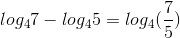
The logarithm of a fraction is equal to the logarithm of the numerator minus the logarithm of the denominator.
If we encounter two logarithms with the same base, we can likely combine them. In this case, we can use the reverse of the above identity.
← Didn't Know|Knew It →
Which of the following represents a simplified form of  ?
?
Which of the following represents a simplified form of
Tap to reveal answer
The rule for the addition of logarithms is as follows:
 .
.
As an application of this, .
.
The rule for the addition of logarithms is as follows:
As an application of this,
← Didn't Know|Knew It →
Simplify  .
.
Simplify
Tap to reveal answer
Using properties of logs we get:


Using properties of logs we get:
← Didn't Know|Knew It →
Simplify the following expression:

Simplify the following expression:
Tap to reveal answer
Recall the log rule:

In this particular case,  and
and  . Thus, our answer is
  .
.
Recall the log rule:
In this particular case,
← Didn't Know|Knew It →
Use the properties of logarithms to solve the following equation:

Use the properties of logarithms to solve the following equation:
Tap to reveal answer
Since the bases of the logs are the same and the logarithms are added, the arguments can be multiplied together. We then simplify the right side of the equation:


The logarithm can be converted to exponential form:



Factor the equation:


Although there are two solutions to the equation, logarithms cannot be negative. Therefore, the only real solution is  .
.
Since the bases of the logs are the same and the logarithms are added, the arguments can be multiplied together. We then simplify the right side of the equation:
The logarithm can be converted to exponential form:
Factor the equation:
Although there are two solutions to the equation, logarithms cannot be negative. Therefore, the only real solution is
← Didn't Know|Knew It →
Simplify the expression using logarithmic identities.
Simplify the expression using logarithmic identities.
Tap to reveal answer
The logarithm of a fraction is equal to the logarithm of the numerator minus the logarithm of the denominator.
If we encounter two logarithms with the same base, we can likely combine them. In this case, we can use the reverse of the above identity.
The logarithm of a fraction is equal to the logarithm of the numerator minus the logarithm of the denominator.
If we encounter two logarithms with the same base, we can likely combine them. In this case, we can use the reverse of the above identity.
← Didn't Know|Knew It →
Which of the following represents a simplified form of ?
Which of the following represents a simplified form of
Tap to reveal answer
The rule for the addition of logarithms is as follows:
.
As an application of this,.
The rule for the addition of logarithms is as follows:
As an application of this,
← Didn't Know|Knew It →
Simplify .
Simplify
Tap to reveal answer
Using properties of logs we get:
Using properties of logs we get:
← Didn't Know|Knew It →
Simplify the following expression:
Simplify the following expression:
Tap to reveal answer
Recall the log rule:
In this particular case, and . Thus, our answer is .
Recall the log rule:
In this particular case,
← Didn't Know|Knew It →
Use the properties of logarithms to solve the following equation:
Use the properties of logarithms to solve the following equation:
Tap to reveal answer
Since the bases of the logs are the same and the logarithms are added, the arguments can be multiplied together. We then simplify the right side of the equation:
The logarithm can be converted to exponential form:
Factor the equation:
Although there are two solutions to the equation, logarithms cannot be negative. Therefore, the only real solution is .
Since the bases of the logs are the same and the logarithms are added, the arguments can be multiplied together. We then simplify the right side of the equation:
The logarithm can be converted to exponential form:
Factor the equation:
Although there are two solutions to the equation, logarithms cannot be negative. Therefore, the only real solution is
← Didn't Know|Knew It →
Simplify the expression using logarithmic identities.
Simplify the expression using logarithmic identities.
Tap to reveal answer
The logarithm of a fraction is equal to the logarithm of the numerator minus the logarithm of the denominator.
If we encounter two logarithms with the same base, we can likely combine them. In this case, we can use the reverse of the above identity.
The logarithm of a fraction is equal to the logarithm of the numerator minus the logarithm of the denominator.
If we encounter two logarithms with the same base, we can likely combine them. In this case, we can use the reverse of the above identity.
← Didn't Know|Knew It →
Which of the following represents a simplified form of ?
Which of the following represents a simplified form of
Tap to reveal answer
The rule for the addition of logarithms is as follows:
.
As an application of this,.
The rule for the addition of logarithms is as follows:
As an application of this,
← Didn't Know|Knew It →
Simplify .
Simplify
Tap to reveal answer
Using properties of logs we get:
Using properties of logs we get:
← Didn't Know|Knew It →
Simplify the following expression:
Simplify the following expression:
Tap to reveal answer
Recall the log rule:
In this particular case, and . Thus, our answer is .
Recall the log rule:
In this particular case,
← Didn't Know|Knew It →
Use the properties of logarithms to solve the following equation:
Use the properties of logarithms to solve the following equation:
Tap to reveal answer
Since the bases of the logs are the same and the logarithms are added, the arguments can be multiplied together. We then simplify the right side of the equation:
The logarithm can be converted to exponential form:
Factor the equation:
Although there are two solutions to the equation, logarithms cannot be negative. Therefore, the only real solution is .
Since the bases of the logs are the same and the logarithms are added, the arguments can be multiplied together. We then simplify the right side of the equation:
The logarithm can be converted to exponential form:
Factor the equation:
Although there are two solutions to the equation, logarithms cannot be negative. Therefore, the only real solution is
← Didn't Know|Knew It →
Simplify the expression using logarithmic identities.
Simplify the expression using logarithmic identities.
Tap to reveal answer
The logarithm of a fraction is equal to the logarithm of the numerator minus the logarithm of the denominator.
If we encounter two logarithms with the same base, we can likely combine them. In this case, we can use the reverse of the above identity.
The logarithm of a fraction is equal to the logarithm of the numerator minus the logarithm of the denominator.
If we encounter two logarithms with the same base, we can likely combine them. In this case, we can use the reverse of the above identity.
← Didn't Know|Knew It →
Which of the following represents a simplified form of ?
Which of the following represents a simplified form of
Tap to reveal answer
The rule for the addition of logarithms is as follows:
.
As an application of this,.
The rule for the addition of logarithms is as follows:
As an application of this,
← Didn't Know|Knew It →
Simplify .
Simplify
Tap to reveal answer
Using properties of logs we get:
Using properties of logs we get:
← Didn't Know|Knew It →
Simplify the following expression:
Simplify the following expression:
Tap to reveal answer
Recall the log rule:
In this particular case, and . Thus, our answer is .
Recall the log rule:
In this particular case,
← Didn't Know|Knew It →
Use the properties of logarithms to solve the following equation:
Use the properties of logarithms to solve the following equation:
Tap to reveal answer
Since the bases of the logs are the same and the logarithms are added, the arguments can be multiplied together. We then simplify the right side of the equation:
The logarithm can be converted to exponential form:
Factor the equation:
Although there are two solutions to the equation, logarithms cannot be negative. Therefore, the only real solution is .
Since the bases of the logs are the same and the logarithms are added, the arguments can be multiplied together. We then simplify the right side of the equation:
The logarithm can be converted to exponential form:
Factor the equation:
Although there are two solutions to the equation, logarithms cannot be negative. Therefore, the only real solution is
← Didn't Know|Knew It →