
Triangles - Math
Card 1 of 880
An isosceles triangle has a base of  and an area of
  . What must be the height of this triangle?
An isosceles triangle has a base of
Tap to reveal answer
 .
.


← Didn't Know|Knew It →
A triangle has sides of length 8, 13, and L. Which of the following cannot equal L?
A triangle has sides of length 8, 13, and L. Which of the following cannot equal L?
Tap to reveal answer
The sum of the lengths of two sides of a triangle cannot be less than the length of the third side. 8 + 4 = 12, which is less than 13.
The sum of the lengths of two sides of a triangle cannot be less than the length of the third side. 8 + 4 = 12, which is less than 13.
← Didn't Know|Knew It →
Two sides of a triangle are 20 and 32. Which of the following CANNOT be the third side of this triangle.
Two sides of a triangle are 20 and 32. Which of the following CANNOT be the third side of this triangle.
Tap to reveal answer
Please remember the Triangle Inequality Theorem, which states that the sum of any two sides of a triangle must be greater than the third side. Therefore, the correct answer is 10 because the sum of 10 and 20 would not be greater than the third side 32.
Please remember the Triangle Inequality Theorem, which states that the sum of any two sides of a triangle must be greater than the third side. Therefore, the correct answer is 10 because the sum of 10 and 20 would not be greater than the third side 32.
← Didn't Know|Knew It →
A triangle has a perimeter of 36 inches, and one side that is 12 inches long. The lengths of the other two sides have a ratio of 3:5. What is the length of the longest side of the triangle?
A triangle has a perimeter of 36 inches, and one side that is 12 inches long. The lengths of the other two sides have a ratio of 3:5. What is the length of the longest side of the triangle?
Tap to reveal answer
We know that the perimeter is 36 inches, and one side is 12. This means, the sum of the lengths of the other two sides are 24. The ratio between the two sides is 3:5, giving a total of 8 parts. We divide the remaining length, 24 inches, by 8 giving us 3. This means each part is 3. We multiply this by the ratio and get 9:15, meaning the longest side is 15 inches.
We know that the perimeter is 36 inches, and one side is 12. This means, the sum of the lengths of the other two sides are 24. The ratio between the two sides is 3:5, giving a total of 8 parts. We divide the remaining length, 24 inches, by 8 giving us 3. This means each part is 3. We multiply this by the ratio and get 9:15, meaning the longest side is 15 inches.
← Didn't Know|Knew It →
A triangle has sides of length 5, 7, and x. Which of the following can NOT be a value of x?
A triangle has sides of length 5, 7, and x. Which of the following can NOT be a value of x?
Tap to reveal answer
The sum of the lengths of any two sides of a triangle must exceed the length of the third side; therefore, 5+7 > x, which cannot happen if x = 13.
The sum of the lengths of any two sides of a triangle must exceed the length of the third side; therefore, 5+7 > x, which cannot happen if x = 13.
← Didn't Know|Knew It →
Two sides of a triangle have lengths 4 and 7. Which of the following represents the set of all possible lengths of the third side, x?
Two sides of a triangle have lengths 4 and 7. Which of the following represents the set of all possible lengths of the third side, x?
Tap to reveal answer
The set of possible lengths is: 7-4 < x < 7+4, or 3 < X < 11.
The set of possible lengths is: 7-4 < x < 7+4, or 3 < X < 11.
← Didn't Know|Knew It →
If two sides of a triangle have lengths 8 and 10, what could the length of the third side NOT be?
If two sides of a triangle have lengths 8 and 10, what could the length of the third side NOT be?
Tap to reveal answer
According to the Triangle Inequality Theorem, the sums of the lengths of any two sides of a triangle must be greater than the length of the third side. Since 10 + 8 is 18, the only length out of the answer choices that is not possible is 19.
According to the Triangle Inequality Theorem, the sums of the lengths of any two sides of a triangle must be greater than the length of the third side. Since 10 + 8 is 18, the only length out of the answer choices that is not possible is 19.
← Didn't Know|Knew It →
The lengths of two sides of a triangle are 9 and 7. Which of the following could be the length of the third side?
The lengths of two sides of a triangle are 9 and 7. Which of the following could be the length of the third side?
Tap to reveal answer
Let us call the third side x. According to the Triangle Inequality Theorem, the sum of any two sides of a triangle must be larger than the other two sides. Thus, all of the following must be true:
x + 7 > 9
x + 9 > 7
7 + 9 > x
We can solve these three inequalities to determine the possible values of x.
x + 7 > 9
Subtract 7 from both sides.
x > 2
Now, we can look at x + 9 > 7. Subtracting 9 from both sides, we obtain
x > –2
Finally, 7 + 9 > x, which means that 16 > x.
Therefore, x must be greater than 2, greater than –2, but also less than 16. The only number that satisfies all of these requirements is 12.
The answer is 12.
Let us call the third side x. According to the Triangle Inequality Theorem, the sum of any two sides of a triangle must be larger than the other two sides. Thus, all of the following must be true:
x + 7 > 9
x + 9 > 7
7 + 9 > x
We can solve these three inequalities to determine the possible values of x.
x + 7 > 9
Subtract 7 from both sides.
x > 2
Now, we can look at x + 9 > 7. Subtracting 9 from both sides, we obtain
x > –2
Finally, 7 + 9 > x, which means that 16 > x.
Therefore, x must be greater than 2, greater than –2, but also less than 16. The only number that satisfies all of these requirements is 12.
The answer is 12.
← Didn't Know|Knew It →
The lengths of a triangle are 8, 12, and x. Which of the following inequalities shows all of the possible values of x?
The lengths of a triangle are 8, 12, and x. Which of the following inequalities shows all of the possible values of x?
Tap to reveal answer
According to the Triangle Inequality Theorem, the sum of any two sides of a triangle must be greater (not greater than or equal) than the remaining side. Thus, the following inequalities must all be true:
x + 8 > 12
x + 12 > 8
8 + 12 > x
Let's solve each inequality.
x + 8 > 12
Subtract 8 from both sides.
x > 4
Next, let's look at the inequality x + 12 > 8
x + 12 > 8
Subtract 12 from both sides.
x > –4
Lastly, 8 + 12 > x, which means that x < 20.
This means that x must be less than twenty, but greater than 4 and greater than –4. Since any number greater than 4 is also greater than –4, we can exclude the inequality x > –4.
To summarize, x must be greater than 4 and less than 20. We can write this as 4 < x < 20.
The answer is 4 < x < 20.
According to the Triangle Inequality Theorem, the sum of any two sides of a triangle must be greater (not greater than or equal) than the remaining side. Thus, the following inequalities must all be true:
x + 8 > 12
x + 12 > 8
8 + 12 > x
Let's solve each inequality.
x + 8 > 12
Subtract 8 from both sides.
x > 4
Next, let's look at the inequality x + 12 > 8
x + 12 > 8
Subtract 12 from both sides.
x > –4
Lastly, 8 + 12 > x, which means that x < 20.
This means that x must be less than twenty, but greater than 4 and greater than –4. Since any number greater than 4 is also greater than –4, we can exclude the inequality x > –4.
To summarize, x must be greater than 4 and less than 20. We can write this as 4 < x < 20.
The answer is 4 < x < 20.
← Didn't Know|Knew It →
If 2 sides of the triangle are have lengths equal to 8 and 14, what is one possible length of the third side?
If 2 sides of the triangle are have lengths equal to 8 and 14, what is one possible length of the third side?
Tap to reveal answer
The sum of the lengths of 2 sides of a triangle must be greater than—but not equal to—the length of the third side. Further, the third side must be longer than the difference between the greater and the lesser of the other two sides; therefore, 20 is the only possible answer.


The sum of the lengths of 2 sides of a triangle must be greater than—but not equal to—the length of the third side. Further, the third side must be longer than the difference between the greater and the lesser of the other two sides; therefore, 20 is the only possible answer.
← Didn't Know|Knew It →
In  the length of AB is 15 and the length of side AC is 5. What is the least possible integer length of side BC?
In
Tap to reveal answer
Rule - the length of one side of a triangle must be greater than the differnce and less than the sum of the lengths of the other two sides.
Given lengths of two of the sides of the  are 15 and 5. The length of the third side must be greater than 15-5 or 10 and less than 15+5 or 20.
The question asks what is the least possible integer length of BC, which would be 11
Rule - the length of one side of a triangle must be greater than the differnce and less than the sum of the lengths of the other two sides.
Given lengths of two of the sides of the
The question asks what is the least possible integer length of BC, which would be 11
← Didn't Know|Knew It →
Two similiar triangles exist where the ratio of perimeters is 4:5 for the smaller to the larger triangle. If the larger triangle has sides of 6, 7, and 12 inches, what is the perimeter, in inches, of the smaller triangle?
Two similiar triangles exist where the ratio of perimeters is 4:5 for the smaller to the larger triangle. If the larger triangle has sides of 6, 7, and 12 inches, what is the perimeter, in inches, of the smaller triangle?
Tap to reveal answer
The larger triangle has a perimeter of 25 inches. Therefore, using a 4:5 ratio, the smaller triangle's perimeter will be 20 inches.
The larger triangle has a perimeter of 25 inches. Therefore, using a 4:5 ratio, the smaller triangle's perimeter will be 20 inches.
← Didn't Know|Knew It →
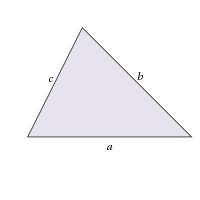
If a = 7 and b = 4, which of the following could be the perimeter of the triangle?
I. 11
II. 15
III. 25
If a = 7 and b = 4, which of the following could be the perimeter of the triangle?
I. 11
II. 15
III. 25
Tap to reveal answer
Consider the perimeter of a triangle:
P = a + b + c
Since we know a and b, we can find c.
In I:
11 = 7 + 4 + c
11 = 11 + c
c = 0
Note that if c = 0, the shape is no longer a trial. Thus, we can eliminate I.
In II:
15 = 7 + 4 + c
15 = 11 + c
c = 4.
This is plausible given that the other sides are 7 and 4.
In III:
25 = 7 + 4 + c
25 = 11 + c
c = 14.
It is not possible for one side of a triangle to be greater than the sum of both of the other sides, so eliminate III.
Thus we are left with only II.
Consider the perimeter of a triangle:
P = a + b + c
Since we know a and b, we can find c.
In I:
11 = 7 + 4 + c
11 = 11 + c
c = 0
Note that if c = 0, the shape is no longer a trial. Thus, we can eliminate I.
In II:
15 = 7 + 4 + c
15 = 11 + c
c = 4.
This is plausible given that the other sides are 7 and 4.
In III:
25 = 7 + 4 + c
25 = 11 + c
c = 14.
It is not possible for one side of a triangle to be greater than the sum of both of the other sides, so eliminate III.
Thus we are left with only II.
← Didn't Know|Knew It →
Two sides of an isosceles triangle are 20 and 30. What is the difference of the largest and the smallest possible perimeters?
Two sides of an isosceles triangle are 20 and 30. What is the difference of the largest and the smallest possible perimeters?
Tap to reveal answer
The trick here is that we don't know which is the repeated side. Our possible triangles are therefore 20 + 20 + 30 = 70 or 30 + 30 + 20 = 80. The difference is therefore 80 – 70 or 10.
The trick here is that we don't know which is the repeated side. Our possible triangles are therefore 20 + 20 + 30 = 70 or 30 + 30 + 20 = 80. The difference is therefore 80 – 70 or 10.
← Didn't Know|Knew It →
Two similiar triangles have a ratio of perimeters of  .
.
If the smaller triangle has sides of 3, 7, and 5, what is the perimeter of the larger triangle.
Two similiar triangles have a ratio of perimeters of
If the smaller triangle has sides of 3, 7, and 5, what is the perimeter of the larger triangle.
Tap to reveal answer
Adding the sides gives a perimeter of 15 for the smaller triangle. Multipying by the given ratio of  , yields 52.5.
Adding the sides gives a perimeter of 15 for the smaller triangle. Multipying by the given ratio of
← Didn't Know|Knew It →
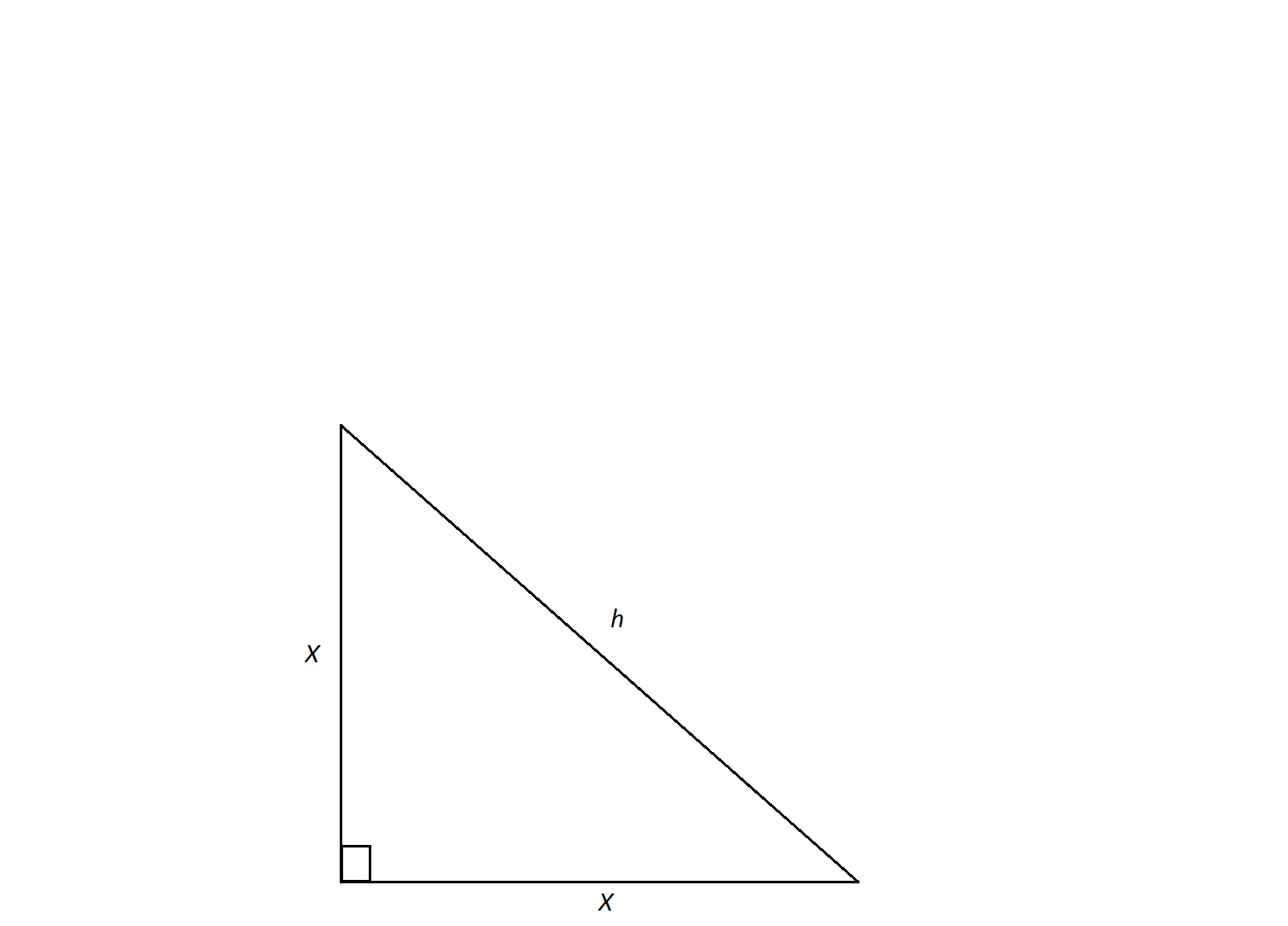
In an isosceles right triangle, two sides equal  . Find the length of side
  .
.
In an isosceles right triangle, two sides equal
Tap to reveal answer
This problem represents the definition of the side lengths of an isosceles right triangle. By definition the sides equal  ,
,  , and
, and  . However, if you did not remember this definition one can also find the length of the side using the Pythagorean theorem
  .
.


This problem represents the definition of the side lengths of an isosceles right triangle. By definition the sides equal
← Didn't Know|Knew It →
ABCD is a square whose side is  units. Find the length of diagonal AC.
ABCD is a square whose side is
Tap to reveal answer
To find the length of the diagonal, given two sides of the square, we can create two equal triangles from the square. The diagonal line splits the right angles of the square in half, creating two triangles with the angles of  ,
,  , and
, and  degrees. This type of triangle is a special right triangle, with the relationship between the side opposite the
  degree angles serving as x, and the side opposite the
  degree angle serving as
  .
.
Appyling this, if we plug  in for
  we get that the side opposite the right angle (aka the diagonal) is
To find the length of the diagonal, given two sides of the square, we can create two equal triangles from the square. The diagonal line splits the right angles of the square in half, creating two triangles with the angles of
Appyling this, if we plug
← Didn't Know|Knew It →
The area of a square is  . Find the length of the diagonal of the square.
The area of a square is
Tap to reveal answer
If the area of the square is  , we know that each side of the square is
  , because the area of a square is
  .
.
Then, the diagonal creates two  special right triangles. Knowing that the sides =
  , we can find that the hypotenuse (aka diagonal) is
If the area of the square is
Then, the diagonal creates two
← Didn't Know|Knew It →
One side of an acute isosceles triangle is 15 feet. Another side is 5 feet. What is the perimeter of the triangle in feet?
One side of an acute isosceles triangle is 15 feet. Another side is 5 feet. What is the perimeter of the triangle in feet?
Tap to reveal answer
Because this is an acute isosceles triangle, the third side must be the same as the longer of the sides that you were given. To find the perimeter, multiply the longer side by 2 and add the shorter side.

Because this is an acute isosceles triangle, the third side must be the same as the longer of the sides that you were given. To find the perimeter, multiply the longer side by 2 and add the shorter side.
← Didn't Know|Knew It →
Acute angles x and y are inside a right triangle. If x is four less than one third of 21, what is y?
Acute angles x and y are inside a right triangle. If x is four less than one third of 21, what is y?
Tap to reveal answer
We know that the sum of all the angles must be 180 and we already know one angle is 90, leaving the sum of x and y to be 90.
Solve for x to find y.
One third of 21 is 7. Four less than 7 is 3. So if angle x is 3 then that leaves 87 for angle y.
We know that the sum of all the angles must be 180 and we already know one angle is 90, leaving the sum of x and y to be 90.
Solve for x to find y.
One third of 21 is 7. Four less than 7 is 3. So if angle x is 3 then that leaves 87 for angle y.
← Didn't Know|Knew It →