
DNA, RNA, and Proteins - MCAT Biological and Biochemical Foundations of Living Systems
Card 1 of 552
Which of the following cell organelles is responsible for making proteins?
Which of the following cell organelles is responsible for making proteins?
Tap to reveal answer
Ribisomes are the protein creators within the cell. Ribisomes use a process called translation (via the use of mRNA) to form proteins.
The Golgi apparatus and rough endoplasmic reticulum are involved in protein modification and packaging. Lysosomes are involved in detoxification.
Ribisomes are the protein creators within the cell. Ribisomes use a process called translation (via the use of mRNA) to form proteins.
The Golgi apparatus and rough endoplasmic reticulum are involved in protein modification and packaging. Lysosomes are involved in detoxification.
← Didn't Know|Knew It →
Prions are the suspected cause of a wide variety of neurodegenerative diseases in mammals. According to prevailing theory, prions are infectious particles made only of protein and found in high concentrations in the brains of infected animals. All mammals produce normal prion protein, PrPC, a transmembrane protein whose function remains unclear.
Infectious prions, PrPRes, induce conformational changes in the existing PrPC proteins according to the following reaction:
PrPC + PrPRes → PrPRes + PrPRes
The PrPRes is then suspected to accumulate in the nervous tissue of infected patients and cause disease. This model of transmission generates replicated proteins, but does so bypassing the standard model of the central dogma of molecular biology. Transcription and translation apparently do not play a role in this replication process.
This theory is a major departure from previously established biological dogma. A scientist decides to test the protein-only theory of prion propagation. He establishes his experiment as follows:
Homogenized brain matter of infected rabbits is injected into the brains of healthy rabbits, as per the following table:
Rabbit 1 and 2: injected with normal saline on days 1 and 2
The above trials serve as controls.
Rabbit 3 and 4: injected with homogenized brain matter on days 1 and 2
The above trials use unmodified brain matter.
Rabbit 5 and 6: injected with irradiated homogenized brain matter on days 1 and 2
The above trials use brain matter that has been irradiated to destroy nucleic acids in the homogenate.
Rabbit 7 and 8: injected with protein-free centrifuged homogenized brain matter on days 1 and 2
The above trials use brain matter that has been centrifuged to generate a protein-free homogenate and a protein-rich homogenate based on molecular weight.
Rabbit 9 and 10: injected with boiled homogenized brain matter on days 1 and 2
The above trials use brain matter that have been boiled to destroy any bacterial contaminants in the homogenate.
Which intermediates of the central dogma of molecular biology below are present in normal cellular replication, but apparently absent in the above model of prion replication?
I. mRNA
II. tRNA
III. Protein
Prions are the suspected cause of a wide variety of neurodegenerative diseases in mammals. According to prevailing theory, prions are infectious particles made only of protein and found in high concentrations in the brains of infected animals. All mammals produce normal prion protein, PrPC, a transmembrane protein whose function remains unclear.
Infectious prions, PrPRes, induce conformational changes in the existing PrPC proteins according to the following reaction:
PrPC + PrPRes → PrPRes + PrPRes
The PrPRes is then suspected to accumulate in the nervous tissue of infected patients and cause disease. This model of transmission generates replicated proteins, but does so bypassing the standard model of the central dogma of molecular biology. Transcription and translation apparently do not play a role in this replication process.
This theory is a major departure from previously established biological dogma. A scientist decides to test the protein-only theory of prion propagation. He establishes his experiment as follows:
Homogenized brain matter of infected rabbits is injected into the brains of healthy rabbits, as per the following table:
Rabbit 1 and 2: injected with normal saline on days 1 and 2
The above trials serve as controls.
Rabbit 3 and 4: injected with homogenized brain matter on days 1 and 2
The above trials use unmodified brain matter.
Rabbit 5 and 6: injected with irradiated homogenized brain matter on days 1 and 2
The above trials use brain matter that has been irradiated to destroy nucleic acids in the homogenate.
Rabbit 7 and 8: injected with protein-free centrifuged homogenized brain matter on days 1 and 2
The above trials use brain matter that has been centrifuged to generate a protein-free homogenate and a protein-rich homogenate based on molecular weight.
Rabbit 9 and 10: injected with boiled homogenized brain matter on days 1 and 2
The above trials use brain matter that have been boiled to destroy any bacterial contaminants in the homogenate.
Which intermediates of the central dogma of molecular biology below are present in normal cellular replication, but apparently absent in the above model of prion replication?
I. mRNA
II. tRNA
III. Protein
Tap to reveal answer
The above reaction shows an actual transfer of information. The information contaiend in the specific structure of PrPC is converted to that contained in PrPRes; in other words, PrPRes is effectively replicating. In all other forms of cellular replication, based on the central dogma of molecular biology, replication occurs based on the following pattern:
Parental DNA → mRNA → Protein, carried by tRNA
The above reaction shows an actual transfer of information. The information contaiend in the specific structure of PrPC is converted to that contained in PrPRes; in other words, PrPRes is effectively replicating. In all other forms of cellular replication, based on the central dogma of molecular biology, replication occurs based on the following pattern:
Parental DNA → mRNA → Protein, carried by tRNA
← Didn't Know|Knew It →
Prions are the suspected cause of a wide variety of neurodegenerative diseases in mammals. According to prevailing theory, prions are infectious particles made only of protein and found in high concentrations in the brains of infected animals. All mammals produce normal prion protein, PrPC, a transmembrane protein whose function remains unclear.
Infectious prions, PrPRes, induce conformational changes in the existing PrPC proteins according to the following reaction:
PrPC + PrPRes → PrPRes + PrPRes
The PrPRes is then suspected to accumulate in the nervous tissue of infected patients and cause disease. This model of transmission generates replicated proteins, but does so bypassing the standard model of the central dogma of molecular biology. Transcription and translation apparently do not play a role in this replication process.
This theory is a major departure from previously established biological dogma. A scientist decides to test the protein-only theory of prion propagation. He establishes his experiment as follows:
Homogenized brain matter of infected rabbits is injected into the brains of healthy rabbits, as per the following table:
Rabbit 1 and 2: injected with normal saline on days 1 and 2
The above trials serve as controls.
Rabbit 3 and 4: injected with homogenized brain matter on days 1 and 2
The above trials use unmodified brain matter.
Rabbit 5 and 6: injected with irradiated homogenized brain matter on days 1 and 2
The above trials use brain matter that has been irradiated to destroy nucleic acids in the homogenate.
Rabbit 7 and 8: injected with protein-free centrifuged homogenized brain matter on days 1 and 2
The above trials use brain matter that has been centrifuged to generate a protein-free homogenate and a protein-rich homogenate based on molecular weight.
Rabbit 9 and 10: injected with boiled homogenized brain matter on days 1 and 2
The above trials use brain matter that have been boiled to destroy any bacterial contaminants in the homogenate.
Which of the following findings would most strongly refute the protein-transmission hypothesis of prion propagation?
Prions are the suspected cause of a wide variety of neurodegenerative diseases in mammals. According to prevailing theory, prions are infectious particles made only of protein and found in high concentrations in the brains of infected animals. All mammals produce normal prion protein, PrPC, a transmembrane protein whose function remains unclear.
Infectious prions, PrPRes, induce conformational changes in the existing PrPC proteins according to the following reaction:
PrPC + PrPRes → PrPRes + PrPRes
The PrPRes is then suspected to accumulate in the nervous tissue of infected patients and cause disease. This model of transmission generates replicated proteins, but does so bypassing the standard model of the central dogma of molecular biology. Transcription and translation apparently do not play a role in this replication process.
This theory is a major departure from previously established biological dogma. A scientist decides to test the protein-only theory of prion propagation. He establishes his experiment as follows:
Homogenized brain matter of infected rabbits is injected into the brains of healthy rabbits, as per the following table:
Rabbit 1 and 2: injected with normal saline on days 1 and 2
The above trials serve as controls.
Rabbit 3 and 4: injected with homogenized brain matter on days 1 and 2
The above trials use unmodified brain matter.
Rabbit 5 and 6: injected with irradiated homogenized brain matter on days 1 and 2
The above trials use brain matter that has been irradiated to destroy nucleic acids in the homogenate.
Rabbit 7 and 8: injected with protein-free centrifuged homogenized brain matter on days 1 and 2
The above trials use brain matter that has been centrifuged to generate a protein-free homogenate and a protein-rich homogenate based on molecular weight.
Rabbit 9 and 10: injected with boiled homogenized brain matter on days 1 and 2
The above trials use brain matter that have been boiled to destroy any bacterial contaminants in the homogenate.
Which of the following findings would most strongly refute the protein-transmission hypothesis of prion propagation?
Tap to reveal answer
Transmission in the control and a transmission in those rabbits injected with protein free homogenate would refute the above model. A protein-free homogenate would only be able to transmit disease via nucleic acids.
Transmission in the control and a transmission in those rabbits injected with protein free homogenate would refute the above model. A protein-free homogenate would only be able to transmit disease via nucleic acids.
← Didn't Know|Knew It →
A surface protein would most likely be translated from mRNA by the .
A surface protein would most likely be translated from mRNA by the .
Tap to reveal answer
Proteins are translated from mRNA by ribosomes. Ribosomes are located on the surface of the rough endoplasmic reticulum, as well as in the cytoplasm. Inter-membrane proteins are constructed by the rough endoplasmic reticulum and sent off in a vesicle, which later becomes part of the cell surface. Generally, proteins created by cytoplasmic ribosomes are destined to serve as cytoplasmic proteins.
Proteins are translated from mRNA by ribosomes. Ribosomes are located on the surface of the rough endoplasmic reticulum, as well as in the cytoplasm. Inter-membrane proteins are constructed by the rough endoplasmic reticulum and sent off in a vesicle, which later becomes part of the cell surface. Generally, proteins created by cytoplasmic ribosomes are destined to serve as cytoplasmic proteins.
← Didn't Know|Knew It →
Cryptosporidium is a genus of gastrointestinal parasite that infects the intestinal epithelium of mammals. Cryptosporidium is water-borne, and is an apicomplexan parasite. This phylum also includes Plasmodium, Babesia, and Toxoplasma.
Apicomplexans are unique due to their apicoplast, an apical organelle that helps penetrate mammalian epithelium. In the case of cryptosporidium, there is an interaction between the surface proteins of mammalian epithelial tissue and those of the apical portion of the cryptosporidium infective stage, or oocyst. A scientist is conducting an experiment to test the hypothesis that the oocyst secretes a peptide compound that neutralizes intestinal defense cells. These defense cells are resident in the intestinal epithelium, and defend the tissue by phagocytizing the oocysts.
She sets up the following experiment:
As the neutralizing compound was believed to be secreted by the oocyst, the scientist collected oocysts onto growth media. The oocysts were grown among intestinal epithelial cells, and then the media was collected. The media was then added to another plate where Toxoplasma gondii was growing with intestinal epithelial cells. A second plate of Toxoplasma gondii was grown with the same type of intestinal epithelium, but no oocyst-sourced media was added.
The scientist in the passage develops an effective treatment for cryptosporidium infection. The treatment exploits a difference in the rRNA structure between cryptosporidium and its human hosts. In which organelle is this difference most likely to directly manifest?
Cryptosporidium is a genus of gastrointestinal parasite that infects the intestinal epithelium of mammals. Cryptosporidium is water-borne, and is an apicomplexan parasite. This phylum also includes Plasmodium, Babesia, and Toxoplasma.
Apicomplexans are unique due to their apicoplast, an apical organelle that helps penetrate mammalian epithelium. In the case of cryptosporidium, there is an interaction between the surface proteins of mammalian epithelial tissue and those of the apical portion of the cryptosporidium infective stage, or oocyst. A scientist is conducting an experiment to test the hypothesis that the oocyst secretes a peptide compound that neutralizes intestinal defense cells. These defense cells are resident in the intestinal epithelium, and defend the tissue by phagocytizing the oocysts.
She sets up the following experiment:
As the neutralizing compound was believed to be secreted by the oocyst, the scientist collected oocysts onto growth media. The oocysts were grown among intestinal epithelial cells, and then the media was collected. The media was then added to another plate where Toxoplasma gondii was growing with intestinal epithelial cells. A second plate of Toxoplasma gondii was grown with the same type of intestinal epithelium, but no oocyst-sourced media was added.
The scientist in the passage develops an effective treatment for cryptosporidium infection. The treatment exploits a difference in the rRNA structure between cryptosporidium and its human hosts. In which organelle is this difference most likely to directly manifest?
Tap to reveal answer
Ribosomes have rRNA as a critical component, and assisting in protein synthesis is the major role for rRNA in eukaryotic cells.
Ribosomes have rRNA as a critical component, and assisting in protein synthesis is the major role for rRNA in eukaryotic cells.
← Didn't Know|Knew It →
The genetic code is composed of only four nucleotides. Each codon that is read by a ribosome is composed of a distinct three-nucleotide sequence.
There are sixty-four total codons that can be made using four different nucleotides, however, there are only twenty different amino acids created by ribosomes. What is the reason for this discrepancy?
The genetic code is composed of only four nucleotides. Each codon that is read by a ribosome is composed of a distinct three-nucleotide sequence.
There are sixty-four total codons that can be made using four different nucleotides, however, there are only twenty different amino acids created by ribosomes. What is the reason for this discrepancy?
Tap to reveal answer
The genetic code is described as degenerative, meaning that more than one codon may code for the same amino acid.
While it is true that a codon will only code for one amino acid, this does not explain why there is a difference in the number of possible codons and amino acids. All combinations of three nucleotides are observed in nature, and ribosomes are capable of reading all possible codons.
The genetic code is described as degenerative, meaning that more than one codon may code for the same amino acid.
While it is true that a codon will only code for one amino acid, this does not explain why there is a difference in the number of possible codons and amino acids. All combinations of three nucleotides are observed in nature, and ribosomes are capable of reading all possible codons.
← Didn't Know|Knew It →
A mutation causes the insertion of a single nucleotide into a template strand of DNA. How will the mutant protein compare to the wild type protein?
A mutation causes the insertion of a single nucleotide into a template strand of DNA. How will the mutant protein compare to the wild type protein?
Tap to reveal answer
The insertion or deletion of one base pair to a strand of mRNA results in a frameshift mutation. Because ribosomes read mRNA by reading three nucleotides at a time, the addition of another nucleotide can completely alter the reading frame, thus the name of the mutation. The ribosome will now be reading completely different codons, and the mutant protein will look entirely different from the original protein. The shift will also affect the "stop" codon, likely leading to early termination and a shorter protein.
The alteration of only one amino acid is typically seen when one nucleotide is replaced by another nucleotide, so this would not be seen in this case.
The insertion or deletion of one base pair to a strand of mRNA results in a frameshift mutation. Because ribosomes read mRNA by reading three nucleotides at a time, the addition of another nucleotide can completely alter the reading frame, thus the name of the mutation. The ribosome will now be reading completely different codons, and the mutant protein will look entirely different from the original protein. The shift will also affect the "stop" codon, likely leading to early termination and a shorter protein.
The alteration of only one amino acid is typically seen when one nucleotide is replaced by another nucleotide, so this would not be seen in this case.
← Didn't Know|Knew It →
Most scientists subscribe to the theory of endosymbiosis to explain the presence of mitochondria in eukaryotic cells. According to the theory of endosymbiosis, early pre-eukaryotic cells phagocytosed free living prokaryotes, but failed to digest them. As a result, these prokaryotes remained in residence in the pre-eukaryotes, and continued to generate energy. The host cells were able to use this energy to gain a selective advantage over their competitors, and eventually the energy-producing prokaryotes became mitochondria.
In many ways, mitochondria are different from other cellular organelles, and these differences puzzled scientists for many years. The theory of endosymbiosis concisely explains a number of these observations about mitochondria. Perhaps most of all, the theory explains why aerobic metabolism is entirely limited to this one organelle, while other kinds of metabolism are more distributed in the cellular cytosol.
Scientists studying endosymbiosis often support the theory by referencing the differences between mitochondria and other membrane-bound organelles, as the passage discusses. Which of the following is NOT a membrane-bound organelle?
Most scientists subscribe to the theory of endosymbiosis to explain the presence of mitochondria in eukaryotic cells. According to the theory of endosymbiosis, early pre-eukaryotic cells phagocytosed free living prokaryotes, but failed to digest them. As a result, these prokaryotes remained in residence in the pre-eukaryotes, and continued to generate energy. The host cells were able to use this energy to gain a selective advantage over their competitors, and eventually the energy-producing prokaryotes became mitochondria.
In many ways, mitochondria are different from other cellular organelles, and these differences puzzled scientists for many years. The theory of endosymbiosis concisely explains a number of these observations about mitochondria. Perhaps most of all, the theory explains why aerobic metabolism is entirely limited to this one organelle, while other kinds of metabolism are more distributed in the cellular cytosol.
Scientists studying endosymbiosis often support the theory by referencing the differences between mitochondria and other membrane-bound organelles, as the passage discusses. Which of the following is NOT a membrane-bound organelle?
Tap to reveal answer
Ribosomes are the only answer choices not bound by a membrane. Prokaryotes do not have membrane bounded organelles, but do have ribosomes to translate their RNA into proteins.
Ribosomes are the only answer choices not bound by a membrane. Prokaryotes do not have membrane bounded organelles, but do have ribosomes to translate their RNA into proteins.
← Didn't Know|Knew It →
In 2013, scientists linked a cellular response called the unfolded protein response (UPR) to a series of neurodegenerative diseases, including such major health issues as Parkinson’s and Alzheimer’s Disease. According to their work, the unfolded protein response is a reduction in translation as a result of a series of enzymes that modify a translation initiation factor, eIF2, as below:

In the above sequence, the unfolded protein sensor binds to unfolded protein, such as the pathogenic amyloid-beta found in the brains of Alzheimer’s Disease patients. This sensor then phosphorylates PERK, or protein kinase RNA-like endoplasmic reticulum kinase. This leads to downstream effects on eIF2, inhibition of which represses translation. It is thought that symptoms of neurodegenerative disease may be a result of this reduced translation.
Which of the following is true of the process of translation discussed in the passage?
In 2013, scientists linked a cellular response called the unfolded protein response (UPR) to a series of neurodegenerative diseases, including such major health issues as Parkinson’s and Alzheimer’s Disease. According to their work, the unfolded protein response is a reduction in translation as a result of a series of enzymes that modify a translation initiation factor, eIF2, as below:
In the above sequence, the unfolded protein sensor binds to unfolded protein, such as the pathogenic amyloid-beta found in the brains of Alzheimer’s Disease patients. This sensor then phosphorylates PERK, or protein kinase RNA-like endoplasmic reticulum kinase. This leads to downstream effects on eIF2, inhibition of which represses translation. It is thought that symptoms of neurodegenerative disease may be a result of this reduced translation.
Which of the following is true of the process of translation discussed in the passage?
Tap to reveal answer
rRNA is an important building block of ribosomes, which synthesize proteins.
The anticodons of tRNA (not mRNA) bind to codons of mRNA (not rRNA), allowing ribosomes to tie together amino acids shuttled in on tRNA molecules. Many ribosomes are bound to the rough endoplasmic reticulum, but are not commonly bound to the membrane of the cell.
rRNA is an important building block of ribosomes, which synthesize proteins.
The anticodons of tRNA (not mRNA) bind to codons of mRNA (not rRNA), allowing ribosomes to tie together amino acids shuttled in on tRNA molecules. Many ribosomes are bound to the rough endoplasmic reticulum, but are not commonly bound to the membrane of the cell.
← Didn't Know|Knew It →
In 2013, scientists linked a cellular response called the unfolded protein response (UPR) to a series of neurodegenerative diseases, including such major health issues as Parkinson’s and Alzheimer’s Disease. According to their work, the unfolded protein response is a reduction in translation as a result of a series of enzymes that modify a translation initiation factor, eIF2, as below:
In the above sequence, the unfolded protein sensor binds to unfolded protein, such as the pathogenic amyloid-beta found in the brains of Alzheimer’s Disease patients. This sensor then phosphorylates PERK, or protein kinase RNA-like endoplasmic reticulum kinase. This leads to downstream effects on eIF2, inhibition of which represses translation. It is thought that symptoms of neurodegenerative disease may be a result of this reduced translation.
Which of the following is true of the ribosomes central to translation, as discussed in the passage?
In 2013, scientists linked a cellular response called the unfolded protein response (UPR) to a series of neurodegenerative diseases, including such major health issues as Parkinson’s and Alzheimer’s Disease. According to their work, the unfolded protein response is a reduction in translation as a result of a series of enzymes that modify a translation initiation factor, eIF2, as below:
In the above sequence, the unfolded protein sensor binds to unfolded protein, such as the pathogenic amyloid-beta found in the brains of Alzheimer’s Disease patients. This sensor then phosphorylates PERK, or protein kinase RNA-like endoplasmic reticulum kinase. This leads to downstream effects on eIF2, inhibition of which represses translation. It is thought that symptoms of neurodegenerative disease may be a result of this reduced translation.
Which of the following is true of the ribosomes central to translation, as discussed in the passage?
Tap to reveal answer
Ribosomes are the main place where rRNA is used in cells. The rRNA makes up a portion of the ribosome structure, and this rRNA is made in the nucleolus before leaving the nucleus via nuclear pores
The remaining choices are all false. Ribosomes are found in both prokaryotes and eukaryotes and can hold two tRNA molecules (though they have three binding sites). Ribosomes bind to mRNA during translation, but most protein modification occurs later in the endoplasmic reticulum.
Ribosomes are the main place where rRNA is used in cells. The rRNA makes up a portion of the ribosome structure, and this rRNA is made in the nucleolus before leaving the nucleus via nuclear pores
The remaining choices are all false. Ribosomes are found in both prokaryotes and eukaryotes and can hold two tRNA molecules (though they have three binding sites). Ribosomes bind to mRNA during translation, but most protein modification occurs later in the endoplasmic reticulum.
← Didn't Know|Knew It →
In 2013, scientists linked a cellular response called the unfolded protein response (UPR) to a series of neurodegenerative diseases, including such major health issues as Parkinson’s and Alzheimer’s Disease. According to their work, the unfolded protein response is a reduction in translation as a result of a series of enzymes that modify a translation initiation factor, eIF2, as below:
In the above sequence, the unfolded protein sensor binds to unfolded protein, such as the pathogenic amyloid-beta found in the brains of Alzheimer’s Disease patients. This sensor then phosphorylates PERK, or protein kinase RNA-like endoplasmic reticulum kinase. This leads to downstream effects on eIF2, inhibition of which represses translation. It is thought that symptoms of neurodegenerative disease may be a result of this reduced translation.
In which type of cell would a factor such as eIF2 be most active?
In 2013, scientists linked a cellular response called the unfolded protein response (UPR) to a series of neurodegenerative diseases, including such major health issues as Parkinson’s and Alzheimer’s Disease. According to their work, the unfolded protein response is a reduction in translation as a result of a series of enzymes that modify a translation initiation factor, eIF2, as below:
In the above sequence, the unfolded protein sensor binds to unfolded protein, such as the pathogenic amyloid-beta found in the brains of Alzheimer’s Disease patients. This sensor then phosphorylates PERK, or protein kinase RNA-like endoplasmic reticulum kinase. This leads to downstream effects on eIF2, inhibition of which represses translation. It is thought that symptoms of neurodegenerative disease may be a result of this reduced translation.
In which type of cell would a factor such as eIF2 be most active?
Tap to reveal answer
We know that inhibition fo eIF2 represses traslation. The question asks for the cells where eIF2 is most active, thus where translation is likely at its higest.
Secretory cells make protein secretions, such as Goblet cells or pancreatic acinar cells. These protein secretions are the product of translation, which requires eIF2 to function, based on the passage.
Keratinocytes form the outermost layer of the dermis, sperm cells are essential to reproduction, and apoptotic and necrotic cells are in the process of cell death; none of these will put significant energy into the translation of proteins.
We know that inhibition fo eIF2 represses traslation. The question asks for the cells where eIF2 is most active, thus where translation is likely at its higest.
Secretory cells make protein secretions, such as Goblet cells or pancreatic acinar cells. These protein secretions are the product of translation, which requires eIF2 to function, based on the passage.
Keratinocytes form the outermost layer of the dermis, sperm cells are essential to reproduction, and apoptotic and necrotic cells are in the process of cell death; none of these will put significant energy into the translation of proteins.
← Didn't Know|Knew It →
In the crusade to create a vaccine for Poliomyelitis, Jonas Salk and Albert Sabin created two separate vaccines that proved to be successful in preventing Polio onset.
The Salk vaccine, which is given by standard injection, contained virus particles inactivated by an organic solvent. This method has the advantage of inactivating each of the three Polio strains with no bias.
Albert Sabin's vaccine, given by oral inoculation via sugar water, contained live virus particles that had been genetically attenuated. With this method, each of the three Polio strains acquired separate mutations that made them unable to infect the human host cells. Strain 2 in particular contained one single nucleotide polymorphism in the internal ribosomal entry site (IRES) that prevented successful viral replication.
What is the function of the internal ribosomal entry site (IRES) utilized by the Poliovirus?
In the crusade to create a vaccine for Poliomyelitis, Jonas Salk and Albert Sabin created two separate vaccines that proved to be successful in preventing Polio onset.
The Salk vaccine, which is given by standard injection, contained virus particles inactivated by an organic solvent. This method has the advantage of inactivating each of the three Polio strains with no bias.
Albert Sabin's vaccine, given by oral inoculation via sugar water, contained live virus particles that had been genetically attenuated. With this method, each of the three Polio strains acquired separate mutations that made them unable to infect the human host cells. Strain 2 in particular contained one single nucleotide polymorphism in the internal ribosomal entry site (IRES) that prevented successful viral replication.
What is the function of the internal ribosomal entry site (IRES) utilized by the Poliovirus?
Tap to reveal answer
Poliovirus mRNA is not capped, and therefore cannot be loaded onto host ribosomes for translation. To overcome this, viral mRNA contains an internal ribosomal entry site (IRES) sequence that allows it to bind and bring the translational machinery in close contact with the start codon to initiate translation.
Poliovirus mRNA is not capped, and therefore cannot be loaded onto host ribosomes for translation. To overcome this, viral mRNA contains an internal ribosomal entry site (IRES) sequence that allows it to bind and bring the translational machinery in close contact with the start codon to initiate translation.
← Didn't Know|Knew It →
Which of the following statements about translation is incorrect?
Which of the following statements about translation is incorrect?
Tap to reveal answer
Make sure that you know the three steps of translation: initiation, elongation, and termination. The order of the three sites available to a tRNA in the ribosome are A, P, and E. New tRNAs with an amino acid attached enter the ribosome at the A site. The tRNA that previously occupied the A site is pushed to the P site, with the growing polypeptide attached to it. It then gives the polypeptide to the next tRNA in the A site, and the now amino acid deficient tRNA can exit at the E site.
All other answer choices are true.
Make sure that you know the three steps of translation: initiation, elongation, and termination. The order of the three sites available to a tRNA in the ribosome are A, P, and E. New tRNAs with an amino acid attached enter the ribosome at the A site. The tRNA that previously occupied the A site is pushed to the P site, with the growing polypeptide attached to it. It then gives the polypeptide to the next tRNA in the A site, and the now amino acid deficient tRNA can exit at the E site.
All other answer choices are true.
← Didn't Know|Knew It →
Type 1 diabetes is a well-understood autoimmune disease. Autoimmune diseases result from an immune system-mediated attack on one’s own body tissues. In normal development, an organ called the thymus introduces immune cells to the body’s normal proteins. This process is called negative selection, as those immune cells that recognize normal proteins are deleted. If cells evade this process, those that recognize normal proteins enter into circulation, where they can attack body tissues. The thymus is also important for activating T-cells that recognize foreign proteins.
As the figure below shows, immune cells typically originate in the bone marrow. Some immune cells, called T-cells, then go to the thymus for negative selection. Those that survive negative selection, enter into general circulation to fight infection. Other cells, called B-cells, directly enter general circulation from the bone marrow. It is a breakdown in this carefully orchestrated process that leads to autoimmune disease, such as type 1 diabetes.

When activated, T-cells use a number of proteins to kill cells that they recognize as foreign. A scientist develops an experimental drug to treat autoimmune disease by disrupting one of these proteins. The drug degrades the cytosolic mRNA for this protein in a T-cell. Which of the following is true if this drug is used successfully?
I. The protein is synthesized, but in an inactive form
II. The protein gene is transcribed
III. The total complement tRNA used for synthesis of the protein is not mobilized to active ribosomes
Type 1 diabetes is a well-understood autoimmune disease. Autoimmune diseases result from an immune system-mediated attack on one’s own body tissues. In normal development, an organ called the thymus introduces immune cells to the body’s normal proteins. This process is called negative selection, as those immune cells that recognize normal proteins are deleted. If cells evade this process, those that recognize normal proteins enter into circulation, where they can attack body tissues. The thymus is also important for activating T-cells that recognize foreign proteins.
As the figure below shows, immune cells typically originate in the bone marrow. Some immune cells, called T-cells, then go to the thymus for negative selection. Those that survive negative selection, enter into general circulation to fight infection. Other cells, called B-cells, directly enter general circulation from the bone marrow. It is a breakdown in this carefully orchestrated process that leads to autoimmune disease, such as type 1 diabetes.
When activated, T-cells use a number of proteins to kill cells that they recognize as foreign. A scientist develops an experimental drug to treat autoimmune disease by disrupting one of these proteins. The drug degrades the cytosolic mRNA for this protein in a T-cell. Which of the following is true if this drug is used successfully?
I. The protein is synthesized, but in an inactive form
II. The protein gene is transcribed
III. The total complement tRNA used for synthesis of the protein is not mobilized to active ribosomes
Tap to reveal answer
The successful use of the drug implies that the mRNA is degraded before it can be used in translation. As a result, the tRNAs used for the translation would not be mobilized for use on translating ribosomes, but transcription of mRNA would be unimpeded. The protein gene would be transcribed, the mRNA would be modified and leaves the nucleus, and would then be degraded before any synthesis could occur.
The successful use of the drug implies that the mRNA is degraded before it can be used in translation. As a result, the tRNAs used for the translation would not be mobilized for use on translating ribosomes, but transcription of mRNA would be unimpeded. The protein gene would be transcribed, the mRNA would be modified and leaves the nucleus, and would then be degraded before any synthesis could occur.
← Didn't Know|Knew It →
Protein is translated from transcripts.
Protein is translated from transcripts.
Tap to reveal answer
DNA is transcribed into pre-mRNA in the nucleus. To leave the nucleus, the pre-mRNA undergoes modification to remove introns, add a poly-A tail, and add a 5' cap. When modification is complete, the chain is a mature mRNA that is capable of exiting the nucleus. Upon leaving the nucleus, the mRNA is bound to a ribosome for translation into protein product.
Ribosomes are largely comprised of rRNA. tRNA is used during the translation process to transport amino acids through the cytoplasm for addition onto the growing amino acid chain in the ribosome.
DNA is transcribed into pre-mRNA in the nucleus. To leave the nucleus, the pre-mRNA undergoes modification to remove introns, add a poly-A tail, and add a 5' cap. When modification is complete, the chain is a mature mRNA that is capable of exiting the nucleus. Upon leaving the nucleus, the mRNA is bound to a ribosome for translation into protein product.
Ribosomes are largely comprised of rRNA. tRNA is used during the translation process to transport amino acids through the cytoplasm for addition onto the growing amino acid chain in the ribosome.
← Didn't Know|Knew It →
Temperature sensitive (Ts) mutations are a powerful genetic tool in yeast and fruit flies. Ts mutations allow researchers to examine biological functions of specific genes at permissive (phenotypically normal) and restrictive (phenotypically abnormal) temperatures. What is the likely result of the Ts mutation at the restrictive temperature?
Temperature sensitive (Ts) mutations are a powerful genetic tool in yeast and fruit flies. Ts mutations allow researchers to examine biological functions of specific genes at permissive (phenotypically normal) and restrictive (phenotypically abnormal) temperatures. What is the likely result of the Ts mutation at the restrictive temperature?
Tap to reveal answer
The temperature sensitive (Ts) mutation to a given gene results in a less stable protein product. At higher temperatures the protein does not fold properly or "melts," resulting in an improper structure of the protein. In turn, this improper structure will inhibit its function.
The Ts mutation will only affect a single gene, and is unlikely to affect global functions or cause apoptosis. Very few genes are only required at specific temperatures (genes required for stress response is an example). It is possible that the gene in question is required only at the restricted temperature, however, this is not the likely cause.
The temperature sensitive (Ts) mutation to a given gene results in a less stable protein product. At higher temperatures the protein does not fold properly or "melts," resulting in an improper structure of the protein. In turn, this improper structure will inhibit its function.
The Ts mutation will only affect a single gene, and is unlikely to affect global functions or cause apoptosis. Very few genes are only required at specific temperatures (genes required for stress response is an example). It is possible that the gene in question is required only at the restricted temperature, however, this is not the likely cause.
← Didn't Know|Knew It →
Which of the following statements is FALSE regarding transcription in eukaryotic cells?
Which of the following statements is FALSE regarding transcription in eukaryotic cells?
Tap to reveal answer
Remember that DNA is found in the nucleus of cells. As a result, it would not make sense that transcription would take place in the cytoplasm.
RNA polymerase replaces thymine with uracil, and a specific DNA sequence (the promoter) shows RNA polymerase where to begin transcription on the template strand. RNA polymerase will only transcribe one DNA strand (the template strand) because the complementary strand would result in a different mRNA product.
Remember that DNA is found in the nucleus of cells. As a result, it would not make sense that transcription would take place in the cytoplasm.
RNA polymerase replaces thymine with uracil, and a specific DNA sequence (the promoter) shows RNA polymerase where to begin transcription on the template strand. RNA polymerase will only transcribe one DNA strand (the template strand) because the complementary strand would result in a different mRNA product.
← Didn't Know|Knew It →
Human chromosomes are divided into two arms, a long q arm and a short p arm. A karyotype is the organization of a human cell’s total genetic complement. A typical karyotype is generated by ordering chromosome 1 to chromosome 23 in order of decreasing size.
When viewing a karyotype, it can often become apparent that changes in chromosome number, arrangement, or structure are present. Among the most common genetic changes are Robertsonian translocations, involving transposition of chromosomal material between long arms of certain chromosomes to form one derivative chromosome. Chromosomes 14 and 21, for example, often undergo a Robertsonian translocation, as below.

A karyotype of this individual for chromosomes 14 and 21 would thus appear as follows:

Though an individual with aberrations such as a Robertsonian translocation may be phenotypically normal, they can generate gametes through meiosis that have atypical organizations of chromosomes, resulting in recurrent fetal abnormalities or miscarriages.
In chromosome 21, parts of the DNA are converted to protein, while other parts are interspersed, but do not correlate to the final protein sequence. The portions of the DNA that code for final amino acid sequence are called .
Human chromosomes are divided into two arms, a long q arm and a short p arm. A karyotype is the organization of a human cell’s total genetic complement. A typical karyotype is generated by ordering chromosome 1 to chromosome 23 in order of decreasing size.
When viewing a karyotype, it can often become apparent that changes in chromosome number, arrangement, or structure are present. Among the most common genetic changes are Robertsonian translocations, involving transposition of chromosomal material between long arms of certain chromosomes to form one derivative chromosome. Chromosomes 14 and 21, for example, often undergo a Robertsonian translocation, as below.
A karyotype of this individual for chromosomes 14 and 21 would thus appear as follows:
Though an individual with aberrations such as a Robertsonian translocation may be phenotypically normal, they can generate gametes through meiosis that have atypical organizations of chromosomes, resulting in recurrent fetal abnormalities or miscarriages.
In chromosome 21, parts of the DNA are converted to protein, while other parts are interspersed, but do not correlate to the final protein sequence. The portions of the DNA that code for final amino acid sequence are called .
Tap to reveal answer
In the splicing model of DNA expression, certain regions of DNA are converted to proteins while intervening portions are cut out. The portions of "junk DNA" are known as introns, while exons are the sequences actually converted to protein. Okazaki fragments may appear tempting, but actually refers to fragments of DNA synthesized during replication of the lagging strand.
In the splicing model of DNA expression, certain regions of DNA are converted to proteins while intervening portions are cut out. The portions of "junk DNA" are known as introns, while exons are the sequences actually converted to protein. Okazaki fragments may appear tempting, but actually refers to fragments of DNA synthesized during replication of the lagging strand.
← Didn't Know|Knew It →
What enzyme is required for transcription of mRNA in eukaryotes?
What enzyme is required for transcription of mRNA in eukaryotes?
Tap to reveal answer
RNA polymerase II is required for transcription of mRNA, snRNA, and miRNA. Alternatively, RNA polymerase I transcribes some rRNA and RNA polymerase III transcribes tRNA, some rRNA, and other small RNAs. DNA polymerase is required for DNA replication but does not play a role in transcription.
RNA polymerase II is required for transcription of mRNA, snRNA, and miRNA. Alternatively, RNA polymerase I transcribes some rRNA and RNA polymerase III transcribes tRNA, some rRNA, and other small RNAs. DNA polymerase is required for DNA replication but does not play a role in transcription.
← Didn't Know|Knew It →
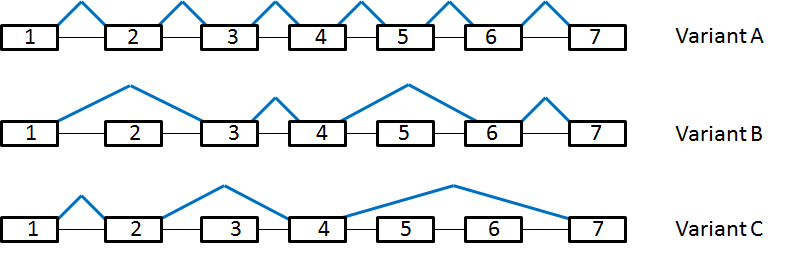
Three isoforms of a particular protein (variants A, B, and C) are expressed. In the following diagram, exons are indicating by boxes, introns by the black lines, and splice junctions by blue lines. Assume each exon is greater than 500 bp in length (figure not drawn to scale).
In the absence of available antibodies for Western blotting, how would one experimentally determine if variant C was expressed in HeLa cells?
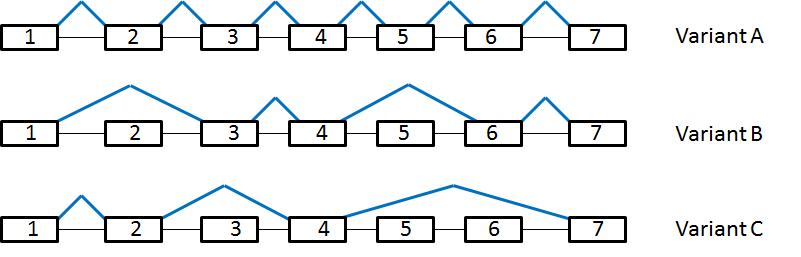
Three isoforms of a particular protein (variants A, B, and C) are expressed. In the following diagram, exons are indicating by boxes, introns by the black lines, and splice junctions by blue lines. Assume each exon is greater than 500 bp in length (figure not drawn to scale).
In the absence of available antibodies for Western blotting, how would one experimentally determine if variant C was expressed in HeLa cells?
Tap to reveal answer
Although each splice variant contains exons 4 and 7, PCR products between these exons in variants A and B would be too large to be detected using real time PCR; therefore, amplifying that region would conclusively identify the presence of variant C in HeLa cells. If variant C is not expressed in HeLa cells, one would expect a negative (or unamplified) result using real time PCR.
Variant A expression: 1, 2, 3, 4, 5, 6, 7
Variant B expression: 1, 3, 4, 6, 7
Variant C expression: 1, 2, 4, 7
By amplifying exons 5 and 6, and looking for a negative result, we can identify the presence of variant C.
Although each splice variant contains exons 4 and 7, PCR products between these exons in variants A and B would be too large to be detected using real time PCR; therefore, amplifying that region would conclusively identify the presence of variant C in HeLa cells. If variant C is not expressed in HeLa cells, one would expect a negative (or unamplified) result using real time PCR.
Variant A expression: 1, 2, 3, 4, 5, 6, 7
Variant B expression: 1, 3, 4, 6, 7
Variant C expression: 1, 2, 4, 7
By amplifying exons 5 and 6, and looking for a negative result, we can identify the presence of variant C.
← Didn't Know|Knew It →