
Energetics of Biological Reactions and ATP - MCAT Chemical and Physical Foundations of Biological Systems
Card 1 of 42
ATP stores energy through its ability to lose a phosphate group to form ADP in the following reaction

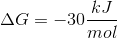
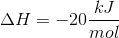
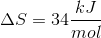
At body temperature, the thermodynamic values for ATP hydrolysis are as follow.
Glycolysis is an energy-liberating process (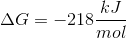 ,
, 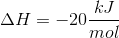 ) that is coupled with the conversion of two ADP molecules into two ATP molecules according to the following reaction.

Glycolysis results in which of the following?
ATP stores energy through its ability to lose a phosphate group to form ADP in the following reaction
At body temperature, the thermodynamic values for ATP hydrolysis are as follow.
Glycolysis is an energy-liberating process (
Glycolysis results in which of the following?
Tap to reveal answer
Since glycolysis is an exothermic reaction (ΔH is negative), enthalpy does not increase. As for entropy, the reaction begins with a large molecule and ends with smaller molecules, therefore entropy increases.
Since glycolysis is an exothermic reaction (ΔH is negative), enthalpy does not increase. As for entropy, the reaction begins with a large molecule and ends with smaller molecules, therefore entropy increases.
← Didn't Know|Knew It →

Which of the following is true, assuming the reaction goes to completion?
I. There is an increase in 
 , entropy
II. 
III. At equilibrium, 
IV. Oxygen is the reducing agent
Which of the following is true, assuming the reaction goes to completion?
I. There is an increase in
II.
III. At equilibrium,
IV. Oxygen is the reducing agent
Tap to reveal answer
This question ties together the reaction for oxidation of glucose with several thermodynamic principles.
The first option, stating that there is an increase of entropy, is true. When balanced, we see that there is an increase in total number of molecules when the reaction completes; thus, there will be an increase in entropy.
The second option states that enthalpy, or  , is less than than zero. This is also true, as it implies that this is an exothermic (or heat generating) reaction. The oxidation of glucose is how our bodies generate heat and keep homeostasis.
The third option, stating that Gibb's free energy is zero at equilibrium, is also true. Any equation will have at equilibrium.
The last option, stating that oxygen is the reducing agent, is false. Oxygen is actually the oxidizing agent and is itself reduced.
This question ties together the reaction for oxidation of glucose with several thermodynamic principles.
The first option, stating that there is an increase of entropy, is true. When balanced, we see that there is an increase in total number of molecules when the reaction completes; thus, there will be an increase in entropy.
The second option states that enthalpy, or
The third option, stating that Gibb's free energy is zero at equilibrium, is also true. Any equation will have
The last option, stating that oxygen is the reducing agent, is false. Oxygen is actually the oxidizing agent and is itself reduced.
← Didn't Know|Knew It →
Adenosine-triphosphate is formed by the following endothermic reaction.

If body temperature decreases, ADP production .
Adenosine-triphosphate is formed by the following endothermic reaction.
If body temperature decreases, ADP production .
Tap to reveal answer
Since heat can be considered a reactant (endothermic), if heat is decreased, ADP is increased according to Le Chatelier’s Principle. If a reactant is removed, the equilibrium will shift toward the reactants. In this reaction, ADP and heat are both reactants.
Since heat can be considered a reactant (endothermic), if heat is decreased, ADP is increased according to Le Chatelier’s Principle. If a reactant is removed, the equilibrium will shift toward the reactants. In this reaction, ADP and heat are both reactants.
← Didn't Know|Knew It →
ATP stores energy through its ability to lose a phosphate group to form ADP in the following reaction

At body temperature, the thermodynamic values for ATP hydrolysis are as follow.
ΔG = –30kJ/mol
ΔH = –20kJ/mol
ΔS = 34kJ/mol
Glycolysis is an energy-liberating process (ΔG = –218kJ/mol, ΔH = –20 kJ/mol) that is coupled with the conversion of two ADP molecules into two ATP molecules according to the following reaction.

Glycolysis is .
ATP stores energy through its ability to lose a phosphate group to form ADP in the following reaction
At body temperature, the thermodynamic values for ATP hydrolysis are as follow.
ΔG = –30kJ/mol
ΔH = –20kJ/mol
ΔS = 34kJ/mol
Glycolysis is an energy-liberating process (ΔG = –218kJ/mol, ΔH = –20 kJ/mol) that is coupled with the conversion of two ADP molecules into two ATP molecules according to the following reaction.
Glycolysis is .
Tap to reveal answer
ΔG and ΔH are both negative for glycolysis, meaning that the reaction is exergonic and exothermic.
ΔG and ΔH are both negative for glycolysis, meaning that the reaction is exergonic and exothermic.
← Didn't Know|Knew It →
ATP stores energy through its ability to lose a phosphate group to form ADP in the following reaction

At body temperature, the thermodynamic values for ATP hydrolysis are as follow.
ΔG = –30kJ/mol
ΔH = –20kJ/mol
ΔS = 34kJ/mol
Glycolysis is an energy-liberating process (ΔG = –218kJ/mol, ΔH = –20 kJ/mol) that is coupled with the conversion of two ADP molecules into two ATP molecules according to the following reaction.

How much heat, in joules, is released when 4 * 1019 molecules of ATP are converted to ADP via ATP hydrolysis?
ATP stores energy through its ability to lose a phosphate group to form ADP in the following reaction
At body temperature, the thermodynamic values for ATP hydrolysis are as follow.
ΔG = –30kJ/mol
ΔH = –20kJ/mol
ΔS = 34kJ/mol
Glycolysis is an energy-liberating process (ΔG = –218kJ/mol, ΔH = –20 kJ/mol) that is coupled with the conversion of two ADP molecules into two ATP molecules according to the following reaction.
How much heat, in joules, is released when 4 * 1019 molecules of ATP are converted to ADP via ATP hydrolysis?
Tap to reveal answer
To solve this problem, first convert molecules to moles with Avogadro’s number, then convert moles to kJ using the ΔH of ATP hydrolysis. Lastly convert kJ to J.



To solve this problem, first convert molecules to moles with Avogadro’s number, then convert moles to kJ using the ΔH of ATP hydrolysis. Lastly convert kJ to J.
← Didn't Know|Knew It →
ATP stores energy through its ability to lose a phosphate group to form ADP in the following reaction

At body temperature, the thermodynamic values for ATP hydrolysis are as follow.
ΔG = –30kJ/mol
ΔH = –20kJ/mol
ΔS = 34kJ/mol
Glycolysis is an energy-liberating process (ΔG = –218kJ/mol, ΔH = –20 kJ/mol) that is coupled with the conversion of two ADP molecules into two ATP molecules according to the following reaction.

The formation of peptide bonds requires 17kJ/mol of energy. It also requires the energy of three ATP molecules. How many ATP molecules are required to synthesize a protein containing 550 peptide bonds?
ATP stores energy through its ability to lose a phosphate group to form ADP in the following reaction
At body temperature, the thermodynamic values for ATP hydrolysis are as follow.
ΔG = –30kJ/mol
ΔH = –20kJ/mol
ΔS = 34kJ/mol
Glycolysis is an energy-liberating process (ΔG = –218kJ/mol, ΔH = –20 kJ/mol) that is coupled with the conversion of two ADP molecules into two ATP molecules according to the following reaction.
The formation of peptide bonds requires 17kJ/mol of energy. It also requires the energy of three ATP molecules. How many ATP molecules are required to synthesize a protein containing 550 peptide bonds?
Tap to reveal answer
Since we know that three ATP molecules per bond are required, 1,650 ATP molecules are needed. However, we also know that 17kJ/mol of additional energy is required for each bond. This energy must come from ATP molecules. The only choice that is greater than 1,650 is 1,962.
Since we know that three ATP molecules per bond are required, 1,650 ATP molecules are needed. However, we also know that 17kJ/mol of additional energy is required for each bond. This energy must come from ATP molecules. The only choice that is greater than 1,650 is 1,962.
← Didn't Know|Knew It →
Which of the following is true, assuming the reaction goes to completion?
I. There is an increase in , entropy
II.
III. At equilibrium,
IV. Oxygen is the reducing agent
Which of the following is true, assuming the reaction goes to completion?
I. There is an increase in
II.
III. At equilibrium,
IV. Oxygen is the reducing agent
Tap to reveal answer
This question ties together the reaction for oxidation of glucose with several thermodynamic principles.
The first option, stating that there is an increase of entropy, is true. When balanced, we see that there is an increase in total number of molecules when the reaction completes; thus, there will be an increase in entropy.
The second option states that enthalpy, or , is less than than zero. This is also true, as it implies that this is an exothermic (or heat generating) reaction. The oxidation of glucose is how our bodies generate heat and keep homeostasis.
The third option, stating that Gibb's free energy is zero at equilibrium, is also true. Any equation will have at equilibrium.
The last option, stating that oxygen is the reducing agent, is false. Oxygen is actually the oxidizing agent and is itself reduced.
This question ties together the reaction for oxidation of glucose with several thermodynamic principles.
The first option, stating that there is an increase of entropy, is true. When balanced, we see that there is an increase in total number of molecules when the reaction completes; thus, there will be an increase in entropy.
The second option states that enthalpy, or
The third option, stating that Gibb's free energy is zero at equilibrium, is also true. Any equation will have
The last option, stating that oxygen is the reducing agent, is false. Oxygen is actually the oxidizing agent and is itself reduced.
← Didn't Know|Knew It →
Adenosine-triphosphate is formed by the following endothermic reaction.
If body temperature decreases, ADP production .
Adenosine-triphosphate is formed by the following endothermic reaction.
If body temperature decreases, ADP production .
Tap to reveal answer
Since heat can be considered a reactant (endothermic), if heat is decreased, ADP is increased according to Le Chatelier’s Principle. If a reactant is removed, the equilibrium will shift toward the reactants. In this reaction, ADP and heat are both reactants.
Since heat can be considered a reactant (endothermic), if heat is decreased, ADP is increased according to Le Chatelier’s Principle. If a reactant is removed, the equilibrium will shift toward the reactants. In this reaction, ADP and heat are both reactants.
← Didn't Know|Knew It →
ATP stores energy through its ability to lose a phosphate group to form ADP in the following reaction
At body temperature, the thermodynamic values for ATP hydrolysis are as follow.
ΔG = –30kJ/mol
ΔH = –20kJ/mol
ΔS = 34kJ/mol
Glycolysis is an energy-liberating process (ΔG = –218kJ/mol, ΔH = –20 kJ/mol) that is coupled with the conversion of two ADP molecules into two ATP molecules according to the following reaction.
Glycolysis is .
ATP stores energy through its ability to lose a phosphate group to form ADP in the following reaction
At body temperature, the thermodynamic values for ATP hydrolysis are as follow.
ΔG = –30kJ/mol
ΔH = –20kJ/mol
ΔS = 34kJ/mol
Glycolysis is an energy-liberating process (ΔG = –218kJ/mol, ΔH = –20 kJ/mol) that is coupled with the conversion of two ADP molecules into two ATP molecules according to the following reaction.
Glycolysis is .
Tap to reveal answer
ΔG and ΔH are both negative for glycolysis, meaning that the reaction is exergonic and exothermic.
ΔG and ΔH are both negative for glycolysis, meaning that the reaction is exergonic and exothermic.
← Didn't Know|Knew It →
ATP stores energy through its ability to lose a phosphate group to form ADP in the following reaction
At body temperature, the thermodynamic values for ATP hydrolysis are as follow.
ΔG = –30kJ/mol
ΔH = –20kJ/mol
ΔS = 34kJ/mol
Glycolysis is an energy-liberating process (ΔG = –218kJ/mol, ΔH = –20 kJ/mol) that is coupled with the conversion of two ADP molecules into two ATP molecules according to the following reaction.
How much heat, in joules, is released when 4 * 1019 molecules of ATP are converted to ADP via ATP hydrolysis?
ATP stores energy through its ability to lose a phosphate group to form ADP in the following reaction
At body temperature, the thermodynamic values for ATP hydrolysis are as follow.
ΔG = –30kJ/mol
ΔH = –20kJ/mol
ΔS = 34kJ/mol
Glycolysis is an energy-liberating process (ΔG = –218kJ/mol, ΔH = –20 kJ/mol) that is coupled with the conversion of two ADP molecules into two ATP molecules according to the following reaction.
How much heat, in joules, is released when 4 * 1019 molecules of ATP are converted to ADP via ATP hydrolysis?
Tap to reveal answer
To solve this problem, first convert molecules to moles with Avogadro’s number, then convert moles to kJ using the ΔH of ATP hydrolysis. Lastly convert kJ to J.
To solve this problem, first convert molecules to moles with Avogadro’s number, then convert moles to kJ using the ΔH of ATP hydrolysis. Lastly convert kJ to J.
← Didn't Know|Knew It →
ATP stores energy through its ability to lose a phosphate group to form ADP in the following reaction
At body temperature, the thermodynamic values for ATP hydrolysis are as follow.
Glycolysis is an energy-liberating process (, ) that is coupled with the conversion of two ADP molecules into two ATP molecules according to the following reaction.
Glycolysis results in which of the following?
ATP stores energy through its ability to lose a phosphate group to form ADP in the following reaction
At body temperature, the thermodynamic values for ATP hydrolysis are as follow.
Glycolysis is an energy-liberating process (
Glycolysis results in which of the following?
Tap to reveal answer
Since glycolysis is an exothermic reaction (ΔH is negative), enthalpy does not increase. As for entropy, the reaction begins with a large molecule and ends with smaller molecules, therefore entropy increases.
Since glycolysis is an exothermic reaction (ΔH is negative), enthalpy does not increase. As for entropy, the reaction begins with a large molecule and ends with smaller molecules, therefore entropy increases.
← Didn't Know|Knew It →
ATP stores energy through its ability to lose a phosphate group to form ADP in the following reaction
At body temperature, the thermodynamic values for ATP hydrolysis are as follow.
ΔG = –30kJ/mol
ΔH = –20kJ/mol
ΔS = 34kJ/mol
Glycolysis is an energy-liberating process (ΔG = –218kJ/mol, ΔH = –20 kJ/mol) that is coupled with the conversion of two ADP molecules into two ATP molecules according to the following reaction.
The formation of peptide bonds requires 17kJ/mol of energy. It also requires the energy of three ATP molecules. How many ATP molecules are required to synthesize a protein containing 550 peptide bonds?
ATP stores energy through its ability to lose a phosphate group to form ADP in the following reaction
At body temperature, the thermodynamic values for ATP hydrolysis are as follow.
ΔG = –30kJ/mol
ΔH = –20kJ/mol
ΔS = 34kJ/mol
Glycolysis is an energy-liberating process (ΔG = –218kJ/mol, ΔH = –20 kJ/mol) that is coupled with the conversion of two ADP molecules into two ATP molecules according to the following reaction.
The formation of peptide bonds requires 17kJ/mol of energy. It also requires the energy of three ATP molecules. How many ATP molecules are required to synthesize a protein containing 550 peptide bonds?
Tap to reveal answer
Since we know that three ATP molecules per bond are required, 1,650 ATP molecules are needed. However, we also know that 17kJ/mol of additional energy is required for each bond. This energy must come from ATP molecules. The only choice that is greater than 1,650 is 1,962.
Since we know that three ATP molecules per bond are required, 1,650 ATP molecules are needed. However, we also know that 17kJ/mol of additional energy is required for each bond. This energy must come from ATP molecules. The only choice that is greater than 1,650 is 1,962.
← Didn't Know|Knew It →
Which of the following is true, assuming the reaction goes to completion?
I. There is an increase in , entropy
II.
III. At equilibrium,
IV. Oxygen is the reducing agent
Which of the following is true, assuming the reaction goes to completion?
I. There is an increase in
II.
III. At equilibrium,
IV. Oxygen is the reducing agent
Tap to reveal answer
This question ties together the reaction for oxidation of glucose with several thermodynamic principles.
The first option, stating that there is an increase of entropy, is true. When balanced, we see that there is an increase in total number of molecules when the reaction completes; thus, there will be an increase in entropy.
The second option states that enthalpy, or , is less than than zero. This is also true, as it implies that this is an exothermic (or heat generating) reaction. The oxidation of glucose is how our bodies generate heat and keep homeostasis.
The third option, stating that Gibb's free energy is zero at equilibrium, is also true. Any equation will have at equilibrium.
The last option, stating that oxygen is the reducing agent, is false. Oxygen is actually the oxidizing agent and is itself reduced.
This question ties together the reaction for oxidation of glucose with several thermodynamic principles.
The first option, stating that there is an increase of entropy, is true. When balanced, we see that there is an increase in total number of molecules when the reaction completes; thus, there will be an increase in entropy.
The second option states that enthalpy, or
The third option, stating that Gibb's free energy is zero at equilibrium, is also true. Any equation will have
The last option, stating that oxygen is the reducing agent, is false. Oxygen is actually the oxidizing agent and is itself reduced.
← Didn't Know|Knew It →
Adenosine-triphosphate is formed by the following endothermic reaction.
If body temperature decreases, ADP production .
Adenosine-triphosphate is formed by the following endothermic reaction.
If body temperature decreases, ADP production .
Tap to reveal answer
Since heat can be considered a reactant (endothermic), if heat is decreased, ADP is increased according to Le Chatelier’s Principle. If a reactant is removed, the equilibrium will shift toward the reactants. In this reaction, ADP and heat are both reactants.
Since heat can be considered a reactant (endothermic), if heat is decreased, ADP is increased according to Le Chatelier’s Principle. If a reactant is removed, the equilibrium will shift toward the reactants. In this reaction, ADP and heat are both reactants.
← Didn't Know|Knew It →
ATP stores energy through its ability to lose a phosphate group to form ADP in the following reaction
At body temperature, the thermodynamic values for ATP hydrolysis are as follow.
ΔG = –30kJ/mol
ΔH = –20kJ/mol
ΔS = 34kJ/mol
Glycolysis is an energy-liberating process (ΔG = –218kJ/mol, ΔH = –20 kJ/mol) that is coupled with the conversion of two ADP molecules into two ATP molecules according to the following reaction.
Glycolysis is .
ATP stores energy through its ability to lose a phosphate group to form ADP in the following reaction
At body temperature, the thermodynamic values for ATP hydrolysis are as follow.
ΔG = –30kJ/mol
ΔH = –20kJ/mol
ΔS = 34kJ/mol
Glycolysis is an energy-liberating process (ΔG = –218kJ/mol, ΔH = –20 kJ/mol) that is coupled with the conversion of two ADP molecules into two ATP molecules according to the following reaction.
Glycolysis is .
Tap to reveal answer
ΔG and ΔH are both negative for glycolysis, meaning that the reaction is exergonic and exothermic.
ΔG and ΔH are both negative for glycolysis, meaning that the reaction is exergonic and exothermic.
← Didn't Know|Knew It →
ATP stores energy through its ability to lose a phosphate group to form ADP in the following reaction
At body temperature, the thermodynamic values for ATP hydrolysis are as follow.
ΔG = –30kJ/mol
ΔH = –20kJ/mol
ΔS = 34kJ/mol
Glycolysis is an energy-liberating process (ΔG = –218kJ/mol, ΔH = –20 kJ/mol) that is coupled with the conversion of two ADP molecules into two ATP molecules according to the following reaction.
How much heat, in joules, is released when 4 * 1019 molecules of ATP are converted to ADP via ATP hydrolysis?
ATP stores energy through its ability to lose a phosphate group to form ADP in the following reaction
At body temperature, the thermodynamic values for ATP hydrolysis are as follow.
ΔG = –30kJ/mol
ΔH = –20kJ/mol
ΔS = 34kJ/mol
Glycolysis is an energy-liberating process (ΔG = –218kJ/mol, ΔH = –20 kJ/mol) that is coupled with the conversion of two ADP molecules into two ATP molecules according to the following reaction.
How much heat, in joules, is released when 4 * 1019 molecules of ATP are converted to ADP via ATP hydrolysis?
Tap to reveal answer
To solve this problem, first convert molecules to moles with Avogadro’s number, then convert moles to kJ using the ΔH of ATP hydrolysis. Lastly convert kJ to J.
To solve this problem, first convert molecules to moles with Avogadro’s number, then convert moles to kJ using the ΔH of ATP hydrolysis. Lastly convert kJ to J.
← Didn't Know|Knew It →
ATP stores energy through its ability to lose a phosphate group to form ADP in the following reaction
At body temperature, the thermodynamic values for ATP hydrolysis are as follow.
Glycolysis is an energy-liberating process (, ) that is coupled with the conversion of two ADP molecules into two ATP molecules according to the following reaction.
Glycolysis results in which of the following?
ATP stores energy through its ability to lose a phosphate group to form ADP in the following reaction
At body temperature, the thermodynamic values for ATP hydrolysis are as follow.
Glycolysis is an energy-liberating process (
Glycolysis results in which of the following?
Tap to reveal answer
Since glycolysis is an exothermic reaction (ΔH is negative), enthalpy does not increase. As for entropy, the reaction begins with a large molecule and ends with smaller molecules, therefore entropy increases.
Since glycolysis is an exothermic reaction (ΔH is negative), enthalpy does not increase. As for entropy, the reaction begins with a large molecule and ends with smaller molecules, therefore entropy increases.
← Didn't Know|Knew It →
ATP stores energy through its ability to lose a phosphate group to form ADP in the following reaction
At body temperature, the thermodynamic values for ATP hydrolysis are as follow.
ΔG = –30kJ/mol
ΔH = –20kJ/mol
ΔS = 34kJ/mol
Glycolysis is an energy-liberating process (ΔG = –218kJ/mol, ΔH = –20 kJ/mol) that is coupled with the conversion of two ADP molecules into two ATP molecules according to the following reaction.
The formation of peptide bonds requires 17kJ/mol of energy. It also requires the energy of three ATP molecules. How many ATP molecules are required to synthesize a protein containing 550 peptide bonds?
ATP stores energy through its ability to lose a phosphate group to form ADP in the following reaction
At body temperature, the thermodynamic values for ATP hydrolysis are as follow.
ΔG = –30kJ/mol
ΔH = –20kJ/mol
ΔS = 34kJ/mol
Glycolysis is an energy-liberating process (ΔG = –218kJ/mol, ΔH = –20 kJ/mol) that is coupled with the conversion of two ADP molecules into two ATP molecules according to the following reaction.
The formation of peptide bonds requires 17kJ/mol of energy. It also requires the energy of three ATP molecules. How many ATP molecules are required to synthesize a protein containing 550 peptide bonds?
Tap to reveal answer
Since we know that three ATP molecules per bond are required, 1,650 ATP molecules are needed. However, we also know that 17kJ/mol of additional energy is required for each bond. This energy must come from ATP molecules. The only choice that is greater than 1,650 is 1,962.
Since we know that three ATP molecules per bond are required, 1,650 ATP molecules are needed. However, we also know that 17kJ/mol of additional energy is required for each bond. This energy must come from ATP molecules. The only choice that is greater than 1,650 is 1,962.
← Didn't Know|Knew It →
ATP stores energy through its ability to lose a phosphate group to form ADP in the following reaction
At body temperature, the thermodynamic values for ATP hydrolysis are as follow.
Glycolysis is an energy-liberating process (, ) that is coupled with the conversion of two ADP molecules into two ATP molecules according to the following reaction.
Glycolysis results in which of the following?
ATP stores energy through its ability to lose a phosphate group to form ADP in the following reaction
At body temperature, the thermodynamic values for ATP hydrolysis are as follow.
Glycolysis is an energy-liberating process (
Glycolysis results in which of the following?
Tap to reveal answer
Since glycolysis is an exothermic reaction (ΔH is negative), enthalpy does not increase. As for entropy, the reaction begins with a large molecule and ends with smaller molecules, therefore entropy increases.
Since glycolysis is an exothermic reaction (ΔH is negative), enthalpy does not increase. As for entropy, the reaction begins with a large molecule and ends with smaller molecules, therefore entropy increases.
← Didn't Know|Knew It →
Which of the following is true, assuming the reaction goes to completion?
I. There is an increase in , entropy
II.
III. At equilibrium,
IV. Oxygen is the reducing agent
Which of the following is true, assuming the reaction goes to completion?
I. There is an increase in
II.
III. At equilibrium,
IV. Oxygen is the reducing agent
Tap to reveal answer
This question ties together the reaction for oxidation of glucose with several thermodynamic principles.
The first option, stating that there is an increase of entropy, is true. When balanced, we see that there is an increase in total number of molecules when the reaction completes; thus, there will be an increase in entropy.
The second option states that enthalpy, or , is less than than zero. This is also true, as it implies that this is an exothermic (or heat generating) reaction. The oxidation of glucose is how our bodies generate heat and keep homeostasis.
The third option, stating that Gibb's free energy is zero at equilibrium, is also true. Any equation will have at equilibrium.
The last option, stating that oxygen is the reducing agent, is false. Oxygen is actually the oxidizing agent and is itself reduced.
This question ties together the reaction for oxidation of glucose with several thermodynamic principles.
The first option, stating that there is an increase of entropy, is true. When balanced, we see that there is an increase in total number of molecules when the reaction completes; thus, there will be an increase in entropy.
The second option states that enthalpy, or
The third option, stating that Gibb's free energy is zero at equilibrium, is also true. Any equation will have
The last option, stating that oxygen is the reducing agent, is false. Oxygen is actually the oxidizing agent and is itself reduced.
← Didn't Know|Knew It →