
Reaction Kinetics - MCAT Chemical and Physical Foundations of Biological Systems
Card 1 of 315
The rate for a reaction is given by the equation  . What is the overall order of the reaction?
The rate for a reaction is given by the equation
Tap to reveal answer
To find the overall order of a reaction, look at the exponents for the reaction rate law. Since A has an exponent of two and B has an exponent of one, the overall reaction has an order of three.
To find the overall order of a reaction, look at the exponents for the reaction rate law. Since A has an exponent of two and B has an exponent of one, the overall reaction has an order of three.
← Didn't Know|Knew It →
A kinetics experiment is constructed, and the following rates of product formation are observed after adding various substrates. The results are recorded below. What is the equation for the rate law?
A B C Initial Rate (M/s) 0.1M 0.2M 0.2M 1.5 0.2M 0.2M 0.2M 3 0.2M 0.2M 0.4M 3 0.2M 0.4M 0.2M 12
A kinetics experiment is constructed, and the following rates of product formation are observed after adding various substrates. The results are recorded below. What is the equation for the rate law?
| A | B | C | Initial Rate (M/s) |
|---|---|---|---|
| 0.1M | 0.2M | 0.2M | 1.5 |
| 0.2M | 0.2M | 0.2M | 3 |
| 0.2M | 0.2M | 0.4M | 3 |
| 0.2M | 0.4M | 0.2M | 12 |
Tap to reveal answer
We can look at the differences between trial 1 and trial 2 to see that the reaction is first order with respect to \[A\], since the rate doubles when the reactant concentration doubles. Reactants are considered first order when this 1:1 relationship between concentration and rate is observed.
We can look at trials 2 and 3 to see that \[C\] has no effect on the reaction, making it a zeroth order reactant and simply equal to 1 in the rate law.
Trials 3 and 4 show that when \[B\] doubles, the rate quadruples. This means it is second order with respect to \[B\], increasing the rate by the square of the increase in concentration. Since we already know that reactant C does not affect the rate, it is irrelevant that its concentration is halved.
This gives us Rate = k\[A\]\[B\]2.
We can look at the differences between trial 1 and trial 2 to see that the reaction is first order with respect to \[A\], since the rate doubles when the reactant concentration doubles. Reactants are considered first order when this 1:1 relationship between concentration and rate is observed.
We can look at trials 2 and 3 to see that \[C\] has no effect on the reaction, making it a zeroth order reactant and simply equal to 1 in the rate law.
Trials 3 and 4 show that when \[B\] doubles, the rate quadruples. This means it is second order with respect to \[B\], increasing the rate by the square of the increase in concentration. Since we already know that reactant C does not affect the rate, it is irrelevant that its concentration is halved.
This gives us Rate = k\[A\]\[B\]2.
← Didn't Know|Knew It →
Which of the following is a second-order rate law?
Which of the following is a second-order rate law?
Tap to reveal answer
The order of a reaction or rate law is given by the sum of the exponents in the rate expression. Rate = k\[A\]1\[B\]1 is the only second-order rate law. This is the case since the reaction order is determined by the number of reactants involved. Rate = k\[A\]1\[B\]2 is not second-order; since it has one A reactant and two B reactants, this is a third-order reaction.
The order of a reaction or rate law is given by the sum of the exponents in the rate expression. Rate = k\[A\]1\[B\]1 is the only second-order rate law. This is the case since the reaction order is determined by the number of reactants involved. Rate = k\[A\]1\[B\]2 is not second-order; since it has one A reactant and two B reactants, this is a third-order reaction.
← Didn't Know|Knew It →
If the reactants and/or products in a chemical reaction are gases, the reaction rate can be determined by measuring the change of pressure as the reaction proceeds. Consider the following reaction and pressure vs. reaction rate data below.

Trial PXY(torr) PZ(torr) Rate (torr/s) 1 100 200 0.16 2 200 200 0.32 3 200 100 0.04 4 200 150 0.14
What is the rate law for this reaction?
If the reactants and/or products in a chemical reaction are gases, the reaction rate can be determined by measuring the change of pressure as the reaction proceeds. Consider the following reaction and pressure vs. reaction rate data below.
| Trial | PXY(torr) | PZ(torr) | Rate (torr/s) |
|---|---|---|---|
| 1 | 100 | 200 | 0.16 |
| 2 | 200 | 200 | 0.32 |
| 3 | 200 | 100 | 0.04 |
| 4 | 200 | 150 | 0.14 |
What is the rate law for this reaction?
Tap to reveal answer
Comparing trials 2 and 3, we see that when PXY is constant and PZ doubles, the rate increases by a factor of 8, or 23. Rate is therefore proportional to \[Z\]3.
Comparing trials 1 and 2, we see that when PZ is held constant and PXY doubles, the rate doubles. Rate is therefore proportional to \[XY\].
Remember that in these problems, you are looking for the value of n in the function  . When doubling the concentration does not affect the reaction rate, n = 0. When doubling the concentration doubles the reaction rate, n = 1. When doubling the concentration quadruples the reaction rate, n = 2.
Comparing trials 2 and 3, we see that when PXY is constant and PZ doubles, the rate increases by a factor of 8, or 23. Rate is therefore proportional to \[Z\]3.
Comparing trials 1 and 2, we see that when PZ is held constant and PXY doubles, the rate doubles. Rate is therefore proportional to \[XY\].
Remember that in these problems, you are looking for the value of n in the function
← Didn't Know|Knew It →
If the reactants and/or products in a chemical reaction are gases, the reaction rate can be determined by measuring the change of pressure as the reaction proceeds. Consider the following reaction and pressure vs. reaction rate data below.

Trial PXY(torr) PZ(torr) Rate (torr/s) 1 100 200 0.16 2 200 200 0.32 3 200 100 0.04 4 200 150 0.14
What is the value of the rate constant, k, for this reaction?
If the reactants and/or products in a chemical reaction are gases, the reaction rate can be determined by measuring the change of pressure as the reaction proceeds. Consider the following reaction and pressure vs. reaction rate data below.
| Trial | PXY(torr) | PZ(torr) | Rate (torr/s) |
|---|---|---|---|
| 1 | 100 | 200 | 0.16 |
| 2 | 200 | 200 | 0.32 |
| 3 | 200 | 100 | 0.04 |
| 4 | 200 | 150 | 0.14 |
What is the value of the rate constant, k, for this reaction?
Tap to reveal answer
The rate law can be determined by comparing changes in reactant concentration to changes in rate. In this reaction, doubling XY doubles the reaction rate; the reaction is first-order for XY. Doubling Z increases the rate by a factor of eight, so the reaction is third-order for Z (23 = 8).
Knowing that Rate = k\[XY\] \[Z\]3, we can solve for k by using data from one of the trials. Plugging in data from trial 1, we can calculate the value of k.
0.16 = k\[100\]\[200\]3
k = 2 * 10-10
The rate law can be determined by comparing changes in reactant concentration to changes in rate. In this reaction, doubling XY doubles the reaction rate; the reaction is first-order for XY. Doubling Z increases the rate by a factor of eight, so the reaction is third-order for Z (23 = 8).
Knowing that Rate = k\[XY\] \[Z\]3, we can solve for k by using data from one of the trials. Plugging in data from trial 1, we can calculate the value of k.
0.16 = k\[100\]\[200\]3
k = 2 * 10-10
← Didn't Know|Knew It →
A scientist is studying a reaction, and places the reactants in a beaker at room temperature. The reaction progresses, and she analyzes the products via NMR. Based on the NMR readout, she determines the reaction proceeds as follows:

In an attempt to better understand the reaction process, she varies the concentrations of the reactants and studies how the rate of the reaction changes. The table below shows the reaction concentrations as she makes modifications in three experimental trials.
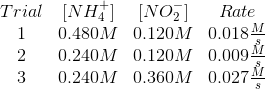
Which of the following most closely approximates the rate law for this reaction?
A scientist is studying a reaction, and places the reactants in a beaker at room temperature. The reaction progresses, and she analyzes the products via NMR. Based on the NMR readout, she determines the reaction proceeds as follows:
In an attempt to better understand the reaction process, she varies the concentrations of the reactants and studies how the rate of the reaction changes. The table below shows the reaction concentrations as she makes modifications in three experimental trials.
Which of the following most closely approximates the rate law for this reaction?
Tap to reveal answer
The reaction table in the passage indicates that the reaction rate varies in a 1-to-1 fashion as you vary the each reactant, while holding the other constant.
The rate law is written as  .
.
Compare trials 1 and 2 to see that doubling the ammonium concentration doubles the rate. The reaction is first order for ammonium:  .
.
Compare trials 2 and 3 to see that tripling nitrate concentration triples the rate. The reaction is first order for nitrate:  .
.
The final rate law is  .
.
The reaction table in the passage indicates that the reaction rate varies in a 1-to-1 fashion as you vary the each reactant, while holding the other constant.
The rate law is written as
Compare trials 1 and 2 to see that doubling the ammonium concentration doubles the rate. The reaction is first order for ammonium:
Compare trials 2 and 3 to see that tripling nitrate concentration triples the rate. The reaction is first order for nitrate:
The final rate law is
← Didn't Know|Knew It →
Consider the reaction  .
.
A set of trials is set up in order to see how manipulating the starting concentrations of reactants can affect the initial rate of the reaction. The experiments are outlined in the table below.
Trial Initial \[A\] Initial \[B\] Initial \[C\] Initial reaction rate (M/s) 1 0.3 0.4 0.2 0.04 2 0.3 0.4 0.6 0.12 3 0.3 0.8 0.6 0.48 4 0.6 0.4 0.2 0.04
Based on the above information, determine the rate law for the reaction.
Consider the reaction
A set of trials is set up in order to see how manipulating the starting concentrations of reactants can affect the initial rate of the reaction. The experiments are outlined in the table below.
| Trial | Initial \[A\] | Initial \[B\] | Initial \[C\] | Initial reaction rate (M/s) |
|---|---|---|---|---|
| 1 | 0.3 | 0.4 | 0.2 | 0.04 |
| 2 | 0.3 | 0.4 | 0.6 | 0.12 |
| 3 | 0.3 | 0.8 | 0.6 | 0.48 |
| 4 | 0.6 | 0.4 | 0.2 | 0.04 |
Based on the above information, determine the rate law for the reaction.
Tap to reveal answer
The coefficients in front of the reactants simply show the balanced equation, and do NOT give any information on the order of the reactants. The order of the reactants must be determined experimentally by comparing how reaction rates change when the reactant's concentration is altered.
Only the reactant in question must have an altered concentration between two trials; all others must be kept constant. When a reaction rate is doubled and the initial reaction rate is quadrupled, we determine that the reaction is second order with respect to the reactant. If the concentration of a reactant is altered but the reaction rate is unaffected, the order of the reactant is zero. Finally, if the reaction rate and reactant are multiplied by the same factor between two trials, the reactant is first order.
In the table, we can compare trial 1 and 4 to see the effect of doubling A, with constant B and C. This does not affect the rate, to A must be zeroth order. Comparing trials 2 and 3 shows that doubling B, with A and C held constant, will quadruple the rate. The reaction must be second order for B. Finally, comparing trials 1 and 2 shows us that tripling C, with A and B held constant, will triple the reaction rate. The reaction must be first order for C. This yields the rate law  .
.
If the concentration of a reactant is doubled,  . The relationship between this change and the change in rate is, therefore,
  , where n is the order of the reaction with respect to X. This can be reduced to
  , allowing us to find the reaction order from the experimental rate.


The coefficients in front of the reactants simply show the balanced equation, and do NOT give any information on the order of the reactants. The order of the reactants must be determined experimentally by comparing how reaction rates change when the reactant's concentration is altered.
Only the reactant in question must have an altered concentration between two trials; all others must be kept constant. When a reaction rate is doubled and the initial reaction rate is quadrupled, we determine that the reaction is second order with respect to the reactant. If the concentration of a reactant is altered but the reaction rate is unaffected, the order of the reactant is zero. Finally, if the reaction rate and reactant are multiplied by the same factor between two trials, the reactant is first order.
In the table, we can compare trial 1 and 4 to see the effect of doubling A, with constant B and C. This does not affect the rate, to A must be zeroth order. Comparing trials 2 and 3 shows that doubling B, with A and C held constant, will quadruple the rate. The reaction must be second order for B. Finally, comparing trials 1 and 2 shows us that tripling C, with A and B held constant, will triple the reaction rate. The reaction must be first order for C. This yields the rate law
If the concentration of a reactant is doubled,
← Didn't Know|Knew It →
What is the order for a reaction with the rate law given below?

What is the order for a reaction with the rate law given below?
Tap to reveal answer

The reaction order is equal to the sum of the exponents of the concentration variables in the rate law.
Because reactant B has an exponent of two and reactant C has an exponent of one, the total sum is three, and the reaction is therefore third order.
The reaction order is equal to the sum of the exponents of the concentration variables in the rate law.
Because reactant B has an exponent of two and reactant C has an exponent of one, the total sum is three, and the reaction is therefore third order.
← Didn't Know|Knew It →
A student is studying the kinetics of the following reaction.

In trying to determine the rate law, he collects the following set of data.

Based on these data, what is the rate law for this reaction?
A student is studying the kinetics of the following reaction.
In trying to determine the rate law, he collects the following set of data.
Based on these data, what is the rate law for this reaction?
Tap to reveal answer
The rate law will have the general formula  . The exponents,
  and
and  , DO NOT necessarily correlate with the reaction stoichiometry. They must be determined from the experimental data.
To determine  , compare trials 1 and 3, where
  is held constant.

Since  is constant and
  is the same for both experiments, by plugging in the values for rate and
  for trials 1 and 3, we get this equation.
 .
.
This reduces to  , which means
  .
.
To find  , compare trials 1 and 2, where
  is held constant. Following the same type of calculation as shown above would give
  .
.


The rate law is  .
.
The rate law will have the general formula
To determine
Since
This reduces to
To find
The rate law is
← Didn't Know|Knew It →
A student is studying the kinetics of the following reaction.

In trying to determine the rate law, he collects the following set of data.
What is the value of  if the rate law is
  ?
?
A student is studying the kinetics of the following reaction.
In trying to determine the rate law, he collects the following set of data.
What is the value of
Tap to reveal answer
To determine  , the data from any of the three trials could be used. Using trial 1 and the rate law, we can solve for
  .
.


Note that the units have to be adjusted, based on the order of  and
and  .
.


To determine
Note that the units have to be adjusted, based on the order of
← Didn't Know|Knew It →
Initial Reaction Rate 
** **M
**M ** M
M **** **M
**M 2000 1.0 1.0 1.0 2000 1.0 1.0 2.0 4000 2.0 1.0 1.0 16000 2.0 2.0 1.0
Using data in the table above to determine the rate law for the reaction.
| Initial Reaction Rate | ****M | ** M | ******M |
|---|---|---|---|
| 2000 | 1.0 | 1.0 | 1.0 |
| 2000 | 1.0 | 1.0 | 2.0 |
| 4000 | 2.0 | 1.0 | 1.0 |
| 16000 | 2.0 | 2.0 | 1.0 |
Using data in the table above to determine the rate law for the reaction.
Tap to reveal answer
Let's look at each of the three reactants individually.
Compare trials 1 and 3. Doubling  without changing the other reactants doubles the rate from
  to
to  ; therefore
  has a superscript of 1.
Compare trials 3 and 4. Doubling  without changing the other reactants results in a rate that is four times faster, increasing from
  to
to  . The rate increases with the square of concentration of
  ,
, 
Compare trials 1 and 2. Doubling  without changing the other reactants has no effect on the rate, which remains at
  , so
, so  is not part of the final rate equation.
The final rate law will be  .
.
Let's look at each of the three reactants individually.
Compare trials 1 and 3. Doubling
Compare trials 3 and 4. Doubling
Compare trials 1 and 2. Doubling
The final rate law will be
← Didn't Know|Knew It →
A scientist is studying a reaction, and places the reactants in a beaker at room temperature. The reaction progresses, and she analyzes the products via NMR. Based on the NMR readout, she determines the reaction proceeds as follows:

In an attempt to better understand the reaction process, she varies the concentrations of the reactants and studies how the rate of the reaction changes. The table below shows the reaction concentrations as she makes modifications in three experimental trials.

What is the overall order for this reaction as written?
A scientist is studying a reaction, and places the reactants in a beaker at room temperature. The reaction progresses, and she analyzes the products via NMR. Based on the NMR readout, she determines the reaction proceeds as follows:
In an attempt to better understand the reaction process, she varies the concentrations of the reactants and studies how the rate of the reaction changes. The table below shows the reaction concentrations as she makes modifications in three experimental trials.
What is the overall order for this reaction as written?
Tap to reveal answer
The rate law is written as  .
.
Compare trials 1 and 2 to see that doubling the ammonium concentration doubles the rate. The reaction is first order for ammonium:  .
.
Compare tirals 2 and 3 to see that tripling nitrate concentration triples the rate. The reaction is first order for nitrate:  .
.
The final rate law is  .
.
The sum of the orders for each reactant gives you the overall order of the reaction. In this case, the reaction is first order with regard to each reactant, and is thus second order overall.
The rate law is written as
Compare trials 1 and 2 to see that doubling the ammonium concentration doubles the rate. The reaction is first order for ammonium:
Compare tirals 2 and 3 to see that tripling nitrate concentration triples the rate. The reaction is first order for nitrate:
The final rate law is
The sum of the orders for each reactant gives you the overall order of the reaction. In this case, the reaction is first order with regard to each reactant, and is thus second order overall.
← Didn't Know|Knew It →
A first-order reaction has a rate constant:

How long does it take for the concentration of the reactant to reach one-fourth of its original amount?
A first-order reaction has a rate constant:
How long does it take for the concentration of the reactant to reach one-fourth of its original amount?
Tap to reveal answer
For a first order reaction, use the equation:

In this formula,  is the concentration at a given time,
  is the initial concentration,
  is the rate constant, and
  is the time elapsed.
If we assume the initial concentration to be  , then we can use
  as the final concentration. Using these values and the given rate constant, we can calculate the time.



For a first order reaction, use the equation:
In this formula,
If we assume the initial concentration to be
← Didn't Know|Knew It →

Which of the following parameters can affect the rate of the given reaction?
Which of the following parameters can affect the rate of the given reaction?
Tap to reveal answer
The rate law for the given reaction will be given by the formula:

The variables  and
and  need to be determined experimentally, and the value
  will be given by another formula.

The coefficient is a constant, and the variables in the exponent are the activation energy and temperature.
Adding an enzyme will lower the activation energy, affecting the rate constant. Changing the temperature will also affect the rate constant. Adjusting the ratio of reactants to products will alter the concentrations of the reactants. As the reaction runs, the rate declines as the reactants are consumed until it reaches equilibrium. Changing the reactant concentrations will change the reaction rate with respect to this equilibrium. Running the reaction in reverse will result in a completely different rate law since the reactants will be altered.
The rate law for the given reaction will be given by the formula:
The variables
The coefficient is a constant, and the variables in the exponent are the activation energy and temperature.
Adding an enzyme will lower the activation energy, affecting the rate constant. Changing the temperature will also affect the rate constant. Adjusting the ratio of reactants to products will alter the concentrations of the reactants. As the reaction runs, the rate declines as the reactants are consumed until it reaches equilibrium. Changing the reactant concentrations will change the reaction rate with respect to this equilibrium. Running the reaction in reverse will result in a completely different rate law since the reactants will be altered.
← Didn't Know|Knew It →
Which of the following is true about the rate-determining step of a reaction that contains two transition states?
Which of the following is true about the rate-determining step of a reaction that contains two transition states?
Tap to reveal answer
The rate-determining step is the slowest step in the reaction; however, there can be more than one rate-determining step if there are two steps that have high activation energies. Enzymes help lower the activation energy for a particular step, and thus diminish the effect of rate-determining steps to speed up the reaction. The rate-determining step generally precedes the highest energy transition state.
The rate-determining step is the slowest step in the reaction; however, there can be more than one rate-determining step if there are two steps that have high activation energies. Enzymes help lower the activation energy for a particular step, and thus diminish the effect of rate-determining steps to speed up the reaction. The rate-determining step generally precedes the highest energy transition state.
← Didn't Know|Knew It →
Which of the following are true concerning the rate-limiting step of a chemical reaction?
I. It is the slowest step
II. Cannot be altered by a catalyst or enzyme
III. Involves the transition state with the highest activation energy
IV. Is un-affected by a change in reactant concentration or reaction temperature
Which of the following are true concerning the rate-limiting step of a chemical reaction?
I. It is the slowest step
II. Cannot be altered by a catalyst or enzyme
III. Involves the transition state with the highest activation energy
IV. Is un-affected by a change in reactant concentration or reaction temperature
Tap to reveal answer
The rate-limiting step of any reaction will always have the highest activation energy, and thus be the slowest step in a chemical reaction (hence the name). It can be altered with the help of a catalyst, by changing the concentration of reactions, and by altering the reaction temperature. These changes can affect the energy of a transition state or chemical equilibrium, altering the rate-limiting step. Only choices I and III are true.
The rate-limiting step of any reaction will always have the highest activation energy, and thus be the slowest step in a chemical reaction (hence the name). It can be altered with the help of a catalyst, by changing the concentration of reactions, and by altering the reaction temperature. These changes can affect the energy of a transition state or chemical equilibrium, altering the rate-limiting step. Only choices I and III are true.
← Didn't Know|Knew It →
Carbonic anhydrase is an important enzyme that allows CO2 and H2O to be converted into H2CO3. In addition to allowing CO2 to be dissolved into the blood and transported to the lungs for exhalation, the products of the carbonic anhydrase reaction, H2CO3 and a related compound HCO3-, also serve to control the pH of the blood to prevent acidosis or alkalosis. The carbonic anhydrase reaction and acid-base reaction are presented below.
CO2 + H2O  H2CO3
H2CO3
H2CO3  HCO3- + H+
If the reaction series presented above is occurring during alkalosis, H2CO3 may be considered a(n) .
Carbonic anhydrase is an important enzyme that allows CO2 and H2O to be converted into H2CO3. In addition to allowing CO2 to be dissolved into the blood and transported to the lungs for exhalation, the products of the carbonic anhydrase reaction, H2CO3 and a related compound HCO3-, also serve to control the pH of the blood to prevent acidosis or alkalosis. The carbonic anhydrase reaction and acid-base reaction are presented below.
CO2 + H2O
H2CO3
If the reaction series presented above is occurring during alkalosis, H2CO3 may be considered a(n) .
Tap to reveal answer
First, we need to see what the information the question provides us, namely that the reaction is occurring during alkalosis. In alkalosis, we know that the H+ concentration is too low, thus the reaction must be favoring the products in order to reduce the effects of alkalosis (Le Chatlier’s Principle). The H+ is low on the products side, so the reaction shifts to the right. Next, we need to determine where in the reaction H2CO3 is and what is happening to it. We can see that H2CO3 is formed from CO2 and H2O, but then is used up to create HCO3- and H+. In the scenario of alkalosis, H2CO3 will be formed then used (the definition of an intermediate).
First, we need to see what the information the question provides us, namely that the reaction is occurring during alkalosis. In alkalosis, we know that the H+ concentration is too low, thus the reaction must be favoring the products in order to reduce the effects of alkalosis (Le Chatlier’s Principle). The H+ is low on the products side, so the reaction shifts to the right. Next, we need to determine where in the reaction H2CO3 is and what is happening to it. We can see that H2CO3 is formed from CO2 and H2O, but then is used up to create HCO3- and H+. In the scenario of alkalosis, H2CO3 will be formed then used (the definition of an intermediate).
← Didn't Know|Knew It →
Carbonic anhydrase is an important enzyme that allows CO2 and H2O to be converted into H2CO3. In addition to allowing CO2 to be dissolved into the blood and transported to the lungs for exhalation, the products of the carbonic anhydrase reaction, H2CO3 and a related compound HCO3-, also serve to control the pH of the blood to prevent acidosis or alkalosis. The carbonic anhydrase reaction and acid-base reaction are presented below.
CO2 + H2O  H2CO3
H2CO3
H2CO3  HCO3- + H+
Increasing the concentration of the carbonic anhydrase would the rate constant of the forward reaction.
Carbonic anhydrase is an important enzyme that allows CO2 and H2O to be converted into H2CO3. In addition to allowing CO2 to be dissolved into the blood and transported to the lungs for exhalation, the products of the carbonic anhydrase reaction, H2CO3 and a related compound HCO3-, also serve to control the pH of the blood to prevent acidosis or alkalosis. The carbonic anhydrase reaction and acid-base reaction are presented below.
CO2 + H2O
H2CO3
Increasing the concentration of the carbonic anhydrase would the rate constant of the forward reaction.
Tap to reveal answer
The concentration of the enzyme is independent of the rate constant because the enzyme can only catalyze the conversion of reactants to products at a specific rate. Increasing the concentration of the enzyme, however, would increase the absolute number of reactions occurring simultaneously; thus, the rate of reaction (but not the rate constant) would increase.
The concentration of the enzyme is independent of the rate constant because the enzyme can only catalyze the conversion of reactants to products at a specific rate. Increasing the concentration of the enzyme, however, would increase the absolute number of reactions occurring simultaneously; thus, the rate of reaction (but not the rate constant) would increase.
← Didn't Know|Knew It →
Carbonic anhydrase is an important enzyme that allows CO2 and H2O to be converted into H2CO3. In addition to allowing CO2 to be dissolved into the blood and transported to the lungs for exhalation, the products of the carbonic anhydrase reaction, H2CO3 and a related compound HCO3-, also serve to control the pH of the blood to prevent acidosis or alkalosis. The carbonic anhydrase reaction and acid-base reaction are presented below.
CO2 + H2O  H2CO3
H2CO3
H2CO3  HCO3- + H+
Carbonic anhydrase catalyzes the reaction of CO2 (g) + H2O (l)  H2CO3 (l). If the temperature of the reaction were increased, such as in exercise, how would the rate of reaction change?
Carbonic anhydrase is an important enzyme that allows CO2 and H2O to be converted into H2CO3. In addition to allowing CO2 to be dissolved into the blood and transported to the lungs for exhalation, the products of the carbonic anhydrase reaction, H2CO3 and a related compound HCO3-, also serve to control the pH of the blood to prevent acidosis or alkalosis. The carbonic anhydrase reaction and acid-base reaction are presented below.
CO2 + H2O
H2CO3
Carbonic anhydrase catalyzes the reaction of CO2 (g) + H2O (l)
Tap to reveal answer
This question asks us how the rate of the reaction would change if temperature were increased. Increasing the temperature increases the relative velocity of each reactant, increasing the chance that two reactants collide and are able to form a product with the help of carbonic anhydrase. This can also be seen with the following equation.
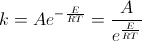
Increasing the temperature decreases the denominator because eE/RT becomes e0 = 1 as the temperature increases. The overall effect is an increasing in reaction rate.
Note however, that the temperature can only increase up to a point. Once the temperature becomes too high, the enzyme would denature and no longer work.
This question asks us how the rate of the reaction would change if temperature were increased. Increasing the temperature increases the relative velocity of each reactant, increasing the chance that two reactants collide and are able to form a product with the help of carbonic anhydrase. This can also be seen with the following equation.
Increasing the temperature decreases the denominator because eE/RT becomes e0 = 1 as the temperature increases. The overall effect is an increasing in reaction rate.
Note however, that the temperature can only increase up to a point. Once the temperature becomes too high, the enzyme would denature and no longer work.
← Didn't Know|Knew It →
Carbonic anhydrase is an important enzyme that allows CO2 and H2O to be converted into H2CO3. In addition to allowing CO2 to be dissolved into the blood and transported to the lungs for exhalation, the products of the carbonic anhydrase reaction, H2CO3 and a related compound HCO3-, also serve to control the pH of the blood to prevent acidosis or alkalosis. The carbonic anhydrase reaction and acid-base reaction are presented below.
CO2 + H2O  H2CO3
H2CO3
H2CO3  HCO3- + H+
If the pH of the blood increases above 8, how would the activity of carbonic anhydrase change?
Carbonic anhydrase is an important enzyme that allows CO2 and H2O to be converted into H2CO3. In addition to allowing CO2 to be dissolved into the blood and transported to the lungs for exhalation, the products of the carbonic anhydrase reaction, H2CO3 and a related compound HCO3-, also serve to control the pH of the blood to prevent acidosis or alkalosis. The carbonic anhydrase reaction and acid-base reaction are presented below.
CO2 + H2O
H2CO3
If the pH of the blood increases above 8, how would the activity of carbonic anhydrase change?
Tap to reveal answer
Extreme temperatures and pH levels decrease the activity of enzymes because they become denatured. In the body, most enzymes work optimally around a pH of 7.4. Increasing the pH too high would denature a protein because amino acids that are normally protonated at physiological pH (i.e. acidic residues) would become deprotonated. Lack of protonation would cause collapse of the tertiary and quaternary structures, leading to a decrease in enzyme function.
Extreme temperatures and pH levels decrease the activity of enzymes because they become denatured. In the body, most enzymes work optimally around a pH of 7.4. Increasing the pH too high would denature a protein because amino acids that are normally protonated at physiological pH (i.e. acidic residues) would become deprotonated. Lack of protonation would cause collapse of the tertiary and quaternary structures, leading to a decrease in enzyme function.
← Didn't Know|Knew It →