
Physics - MCAT Chemical and Physical Foundations of Biological Systems
Card 1 of 3927
What phenomenon can occur with light, but not sound?
What phenomenon can occur with light, but not sound?
Tap to reveal answer
Sound is a longitudinal wave, while light is a transverse wave. Polarization requires the direction of the wave to be perpendicular to the direction of propogation; only light can do this. Doppler effect, refraction, and interference occur in both wave types.
Sound is a longitudinal wave, while light is a transverse wave. Polarization requires the direction of the wave to be perpendicular to the direction of propogation; only light can do this. Doppler effect, refraction, and interference occur in both wave types.
← Didn't Know|Knew It →
Which statement is not true for all waves?
Which statement is not true for all waves?
Tap to reveal answer
The speed of sound is dependent on the temperature of the transmitting medium. The speed of light is not.
The speed of sound is dependent on the temperature of the transmitting medium. The speed of light is not.
← Didn't Know|Knew It →
Sound traveling at a velocity, V1, through a certain medium will travel at what velocity through a medium of twice the density?
Sound traveling at a velocity, V1, through a certain medium will travel at what velocity through a medium of twice the density?
Tap to reveal answer
The speed of sound depends on both the medium’s density and resistance to compression. We do not have enough information to solve for V2 in terms of V1.
The speed of sound depends on both the medium’s density and resistance to compression. We do not have enough information to solve for V2 in terms of V1.
← Didn't Know|Knew It →
What is the frequency of a typical soundwave traveling at 340m/s with a wavelength of 40mm?
What is the frequency of a typical soundwave traveling at 340m/s with a wavelength of 40mm?
Tap to reveal answer
Using the equation  we can find the frequency of the soundwave.


Using the equation
← Didn't Know|Knew It →
Which of the following forces is not conservative?
Which of the following forces is not conservative?
Tap to reveal answer
Conservative forces are forces that do not lose energy to heat, sound, or light. Of these answers, energy is completely conserved and transferred from kinetic energy to potential energy, or vice versa. Gravitational forces, electrostatic forces, and elastic forces all work by providing a potential that will work in the same direction as the motion of an object or particle, allowing kinetic and potential energy to interconvert. Frictional forces lose energy as heat when sliding across a surface, and the more force (the more rough the surface), the more energy that is lost.
Conservative forces are forces that do not lose energy to heat, sound, or light. Of these answers, energy is completely conserved and transferred from kinetic energy to potential energy, or vice versa. Gravitational forces, electrostatic forces, and elastic forces all work by providing a potential that will work in the same direction as the motion of an object or particle, allowing kinetic and potential energy to interconvert. Frictional forces lose energy as heat when sliding across a surface, and the more force (the more rough the surface), the more energy that is lost.
← Didn't Know|Knew It →
Which of the following is not a conservative force?
Which of the following is not a conservative force?
Tap to reveal answer
Friction is a non-conservative force, meaning that the work it does depends on the path taken by the object. For example, moving a brick in a long zig-zag across the table will generate more heat from friction than moving it in a straight line across the table.
Electric and gravitational forces are conservative. This can be tested by knowing a constant equation to calculate the energy associated with these forces; such equations are applicable regardless of path. No such equation exists for frictional energy.
Friction is a non-conservative force, meaning that the work it does depends on the path taken by the object. For example, moving a brick in a long zig-zag across the table will generate more heat from friction than moving it in a straight line across the table.
Electric and gravitational forces are conservative. This can be tested by knowing a constant equation to calculate the energy associated with these forces; such equations are applicable regardless of path. No such equation exists for frictional energy.
← Didn't Know|Knew It →
A person approaches a plane mirror at 5m/s. How fast do they approach the mirror image?
A person approaches a plane mirror at 5m/s. How fast do they approach the mirror image?
Tap to reveal answer
The image distance for a plane mirror is always equal to the object distance because the magnification is 1.

If the object and image are the same distance from the mirror and magnification is 1, then as the object approaches the mirror at a certain speed, the image is approaching the plane mirror at the same speed, therefore you approach the image more quickly than you approach the mirror, since you travel 5m/s toward the mirror and the image travels 5m/s toward the mirror.
The image distance for a plane mirror is always equal to the object distance because the magnification is 1.
If the object and image are the same distance from the mirror and magnification is 1, then as the object approaches the mirror at a certain speed, the image is approaching the plane mirror at the same speed, therefore you approach the image more quickly than you approach the mirror, since you travel 5m/s toward the mirror and the image travels 5m/s toward the mirror.
← Didn't Know|Knew It →
Jimmy is farsighted and uses a convex lens to correct his vision. Wendy is nearsighted and uses a concave lens to correct her vision. They both wear glasses. During a camping trip, they notice they do not have any matches, and decide to use their glasses to start the fire. Whose glasses could be used to start the fire?
Jimmy is farsighted and uses a convex lens to correct his vision. Wendy is nearsighted and uses a concave lens to correct her vision. They both wear glasses. During a camping trip, they notice they do not have any matches, and decide to use their glasses to start the fire. Whose glasses could be used to start the fire?
Tap to reveal answer
This question deals with an application of optics. In this case we have a farsighted person and a near sighted person. The farsighted person would use a convex lens, which is a converging lens. This would allow all of the rays of light to converge on a single point, allowing them to heat the object up and start a fire. Wendy’s glasses are diverging lenses, which would cause the rays to separate.
This question deals with an application of optics. In this case we have a farsighted person and a near sighted person. The farsighted person would use a convex lens, which is a converging lens. This would allow all of the rays of light to converge on a single point, allowing them to heat the object up and start a fire. Wendy’s glasses are diverging lenses, which would cause the rays to separate.
← Didn't Know|Knew It →
A 2kg lead ball is loaded into a spring cannon and the cannon is set at a 45º angle on a platform. The spring has a spring constant of 100N/m and the ball and spring system is compressed by 1m before launch. While the ball is in flight air resistance can be neglected, and the ball finishes its flight by landing at a cushion placed some distance away from the cannon.
Find the horizontal component of velocity once the ball has left the cannon.
A 2kg lead ball is loaded into a spring cannon and the cannon is set at a 45º angle on a platform. The spring has a spring constant of 100N/m and the ball and spring system is compressed by 1m before launch. While the ball is in flight air resistance can be neglected, and the ball finishes its flight by landing at a cushion placed some distance away from the cannon.
Find the horizontal component of velocity once the ball has left the cannon.
Tap to reveal answer
This asks us to understand the vector components of velocity. Remember that the final velocity is the hypotenuse of a triangle (solved to be 10m/s in the previous problem), and that by knowing the hypotenuse value we can solve for the horizontal component by using cosine.
vx = (10m/s)(cos(45o)) = 7.1m/s
This asks us to understand the vector components of velocity. Remember that the final velocity is the hypotenuse of a triangle (solved to be 10m/s in the previous problem), and that by knowing the hypotenuse value we can solve for the horizontal component by using cosine.
vx = (10m/s)(cos(45o)) = 7.1m/s
← Didn't Know|Knew It →
A 2kg lead ball is loaded into a spring cannon and the cannon is set at a 45º angle on a platform. The spring has a spring constant of 100N/m and the ball and spring system is compressed by 1m before launch. While the ball is in flight air resistance can be neglected, and the ball finishes its flight by landing at a cushion placed some distance away from the cannon.
What is the initial vertical component of velocity of the ball?
A 2kg lead ball is loaded into a spring cannon and the cannon is set at a 45º angle on a platform. The spring has a spring constant of 100N/m and the ball and spring system is compressed by 1m before launch. While the ball is in flight air resistance can be neglected, and the ball finishes its flight by landing at a cushion placed some distance away from the cannon.
What is the initial vertical component of velocity of the ball?
Tap to reveal answer
This question also asks us to understand the vector components of velocity. Remember that the final velocity is the hypotenuse of a triangle, and that by knowing the hypotenuse value (solved as 10m/s in a previous problem) we can solve for the vertical component using sine.
vy = (10m/s)(sin(45o)) = 7.1m/s
This question also asks us to understand the vector components of velocity. Remember that the final velocity is the hypotenuse of a triangle, and that by knowing the hypotenuse value (solved as 10m/s in a previous problem) we can solve for the vertical component using sine.
vy = (10m/s)(sin(45o)) = 7.1m/s
← Didn't Know|Knew It →
Which of the following would not cause a decrease in the pressure of a gas in a sealed container?
Which of the following would not cause a decrease in the pressure of a gas in a sealed container?
Tap to reveal answer
A decrease in pressure means a decrease in gas particle collisions. The only option that would not cause a decrease in collisions is adding moles of a different gas. Even though different molecules are added, there will be greater pressure as particle collisions will be more frequent.
Reducing temperature slows the gas particles, thus decreasing the frequency of collisions. Similarly, increasing the volume of the container and removing particles will cause a decrease in collisions, and subsequent pressure.
A decrease in pressure means a decrease in gas particle collisions. The only option that would not cause a decrease in collisions is adding moles of a different gas. Even though different molecules are added, there will be greater pressure as particle collisions will be more frequent.
Reducing temperature slows the gas particles, thus decreasing the frequency of collisions. Similarly, increasing the volume of the container and removing particles will cause a decrease in collisions, and subsequent pressure.
← Didn't Know|Knew It →
A 2kg lead ball is loaded into a spring cannon and the cannon is set at a 45º angle on a platform. The spring has a spring constant of 100N/m and the ball and spring system is compressed by 1m before launch. While the ball is in flight air resistance can be neglected, and the ball finishes its flight by landing at a cushion placed some distance away from the cannon.
What is the horizontal acceleration of the ball during its flight?
A 2kg lead ball is loaded into a spring cannon and the cannon is set at a 45º angle on a platform. The spring has a spring constant of 100N/m and the ball and spring system is compressed by 1m before launch. While the ball is in flight air resistance can be neglected, and the ball finishes its flight by landing at a cushion placed some distance away from the cannon.
What is the horizontal acceleration of the ball during its flight?
Tap to reveal answer
Without an additional force acting in the horizontal direction during flight (we are told we can neglect air resistance), there is no acceleration. Remember that Newton's second law, F = ma, requires that a force act on an object to produce acceleration. Here, we have no additional force and thus no acceleration.
Without an additional force acting in the horizontal direction during flight (we are told we can neglect air resistance), there is no acceleration. Remember that Newton's second law, F = ma, requires that a force act on an object to produce acceleration. Here, we have no additional force and thus no acceleration.
← Didn't Know|Knew It →
Which factors increase the maximum velocity of a pendulum?
Which factors increase the maximum velocity of a pendulum?
Tap to reveal answer
Both the length of the pendulum's string and the angle of displacement affect the maximum velocity of the pendulum. Increasing the length of the pendulum's string and increasing the angle of displacement both increase the distance the pendulum must travel in a single period, increasing its potential energy at its maximum height, and therefore the maximum velocity at its lowest point.
Both the length of the pendulum's string and the angle of displacement affect the maximum velocity of the pendulum. Increasing the length of the pendulum's string and increasing the angle of displacement both increase the distance the pendulum must travel in a single period, increasing its potential energy at its maximum height, and therefore the maximum velocity at its lowest point.
← Didn't Know|Knew It →
What is the period of a pendulum that has a string length of 9.8m?
What is the period of a pendulum that has a string length of 9.8m?
Tap to reveal answer
The key to answering this question is to recall the following important formula for a simple pendulum:  .
.
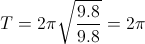
The key to answering this question is to recall the following important formula for a simple pendulum:
← Didn't Know|Knew It →
Which of the following factors does not explain why measurements of real gases deviate from ideal values?
Which of the following factors does not explain why measurements of real gases deviate from ideal values?
Tap to reveal answer
Measurements of real gases deviate from ideal gas predictions because intermolecular forces and the volume of the particles themselves are not taken into consideration for ideal gases. The volume of the space between particles is considered for ideal gases and does not contribute to deviation from ideal gas behavior.
Attraction between molecules causes real pressure to be slightly less than ideal pressure, while the volume of gas particles causes real volume to be slightly greater than ideal volume.
Measurements of real gases deviate from ideal gas predictions because intermolecular forces and the volume of the particles themselves are not taken into consideration for ideal gases. The volume of the space between particles is considered for ideal gases and does not contribute to deviation from ideal gas behavior.
Attraction between molecules causes real pressure to be slightly less than ideal pressure, while the volume of gas particles causes real volume to be slightly greater than ideal volume.
← Didn't Know|Knew It →
Two charges of  coulombs are a distance
  apart from each other. Which of the following would reduce the force exerted between the charges by a factor of 4?
Two charges of
Tap to reveal answer
Given Coulomb's Law electrostatic forces: 
We can see that distance and force are inversly related. Also distance is squared, so if we increase the distance by 2, the force between the two charges will be reduced by a factor of four.
Given Coulomb's Law electrostatic forces:
We can see that distance and force are inversly related. Also distance is squared, so if we increase the distance by 2, the force between the two charges will be reduced by a factor of four.
← Didn't Know|Knew It →


How many electrons would it require to generate a 5 N attractive force on a +3 µC charge from 0.1 m away.
How many electrons would it require to generate a 5 N attractive force on a +3 µC charge from 0.1 m away.
Tap to reveal answer
To find the answer we must first solve for q, using Coulomb's Law. Then after finding q = 1.85 x 10⁻⁶ C, we must divide by 1.6 x 10⁻¹⁹ C to get the amount of electrons required to make such a charge.
To find the answer we must first solve for q, using Coulomb's Law. Then after finding q = 1.85 x 10⁻⁶ C, we must divide by 1.6 x 10⁻¹⁹ C to get the amount of electrons required to make such a charge.
← Didn't Know|Knew It →
At a local concert, a speaker is set up to produce low-pitched base sounds with a frequency range of 20Hz to 200Hz, which can be modeled as sine waves. In a simplified model, the sound waves the speaker produces can be modeled as a cylindrical pipe with one end closed that travel through the air at a velocity of  , where T is the temperature in °C.
As a person walks towards the speaker, the frequency he or she hears .
At a local concert, a speaker is set up to produce low-pitched base sounds with a frequency range of 20Hz to 200Hz, which can be modeled as sine waves. In a simplified model, the sound waves the speaker produces can be modeled as a cylindrical pipe with one end closed that travel through the air at a velocity of
As a person walks towards the speaker, the frequency he or she hears .
Tap to reveal answer
This question is asking us how the frequency changes when one object moves directly towards another; thus, this is a Doppler effect problem. Remembering back to our Doppler effect formula, we know that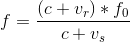 , where f is the frequency heard by the recipient (the person at the concert), vr is the velocity of the receiver, vs is the velocity of the source, and f0 is the original frequency.
In our case, the speaker is not moving, so vs is zero. vr is positive when the person is walking towards the speaker, so the frequency heard will be higher than the original frequency.
This question is asking us how the frequency changes when one object moves directly towards another; thus, this is a Doppler effect problem. Remembering back to our Doppler effect formula, we know that
In our case, the speaker is not moving, so vs is zero. vr is positive when the person is walking towards the speaker, so the frequency heard will be higher than the original frequency.
← Didn't Know|Knew It →
A sound source with a frequency of 790Hz moves away from a stationary observer at a rate of 15m/s. What frequency does the observer hear?
The speed of sound is 340m/s.
A sound source with a frequency of 790Hz moves away from a stationary observer at a rate of 15m/s. What frequency does the observer hear?
The speed of sound is 340m/s.
Tap to reveal answer
In this scenario the Doppler effect is described by the following equation.
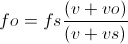
Using the values from the problem, we know that vo is zero and vf is 15m/s. v is 340m/s and fs is 790Hz.

In this scenario the Doppler effect is described by the following equation.
Using the values from the problem, we know that vo is zero and vf is 15m/s. v is 340m/s and fs is 790Hz.
← Didn't Know|Knew It →
A fire truck emits an 880Hz siren. As the truck approaches an obeserver on the sidewalk, he perceives the pitch to be 950Hz. Approximately what pitch does he hear after the truck passes and is moving away? Assume the truck's velocity remains constant, and that the velocity of sound in air is 340m/s.
A fire truck emits an 880Hz siren. As the truck approaches an obeserver on the sidewalk, he perceives the pitch to be 950Hz. Approximately what pitch does he hear after the truck passes and is moving away? Assume the truck's velocity remains constant, and that the velocity of sound in air is 340m/s.
Tap to reveal answer
The equation for Doppler effect is  , where the + sign applies when the source and observer are moving farther apart, and the - sign applies when they are moving closer together. In these equations, v is the speed of sound, 340m/s,
  is the frequency of sound emitted by the source,
  is the freqency perceived by the observer, and
  is the relative velocity between the source and observer.
We can apply this equation to the first part of the motion, as the truck moves closer to the observer, to solve for the velocity of the truck.


Now we can plug this velocity into the equation again for when the truck moves farther away from the observer and solve for  .
.

The equation for Doppler effect is
We can apply this equation to the first part of the motion, as the truck moves closer to the observer, to solve for the velocity of the truck.
Now we can plug this velocity into the equation again for when the truck moves farther away from the observer and solve for
← Didn't Know|Knew It →