
Physical Chemistry - MCAT Chemical and Physical Foundations of Biological Systems
Card 1 of 1288
A specific element is kept in two separate containers. The samples are both heated by the same amount of heat, but the element in container 1 experiences a greater temperature change than the element in container 2.
Which of the following could NOT be an explanation for this difference in temperature change?
A specific element is kept in two separate containers. The samples are both heated by the same amount of heat, but the element in container 1 experiences a greater temperature change than the element in container 2.
Which of the following could NOT be an explanation for this difference in temperature change?
Tap to reveal answer
If there was more mass (in grams) of the element in container 1 than there was in container 2, we would expect container 1 to undergo a smaller temperature change compared to container 2. This is justified by the equation  , where m is the mass.
Rewritten as  , we can see that a larger mass would result in a smaller temperature change. Remember that q is held constant between the two containers.
If element 2 expelled some of its energy to the surroundings in the form of work (expanding the container), it could explain why it had a smaller temperature change. In addition, different phases of an element have different specific heat capacities. This can also explain the difference in temperature between the two element samples.
If there was more mass (in grams) of the element in container 1 than there was in container 2, we would expect container 1 to undergo a smaller temperature change compared to container 2. This is justified by the equation
Rewritten as
If element 2 expelled some of its energy to the surroundings in the form of work (expanding the container), it could explain why it had a smaller temperature change. In addition, different phases of an element have different specific heat capacities. This can also explain the difference in temperature between the two element samples.
← Didn't Know|Knew It →
A burning tree in a forest causes another tree that is twenty inches away to also start burning, without touching it. How is the heat being transferred from the burning tree to the other?
A burning tree in a forest causes another tree that is twenty inches away to also start burning, without touching it. How is the heat being transferred from the burning tree to the other?
Tap to reveal answer
Convection describes heat transfer through a fluid medium, such as a gas or liquid. In this case, the burning tree transfers heat to the air, which transfers the heat to the other tree.
Conduction requires direct contact, which would occur if a burning tree fell into another tree. Radiation is the electromagnetic transfer of heat, such as the sun's heat that travels to Earth, and does not require matter to transfer. Transduction is not a mechanism for heat transfer.
Convection describes heat transfer through a fluid medium, such as a gas or liquid. In this case, the burning tree transfers heat to the air, which transfers the heat to the other tree.
Conduction requires direct contact, which would occur if a burning tree fell into another tree. Radiation is the electromagnetic transfer of heat, such as the sun's heat that travels to Earth, and does not require matter to transfer. Transduction is not a mechanism for heat transfer.
← Didn't Know|Knew It →
Which of the following is not related to bond dissociation energy?
Which of the following is not related to bond dissociation energy?
Tap to reveal answer
Bond dissociation energy is the energy associated with a bond within a molecule. This means that bond dissociation energy is measured for intramolecular bonds. All covalent and ionic bonds are considered intramolecular bonds, and are generally quite permanent. Ionic bonds and polar covalent bonds can help develop dipoles in a molecule, which later facilitate intermolecular interactions.
Hydrogen bonds are intermolecular bonds, which do not have associated bond dissociation energies because these type of bonds are temporary, and are formed between different molecules.
Bond dissociation energy is the energy associated with a bond within a molecule. This means that bond dissociation energy is measured for intramolecular bonds. All covalent and ionic bonds are considered intramolecular bonds, and are generally quite permanent. Ionic bonds and polar covalent bonds can help develop dipoles in a molecule, which later facilitate intermolecular interactions.
Hydrogen bonds are intermolecular bonds, which do not have associated bond dissociation energies because these type of bonds are temporary, and are formed between different molecules.
← Didn't Know|Knew It →
Which of the following describes a transition from gas to solid?
Which of the following describes a transition from gas to solid?
Tap to reveal answer
There are six possible phase changes between the three phases of matter. Deposition describes the change from gas to solid, while sublimation describes the transition from solid to gas. Freezing (crystallization) is the transition from liquid to solid, while fusion (melting) is the transition from solid to liquid. Condensation is the transition from gas to liquid, while vaporization (boiling) is the transition from liquid to gas.
There are six possible phase changes between the three phases of matter. Deposition describes the change from gas to solid, while sublimation describes the transition from solid to gas. Freezing (crystallization) is the transition from liquid to solid, while fusion (melting) is the transition from solid to liquid. Condensation is the transition from gas to liquid, while vaporization (boiling) is the transition from liquid to gas.
← Didn't Know|Knew It →
A brass disk with an outer diameter of  has a
has a  diameter hole cut through its center. If the disk is initially at
  and is then placed into a freezer at
  , what is the final area of the hole?
The linear expansion coefficient for brass is: 
A brass disk with an outer diameter of
The linear expansion coefficient for brass is:
Tap to reveal answer
First, find the original area of the hole, in square meters:

We will also convert the temperatures to Kelvin.


The linear thermal expansion equation is:

Similarly, the thermal expansion of an area is given by the equation:

We are given the value of the constant, we know the original area, and we have the change in temperature. Using these values, we can solve for the change in area.


Find the final area of the hole by adding the change in area to the original area.


First, find the original area of the hole, in square meters:
We will also convert the temperatures to Kelvin.
The linear thermal expansion equation is:
Similarly, the thermal expansion of an area is given by the equation:
We are given the value of the constant, we know the original area, and we have the change in temperature. Using these values, we can solve for the change in area.
Find the final area of the hole by adding the change in area to the original area.
← Didn't Know|Knew It →
What conditions best favor the gaseous state?
What conditions best favor the gaseous state?
Tap to reveal answer
Low pressure ensures that the molecules are not confined to a more organized state such as liquid or solid, while high temperature means higher kinetic energy, which means that the molecules have more energy to move away from one another and into the gaseous state. Low temperature would mean molecules have less energy to move away from one another, and high pressure will force molecules to be in a more organized state.
Low pressure ensures that the molecules are not confined to a more organized state such as liquid or solid, while high temperature means higher kinetic energy, which means that the molecules have more energy to move away from one another and into the gaseous state. Low temperature would mean molecules have less energy to move away from one another, and high pressure will force molecules to be in a more organized state.
← Didn't Know|Knew It →
Raining is an example of what type of phase change?
Raining is an example of what type of phase change?
Tap to reveal answer
Raining occurs when water vapors become liquid water in the sky. Deposition is the phase change from gas to solid, sublimation is the phase change form solid to gas, and evaporation is the phase change from liquid to gas.
Raining occurs when water vapors become liquid water in the sky. Deposition is the phase change from gas to solid, sublimation is the phase change form solid to gas, and evaporation is the phase change from liquid to gas.
← Didn't Know|Knew It →
What is the phase change at the contact point between an ice hockey player's skate and the ice?
What is the phase change at the contact point between an ice hockey player's skate and the ice?
Tap to reveal answer
Melting occurs because the skates apply pressure to the ice. Due to the negative slope of solid-liquid equilibrium line for water, increased pressure results in a change from solid to liquid. None of the other answer choices do not have to do with the equilibrium between solid and liquid.
Melting occurs because the skates apply pressure to the ice. Due to the negative slope of solid-liquid equilibrium line for water, increased pressure results in a change from solid to liquid. None of the other answer choices do not have to do with the equilibrium between solid and liquid.
← Didn't Know|Knew It →
Which of the following describes the concept of sweating?
Which of the following describes the concept of sweating?
Tap to reveal answer
Sweating reduces skin temperature because the sweat that is secreted to the skin evaporates, which is an endothermic process. Thus, heat is absorbed from the body and skin to drive the evaporation of the sweat on the skin.
Sweating reduces skin temperature because the sweat that is secreted to the skin evaporates, which is an endothermic process. Thus, heat is absorbed from the body and skin to drive the evaporation of the sweat on the skin.
← Didn't Know|Knew It →
A student conducts an experiment for a chemistry class. The student wishes to explore power generation from different types of voltaic cells. He sets up three different cells, and then compares the amount of energy generated from each one.
One of his cells is shown below as an example. Both remaining cells follow the same layout.
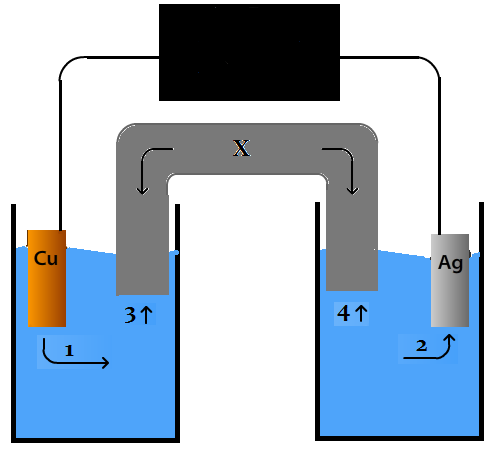
Which of the following compounds could be used to construct the structure labeled "X"?
A student conducts an experiment for a chemistry class. The student wishes to explore power generation from different types of voltaic cells. He sets up three different cells, and then compares the amount of energy generated from each one.
One of his cells is shown below as an example. Both remaining cells follow the same layout.
Which of the following compounds could be used to construct the structure labeled "X"?
Tap to reveal answer
Structure "X" corresponds to the slat bridge. Its main function is balancing the ionic charge that builds up as a voltaic cell functions; therefore, there needs to be an ability for the salt bridge to ionize and send appropriate ions to each half cell. KOH is the only ionizable salt among the answer choices.
Structure "X" corresponds to the slat bridge. Its main function is balancing the ionic charge that builds up as a voltaic cell functions; therefore, there needs to be an ability for the salt bridge to ionize and send appropriate ions to each half cell. KOH is the only ionizable salt among the answer choices.
← Didn't Know|Knew It →
A student conducts an experiment for a chemistry class. The student wishes to explore power generation from different types of voltaic cells. He sets up three different cells, and then compares the amount of energy generated from each one.
One of his cells is shown below as an example. Both remaining cells follow the same layout.
In the above diagram, a KOH salt bridge is used. Which species would you anticipate finding at the tip of the arrow numbered 4?
The reduction potential for  is 0.34. The reduction potential for
  0.80.
0.80.
A student conducts an experiment for a chemistry class. The student wishes to explore power generation from different types of voltaic cells. He sets up three different cells, and then compares the amount of energy generated from each one.
One of his cells is shown below as an example. Both remaining cells follow the same layout.
In the above diagram, a KOH salt bridge is used. Which species would you anticipate finding at the tip of the arrow numbered 4?
The reduction potential for
Tap to reveal answer
The correct answer is  , as we would need to balance the loss of positive silver ions in that half cell. Silver has the greater reduction potential, and is therefore gaining electrons to become more negative. As the negative charge develops, it will attract the positive potassium ions in the salt bridge.
The correct answer is
← Didn't Know|Knew It →
A student conducts an experiment for a chemistry class. The student wishes to explore power generation from different types of voltaic cells. He sets up three different cells, and then compares the amount of energy generated from each one.
One of his cells is shown below as an example. Both remaining cells follow the same layout.
The student in the passage creates a new cell, but uses the same element at both the anode and the cathode. What is likely to be true of this new cell?
A student conducts an experiment for a chemistry class. The student wishes to explore power generation from different types of voltaic cells. He sets up three different cells, and then compares the amount of energy generated from each one.
One of his cells is shown below as an example. Both remaining cells follow the same layout.
The student in the passage creates a new cell, but uses the same element at both the anode and the cathode. What is likely to be true of this new cell?
Tap to reveal answer
This is an example of a concentration cell. If you have two half cells, each made of the same chemical species, and connect them with a wire, the cell will generate a voltage as it attempts to correct the disequilibrium induced by the concentration difference.
This is an example of a concentration cell. If you have two half cells, each made of the same chemical species, and connect them with a wire, the cell will generate a voltage as it attempts to correct the disequilibrium induced by the concentration difference.
← Didn't Know|Knew It →
A student conducts an experiment for a chemistry class. The student wishes to explore power generation from different types of voltaic cells. He sets up three different cells, and then compares the amount of energy generated from each one.
One of his cells is shown below as an example. Both remaining cells follow the same layout.
The student in the passage wants to replace the water, represented by the blue in the diagram, with an alternative solvent. Which solvent would be most likely to produce a functioning cell?
A student conducts an experiment for a chemistry class. The student wishes to explore power generation from different types of voltaic cells. He sets up three different cells, and then compares the amount of energy generated from each one.
One of his cells is shown below as an example. Both remaining cells follow the same layout.
The student in the passage wants to replace the water, represented by the blue in the diagram, with an alternative solvent. Which solvent would be most likely to produce a functioning cell?
Tap to reveal answer
The function of a voltaic cell requires the generation and dissolution of ions. Acetic acid is the only answer choice with a net dipole moment, and would therefore be the only one to dissolve the ions produced. The other choices would be unable to dissolve the ions, and the cell would not function.
The function of a voltaic cell requires the generation and dissolution of ions. Acetic acid is the only answer choice with a net dipole moment, and would therefore be the only one to dissolve the ions produced. The other choices would be unable to dissolve the ions, and the cell would not function.
← Didn't Know|Knew It →
A student conducts an experiment for a chemistry class. The student wishes to explore power generation from different types of voltaic cells. He sets up three different cells, and then compares the amount of energy generated from each one.
One of his cells is shown below as an example. Both remaining cells follow the same layout.
If the structure labeled X were removed from the cell, which of the folllowing would be true?
The reduction potential for  is 0.34. The reduction potential for
  0.80.
0.80.
A student conducts an experiment for a chemistry class. The student wishes to explore power generation from different types of voltaic cells. He sets up three different cells, and then compares the amount of energy generated from each one.
One of his cells is shown below as an example. Both remaining cells follow the same layout.
If the structure labeled X were removed from the cell, which of the folllowing would be true?
The reduction potential for
Tap to reveal answer
As the cell runs, only copper produces ions. Silver actually loses ions from solution. If this continues without balance by the salt bridge, the positive ions build up in the solution on the left side of the diagram, without any balanced negative ions, and repel the formation of new copper ions more and more strongly.
As the cell runs, only copper produces ions. Silver actually loses ions from solution. If this continues without balance by the salt bridge, the positive ions build up in the solution on the left side of the diagram, without any balanced negative ions, and repel the formation of new copper ions more and more strongly.
← Didn't Know|Knew It →
A student conducts an experiment for a chemistry class. The student wishes to explore power generation from different types of voltaic cells. He sets up three different cells, and then compares the amount of energy generated from each one.
One of his cells is shown below as an example. Both remaining cells follow the same layout.
The student in the passage disassembles the cell, and attempts to rebuild it the next day. He forgets, however, to include  in the solvent of the half cell on the right side of the diagram. Which of the following is likely to happen?
A student conducts an experiment for a chemistry class. The student wishes to explore power generation from different types of voltaic cells. He sets up three different cells, and then compares the amount of energy generated from each one.
One of his cells is shown below as an example. Both remaining cells follow the same layout.
The student in the passage disassembles the cell, and attempts to rebuild it the next day. He forgets, however, to include
Tap to reveal answer
There must be  pre-existing in the right-side half reaction for the cell to function at all. Without the pre-existing ions, the cell has no electron acceptor dissolved in solution, and no electron transfer can therefore take place. Electron transfer is the fundamental energy-producing process that takes place in a voltaic cell.
There must be
← Didn't Know|Knew It →
When a galvanic cell contains two different solutions, a salt bridge is often required. The salt bridge allows the two solutions to remain isolated by providing ionic interactions for both solutions, without severely reducing the potential difference. The salt bridge is commonly composed of a potassium chloride solution.
In what direction would you expect the potassium ions to travel in a galvanic cell?
When a galvanic cell contains two different solutions, a salt bridge is often required. The salt bridge allows the two solutions to remain isolated by providing ionic interactions for both solutions, without severely reducing the potential difference. The salt bridge is commonly composed of a potassium chloride solution.
In what direction would you expect the potassium ions to travel in a galvanic cell?
Tap to reveal answer
Potassium ions (K+) will be positively charged, which means they will travel towards the side of the cell that is more negative. Reduction takes place at the cathode, because electrons flow from the anode to the cathode. Since negative charge accumulates at the cathode, the cations will travel in that direction, while the anions will travel towards the anode.
Potassium ions (K+) will be positively charged, which means they will travel towards the side of the cell that is more negative. Reduction takes place at the cathode, because electrons flow from the anode to the cathode. Since negative charge accumulates at the cathode, the cations will travel in that direction, while the anions will travel towards the anode.
← Didn't Know|Knew It →
A burning tree in a forest causes another tree that is twenty inches away to also start burning, without touching it. How is the heat being transferred from the burning tree to the other?
A burning tree in a forest causes another tree that is twenty inches away to also start burning, without touching it. How is the heat being transferred from the burning tree to the other?
Tap to reveal answer
Convection describes heat transfer through a fluid medium, such as a gas or liquid. In this case, the burning tree transfers heat to the air, which transfers the heat to the other tree.
Conduction requires direct contact, which would occur if a burning tree fell into another tree. Radiation is the electromagnetic transfer of heat, such as the sun's heat that travels to Earth, and does not require matter to transfer. Transduction is not a mechanism for heat transfer.
Convection describes heat transfer through a fluid medium, such as a gas or liquid. In this case, the burning tree transfers heat to the air, which transfers the heat to the other tree.
Conduction requires direct contact, which would occur if a burning tree fell into another tree. Radiation is the electromagnetic transfer of heat, such as the sun's heat that travels to Earth, and does not require matter to transfer. Transduction is not a mechanism for heat transfer.
← Didn't Know|Knew It →
Which of the following is not related to bond dissociation energy?
Which of the following is not related to bond dissociation energy?
Tap to reveal answer
Bond dissociation energy is the energy associated with a bond within a molecule. This means that bond dissociation energy is measured for intramolecular bonds. All covalent and ionic bonds are considered intramolecular bonds, and are generally quite permanent. Ionic bonds and polar covalent bonds can help develop dipoles in a molecule, which later facilitate intermolecular interactions.
Hydrogen bonds are intermolecular bonds, which do not have associated bond dissociation energies because these type of bonds are temporary, and are formed between different molecules.
Bond dissociation energy is the energy associated with a bond within a molecule. This means that bond dissociation energy is measured for intramolecular bonds. All covalent and ionic bonds are considered intramolecular bonds, and are generally quite permanent. Ionic bonds and polar covalent bonds can help develop dipoles in a molecule, which later facilitate intermolecular interactions.
Hydrogen bonds are intermolecular bonds, which do not have associated bond dissociation energies because these type of bonds are temporary, and are formed between different molecules.
← Didn't Know|Knew It →
A specific element is kept in two separate containers. The samples are both heated by the same amount of heat, but the element in container 1 experiences a greater temperature change than the element in container 2.
Which of the following could NOT be an explanation for this difference in temperature change?
A specific element is kept in two separate containers. The samples are both heated by the same amount of heat, but the element in container 1 experiences a greater temperature change than the element in container 2.
Which of the following could NOT be an explanation for this difference in temperature change?
Tap to reveal answer
If there was more mass (in grams) of the element in container 1 than there was in container 2, we would expect container 1 to undergo a smaller temperature change compared to container 2. This is justified by the equation , where m is the mass.
Rewritten as , we can see that a larger mass would result in a smaller temperature change. Remember that q is held constant between the two containers.
If element 2 expelled some of its energy to the surroundings in the form of work (expanding the container), it could explain why it had a smaller temperature change. In addition, different phases of an element have different specific heat capacities. This can also explain the difference in temperature between the two element samples.
If there was more mass (in grams) of the element in container 1 than there was in container 2, we would expect container 1 to undergo a smaller temperature change compared to container 2. This is justified by the equation
Rewritten as
If element 2 expelled some of its energy to the surroundings in the form of work (expanding the container), it could explain why it had a smaller temperature change. In addition, different phases of an element have different specific heat capacities. This can also explain the difference in temperature between the two element samples.
← Didn't Know|Knew It →
A researcher is analyzing an electrolytic cell. In trial 1, he applies  of current for two hours to the cell and observes that the cathode produces
  of zinc metal. In trial 2, he applies the same amount of current but only for one hour. What will the researcher observe in the cathode during trial 2?
A researcher is analyzing an electrolytic cell. In trial 1, he applies
Tap to reveal answer
Faraday’s Law states that the amount of substance produced in a half-cell is dependent on the charge applied to the system; therefore, the more charge applied the more substance produced. The question states that the researcher applies the same amount of current, but for a shorter time, in trial 2. Recall the definition of current:
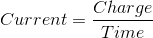
This means that charge equals:

Trial 1 and Trial 2 have the same current; however, trial 2 has a smaller time. This means that the charge applied in trial 2 is smaller than the charge applied in trial 1; therefore, according to Faraday’s law, the researcher must observe a smaller mass of zinc metal in trial 2.
Faraday’s Law states that the amount of substance produced in a half-cell is dependent on the charge applied to the system; therefore, the more charge applied the more substance produced. The question states that the researcher applies the same amount of current, but for a shorter time, in trial 2. Recall the definition of current:
This means that charge equals:
Trial 1 and Trial 2 have the same current; however, trial 2 has a smaller time. This means that the charge applied in trial 2 is smaller than the charge applied in trial 1; therefore, according to Faraday’s law, the researcher must observe a smaller mass of zinc metal in trial 2.
← Didn't Know|Knew It →