
Atoms, Elements, and the Periodic Table - MCAT Chemical and Physical Foundations of Biological Systems
Card 1 of 504
Which of the following elements has the greatest atomic radius?
Which of the following elements has the greatest atomic radius?
Tap to reveal answer
Atomic radius can be determined using the periodic trends. Atomic radius increases to the left of a period and down a group of the periodic table. Electronegativity, in contrast, increases to the right of a period and up a group of the periodic table. Relating the two, we can see that the greater the atomic radius, the weaker its electronegativity because the electrons are farther away from the nucleus and are unable to feel the attractive force of the protons in the nucleus.
Atomic radius can be determined using the periodic trends. Atomic radius increases to the left of a period and down a group of the periodic table. Electronegativity, in contrast, increases to the right of a period and up a group of the periodic table. Relating the two, we can see that the greater the atomic radius, the weaker its electronegativity because the electrons are farther away from the nucleus and are unable to feel the attractive force of the protons in the nucleus.
← Didn't Know|Knew It →
Which of the following elements has the highest electronegativity?
Which of the following elements has the highest electronegativity?
Tap to reveal answer
Remember that electronegativity increases as you approach the top right corner of the periodic table. Since oxygen is the farthest right and the highest up on the perioidic table out of these choices, we conclude that it has the highest electronegativity.
Remember that electronegativity increases as you approach the top right corner of the periodic table. Since oxygen is the farthest right and the highest up on the perioidic table out of these choices, we conclude that it has the highest electronegativity.
← Didn't Know|Knew It →
Which of the following elements has the greatest effective nuclear charge?
Which of the following elements has the greatest effective nuclear charge?
Tap to reveal answer
The effective nuclear charge is the attractive charge a valence electron feels from the nucleus. As you move from left to right along a period, and more positive charges (protons) fill up the nucleus, the more attraction the valence electron feels. As you move down a group, you jump into the next electron shell, thus shielding the valence electrons from the inner positive charge, and decreasing the effective nuclear charge.
Because chlorine is in the same period as phosphorus and sodium, but has the most protons in its shell (the most right within the same period) it has the greatest effective nuclear charge. Additionally, because chlorine is in the same group as bromine, but is higher up on the periodic table, it has a greater effective nuclear charge, making it the correct answer.
The effective nuclear charge is the attractive charge a valence electron feels from the nucleus. As you move from left to right along a period, and more positive charges (protons) fill up the nucleus, the more attraction the valence electron feels. As you move down a group, you jump into the next electron shell, thus shielding the valence electrons from the inner positive charge, and decreasing the effective nuclear charge.
Because chlorine is in the same period as phosphorus and sodium, but has the most protons in its shell (the most right within the same period) it has the greatest effective nuclear charge. Additionally, because chlorine is in the same group as bromine, but is higher up on the periodic table, it has a greater effective nuclear charge, making it the correct answer.
← Didn't Know|Knew It →
Which of the given atoms has the lowest electron affinity?
Which of the given atoms has the lowest electron affinity?
Tap to reveal answer
Beryllium, calcium, strontium, and radium are all alkaline earth metals in the same group of the periodic table.
The electron affinity, a measure of the energy released when an atom gains an electron (an exothermic reaction), decreases from the top of a group (column) to the bottom. The trends in electron affinity can be correlated with ionization energy. When a smaller atom gains an electron, the force between the electron and nucleus is greater than in a larger atom; thus, more energy is released when this “bond” between the nucleus and electron is formed in a smaller atom than in a larger atom, meaning that smaller atoms will have greater electron affinity. Radium is the farthest down the group of alkaline earth metals, and will have the largest atomic radius of the answer choices, giving it the lowest electron affinity.
Beryllium, calcium, strontium, and radium are all alkaline earth metals in the same group of the periodic table.
The electron affinity, a measure of the energy released when an atom gains an electron (an exothermic reaction), decreases from the top of a group (column) to the bottom. The trends in electron affinity can be correlated with ionization energy. When a smaller atom gains an electron, the force between the electron and nucleus is greater than in a larger atom; thus, more energy is released when this “bond” between the nucleus and electron is formed in a smaller atom than in a larger atom, meaning that smaller atoms will have greater electron affinity. Radium is the farthest down the group of alkaline earth metals, and will have the largest atomic radius of the answer choices, giving it the lowest electron affinity.
← Didn't Know|Knew It →
Which of the given atoms has the greatest electron affinity?
Which of the given atoms has the greatest electron affinity?
Tap to reveal answer
Sodium, aluminum, phosphorus, and chlorine are all in the same row (period) of the periodic table.
The electron affinity, a measure of the energy released when an atom gains an electron (an exothermic reaction), increases from left to right across the periodic table because when a smaller atom gains an electron, the force between the electron and nucleus is greater than with a larger atom. More energy is released when this “bond” between the nucleus and electron is formed. Chlorine has the smallest atomic radius of the answer choices because it is located farthest to the right of the period; thus, chlorine will also have the greatest attractive force between its nucleus and electrons, giving it the highest electron affinity.
Sodium, aluminum, phosphorus, and chlorine are all in the same row (period) of the periodic table.
The electron affinity, a measure of the energy released when an atom gains an electron (an exothermic reaction), increases from left to right across the periodic table because when a smaller atom gains an electron, the force between the electron and nucleus is greater than with a larger atom. More energy is released when this “bond” between the nucleus and electron is formed. Chlorine has the smallest atomic radius of the answer choices because it is located farthest to the right of the period; thus, chlorine will also have the greatest attractive force between its nucleus and electrons, giving it the highest electron affinity.
← Didn't Know|Knew It →
Which of the given elements has the greatest electronegativity?
Which of the given elements has the greatest electronegativity?
Tap to reveal answer
Electronegativity, defined as the tendency of an atom to attract an electron, increases from left to right across a period, and the bottom of each group to the top. The most electronegative element is fluorine (F). This is because an electron that can be attracted to fluorine has the greatest ratio of attractive nuclear force to repulsive force by other electrons. Essentially, fluorine is the most stable ion with a negative-one charge. It is small, allowing the nuclear protons to maintain the attractive force on the electron, and it has an octet, giving it the absolute maximum ionic stability possible.
Electronegativity, defined as the tendency of an atom to attract an electron, increases from left to right across a period, and the bottom of each group to the top. The most electronegative element is fluorine (F). This is because an electron that can be attracted to fluorine has the greatest ratio of attractive nuclear force to repulsive force by other electrons. Essentially, fluorine is the most stable ion with a negative-one charge. It is small, allowing the nuclear protons to maintain the attractive force on the electron, and it has an octet, giving it the absolute maximum ionic stability possible.
← Didn't Know|Knew It →
Which of the given elements has the lowest electronegativity?
Which of the given elements has the lowest electronegativity?
Tap to reveal answer
Electronegativity, defined as the tendency of an atom to attract an electron, increases from left to right across a period, and from the bottom of a group to top. The least electronegative (sometimes called most electropositive) element is francium (Fr). This is because an electron that can be attracted to francium has the lowest ratio of attractive nuclear force to repulsive force by other electrons in the atom. Essentially, the distance between the attractive nuclear protons is too great for the attractive force to overcome the repulsion of the orbiting electron cloud. Francium will not be stable if it gains an electron, and is much more stable if it loses an electron and forms an octet as a positive ion.
Electronegativity, defined as the tendency of an atom to attract an electron, increases from left to right across a period, and from the bottom of a group to top. The least electronegative (sometimes called most electropositive) element is francium (Fr). This is because an electron that can be attracted to francium has the lowest ratio of attractive nuclear force to repulsive force by other electrons in the atom. Essentially, the distance between the attractive nuclear protons is too great for the attractive force to overcome the repulsion of the orbiting electron cloud. Francium will not be stable if it gains an electron, and is much more stable if it loses an electron and forms an octet as a positive ion.
← Didn't Know|Knew It →
Which of the following elements is the most electronegative?
Which of the following elements is the most electronegative?
Tap to reveal answer
The correct answer is chlorine. The most electronegative elements are those in the upper right of the periodic table, with the exception of the noble gases. Electronegativity describes how easily an element will gain an electron. The halogens (second to last group) "want" an extra electron to complete their valence shell. Iodine and chlorine are both halogens. Chlorine, however, has a smaller atomic radius, and therefore a smaller distance between the protons and outer electrons. Chlorine thus has a stronger attraction for an additional electron due to the greater effective nuclear attraction.
The correct answer is chlorine. The most electronegative elements are those in the upper right of the periodic table, with the exception of the noble gases. Electronegativity describes how easily an element will gain an electron. The halogens (second to last group) "want" an extra electron to complete their valence shell. Iodine and chlorine are both halogens. Chlorine, however, has a smaller atomic radius, and therefore a smaller distance between the protons and outer electrons. Chlorine thus has a stronger attraction for an additional electron due to the greater effective nuclear attraction.
← Didn't Know|Knew It →
Which of the following alkali metals has the greatest atomic radius?
Which of the following alkali metals has the greatest atomic radius?
Tap to reveal answer
The trend for atomic radius is to increase going from top to bottom, as additional valence shells are added to the atom. Out of the answer choices, rubidium has the highest energy valence shell.

With a single electron in the fifth energy level, krypton will have the highest number of energy levels of the group I elements listed.
When moving across a period, atomic radius will decrease as the number of protons increases. These protons increase the attraction between the high-energy electrons and the nucleus, effectively "shrinking" the electron cloud.
The trend for atomic radius is to increase going from top to bottom, as additional valence shells are added to the atom. Out of the answer choices, rubidium has the highest energy valence shell.
With a single electron in the fifth energy level, krypton will have the highest number of energy levels of the group I elements listed.
When moving across a period, atomic radius will decrease as the number of protons increases. These protons increase the attraction between the high-energy electrons and the nucleus, effectively "shrinking" the electron cloud.
← Didn't Know|Knew It →
Which answer choice has the greatest first ionization energy?
Which answer choice has the greatest first ionization energy?
Tap to reveal answer
Noble gasses, like krypton, have a full octet in their valence shells. Their stability makes it very hard to alter their valence configuration. First ionization energy increases from left to right across the periodic table.
Bromine, which is right next to krypton, also has a high first ionization energy because it would much rather capture an electron than release one. As you move down the table, the energy for that first ionization gets lower, but as you move across from left to right it gets higher. Transition elements don't follow the trend exactly, but the energy required for them is not higher than halogens or noble gasses.
Alkali metals, like lithium, have the lowest first ionization energies because they obtain a full octet by releasing an electron.
Noble gasses, like krypton, have a full octet in their valence shells. Their stability makes it very hard to alter their valence configuration. First ionization energy increases from left to right across the periodic table.
Bromine, which is right next to krypton, also has a high first ionization energy because it would much rather capture an electron than release one. As you move down the table, the energy for that first ionization gets lower, but as you move across from left to right it gets higher. Transition elements don't follow the trend exactly, but the energy required for them is not higher than halogens or noble gasses.
Alkali metals, like lithium, have the lowest first ionization energies because they obtain a full octet by releasing an electron.
← Didn't Know|Knew It →
Which element would experience the greatest energy loss when a neutral atom in the gaseous phase gains one additional electron?
Which element would experience the greatest energy loss when a neutral atom in the gaseous phase gains one additional electron?
Tap to reveal answer
This question refers to electron affinity, which is defined as the energy given off when a neutral atom in the gas phase gains an extra electron.

Electron affinity increases for elements towards the top and right of the periodic table, so the elements in the top right lose the most energy when gaining an electron. Another way of thinking is that they lose energy, but gain stability. Of the available answers, the element to the most upper right of the periodic table is fluorine.
This question refers to electron affinity, which is defined as the energy given off when a neutral atom in the gas phase gains an extra electron.
Electron affinity increases for elements towards the top and right of the periodic table, so the elements in the top right lose the most energy when gaining an electron. Another way of thinking is that they lose energy, but gain stability. Of the available answers, the element to the most upper right of the periodic table is fluorine.
← Didn't Know|Knew It →
Which of the following atoms has the lowest electronegativity?
Which of the following atoms has the lowest electronegativity?
Tap to reveal answer
Electronegativity is the tendency for an atom to attract electrons.
We know that fluorine is the most electronegative atom on the periodic table, and that electronegativity increases to the right across periods and upwards within groups. The trick answer might possible be potassium, since it has a very low electronegativity and is located to the left of the table. The noble gases, however, have virtually no electronegativity. Remember, noble gases are characterized by their valence octets in the ground state. This stability generates resistance to any electron change, including both electronegativity and ionization energy.
Electronegativity is the tendency for an atom to attract electrons.
We know that fluorine is the most electronegative atom on the periodic table, and that electronegativity increases to the right across periods and upwards within groups. The trick answer might possible be potassium, since it has a very low electronegativity and is located to the left of the table. The noble gases, however, have virtually no electronegativity. Remember, noble gases are characterized by their valence octets in the ground state. This stability generates resistance to any electron change, including both electronegativity and ionization energy.
← Didn't Know|Knew It →
Which of the following would have the greatest atomic radius?
Which of the following would have the greatest atomic radius?
Tap to reveal answer
Atomic radius increases down each group of the periodic table and toward the left of each period. Since the elements listed are all in the same group, iodine would have the greatest atomic radius because it farther down the period compared to the others.
Atomic radius increases down each group of the periodic table and toward the left of each period. Since the elements listed are all in the same group, iodine would have the greatest atomic radius because it farther down the period compared to the others.
← Didn't Know|Knew It →
Electronegativity is an important concept in physical chemistry, and often used to help quantify the dipole moment of polar compounds. Polar compounds are different from those compounds that are purely nonpolar or purely ionic. An example can be seen by contrasting sodium chloride, NaCl, with an organic molecule, R-C-OH. The former is purely ionic, and the latter is polar covalent.
When comparing more than one polar covalent molecule, we use the dipole moment value to help us determine relative strength of polarity. Dipole moment, however, is dependent on the electronegativity of the atoms making up the bond. Electronegativity is a property inherent to the atom in question, whereas dipole moment is a property of the bond between them.
For example, oxygen has an electronegativity of 3.44, and hydrogen of 2.20. In other words, oxygen more strongly attracts electrons when in a bond with hydrogen. This leads to the O-H bond having a dipole moment.
When all the dipole moments of polar bonds in a molecule are summed, the molecular dipole moment results, as per the following equation.
Dipole moment = charge * separation distance
A scientist is studying flourine. Which of the following is a possible electronegativity value for flourine?
Electronegativity is an important concept in physical chemistry, and often used to help quantify the dipole moment of polar compounds. Polar compounds are different from those compounds that are purely nonpolar or purely ionic. An example can be seen by contrasting sodium chloride, NaCl, with an organic molecule, R-C-OH. The former is purely ionic, and the latter is polar covalent.
When comparing more than one polar covalent molecule, we use the dipole moment value to help us determine relative strength of polarity. Dipole moment, however, is dependent on the electronegativity of the atoms making up the bond. Electronegativity is a property inherent to the atom in question, whereas dipole moment is a property of the bond between them.
For example, oxygen has an electronegativity of 3.44, and hydrogen of 2.20. In other words, oxygen more strongly attracts electrons when in a bond with hydrogen. This leads to the O-H bond having a dipole moment.
When all the dipole moments of polar bonds in a molecule are summed, the molecular dipole moment results, as per the following equation.
Dipole moment = charge * separation distance
A scientist is studying flourine. Which of the following is a possible electronegativity value for flourine?
Tap to reveal answer
Flourine must have an electronegativity value higher than oxygen. Remember your periodic trends: electronegativity increases as we move up and to the right on the periodic table. We are told in the passage that the electronegativity of oxygen is 3.44, therefore, our answer must be 3.9.
Flourine must have an electronegativity value higher than oxygen. Remember your periodic trends: electronegativity increases as we move up and to the right on the periodic table. We are told in the passage that the electronegativity of oxygen is 3.44, therefore, our answer must be 3.9.
← Didn't Know|Knew It →
Electronegativity is an important concept in physical chemistry, and often used to help quantify the dipole moment of polar compounds. Polar compounds are different from those compounds that are purely nonpolar or purely ionic. An example can be seen by contrasting sodium chloride, NaCl, with an organic molecule, R-C-OH. The former is purely ionic, and the latter is polar covalent.
When comparing more than one polar covalent molecule, we use the dipole moment value to help us determine relative strength of polarity. Dipole moment, however, is dependent on the electronegativity of the atoms making up the bond. Electronegativity is a property inherent to the atom in question, whereas dipole moment is a property of the bond between them.
For example, oxygen has an electronegativity of 3.44, and hydrogen of 2.20. In other words, oxygen more strongly attracts electrons when in a bond with hydrogen. This leads to the O-H bond having a dipole moment.
When all the dipole moments of polar bonds in a molecule are summed, the molecular dipole moment results, as per the following equation.
Dipole moment = charge * separation distance
Electronegativity is associated with another function, electron affinity. What is true of electron affinity?
Electronegativity is an important concept in physical chemistry, and often used to help quantify the dipole moment of polar compounds. Polar compounds are different from those compounds that are purely nonpolar or purely ionic. An example can be seen by contrasting sodium chloride, NaCl, with an organic molecule, R-C-OH. The former is purely ionic, and the latter is polar covalent.
When comparing more than one polar covalent molecule, we use the dipole moment value to help us determine relative strength of polarity. Dipole moment, however, is dependent on the electronegativity of the atoms making up the bond. Electronegativity is a property inherent to the atom in question, whereas dipole moment is a property of the bond between them.
For example, oxygen has an electronegativity of 3.44, and hydrogen of 2.20. In other words, oxygen more strongly attracts electrons when in a bond with hydrogen. This leads to the O-H bond having a dipole moment.
When all the dipole moments of polar bonds in a molecule are summed, the molecular dipole moment results, as per the following equation.
Dipole moment = charge * separation distance
Electronegativity is associated with another function, electron affinity. What is true of electron affinity?
Tap to reveal answer
Chlorine has a great thermodynamic desire to capture an electron, thus taking on the electronic structure of a stable noble gas. This causes chlorine to release energy when it captures an electron as it becomes more stable.
Sodium, on the other hand, would prefer to lose an electron and gain the configuration of a noble gas. Adding an electron would however award some stability to sodium, due to the complete s orbital that this would ensue.
Second electron affinity is usually encountered for such elements as oxygen and sulfur, which form anions with the addition of two electrons. The first electron affinity gives you O- or S-, and so it takes significant energy to add another electron to an already negative ion.
Chlorine has a great thermodynamic desire to capture an electron, thus taking on the electronic structure of a stable noble gas. This causes chlorine to release energy when it captures an electron as it becomes more stable.
Sodium, on the other hand, would prefer to lose an electron and gain the configuration of a noble gas. Adding an electron would however award some stability to sodium, due to the complete s orbital that this would ensue.
Second electron affinity is usually encountered for such elements as oxygen and sulfur, which form anions with the addition of two electrons. The first electron affinity gives you O- or S-, and so it takes significant energy to add another electron to an already negative ion.
← Didn't Know|Knew It →
Electronegativity is an important concept in physical chemistry, and often used to help quantify the dipole moment of polar compounds. Polar compounds are different from those compounds that are purely nonpolar or purely ionic. An example can be seen by contrasting sodium chloride, NaCl, with an organic molecule, R-C-OH. The former is purely ionic, and the latter is polar covalent.
When comparing more than one polar covalent molecule, we use the dipole moment value to help us determine relative strength of polarity. Dipole moment, however, is dependent on the electronegativity of the atoms making up the bond. Electronegativity is a property inherent to the atom in question, whereas dipole moment is a property of the bond between them.
For example, oxygen has an electronegativity of 3.44, and hydrogen of 2.20. In other words, oxygen more strongly attracts electrons when in a bond with hydrogen. This leads to the O-H bond having a dipole moment.
When all the dipole moments of polar bonds in a molecule are summed, the molecular dipole moment results, as per the following equation.
Dipole moment = charge * separation distance
Electronegativity is closely associated with the principle of ionization energy. Which of the following defines ionization energy?
Electronegativity is an important concept in physical chemistry, and often used to help quantify the dipole moment of polar compounds. Polar compounds are different from those compounds that are purely nonpolar or purely ionic. An example can be seen by contrasting sodium chloride, NaCl, with an organic molecule, R-C-OH. The former is purely ionic, and the latter is polar covalent.
When comparing more than one polar covalent molecule, we use the dipole moment value to help us determine relative strength of polarity. Dipole moment, however, is dependent on the electronegativity of the atoms making up the bond. Electronegativity is a property inherent to the atom in question, whereas dipole moment is a property of the bond between them.
For example, oxygen has an electronegativity of 3.44, and hydrogen of 2.20. In other words, oxygen more strongly attracts electrons when in a bond with hydrogen. This leads to the O-H bond having a dipole moment.
When all the dipole moments of polar bonds in a molecule are summed, the molecular dipole moment results, as per the following equation.
Dipole moment = charge * separation distance
Electronegativity is closely associated with the principle of ionization energy. Which of the following defines ionization energy?
Tap to reveal answer
Even though adding an electron would generate an ion (anion), ionization energy is defined as the energy needed to remove an electron.
Even though adding an electron would generate an ion (anion), ionization energy is defined as the energy needed to remove an electron.
← Didn't Know|Knew It →
Electronegativity is an important concept in physical chemistry, and often used to help quantify the dipole moment of polar compounds. Polar compounds are different from those compounds that are purely nonpolar or purely ionic. An example can be seen by contrasting sodium chloride, NaCl, with an organic molecule, R-C-OH. The former is purely ionic, and the latter is polar covalent.
When comparing more than one polar covalent molecule, we use the dipole moment value to help us determine relative strength of polarity. Dipole moment, however, is dependent on the electronegativity of the atoms making up the bond. Electronegativity is a property inherent to the atom in question, whereas dipole moment is a property of the bond between them.
For example, oxygen has an electronegativity of 3.44, and hydrogen of 2.20. In other words, oxygen more strongly attracts electrons when in a bond with hydrogen. This leads to the O-H bond having a dipole moment.
When all the dipole moments of polar bonds in a molecule are summed, the molecular dipole moment results, as per the following equation.
Dipole moment = charge * separation distance
Electronegativity is closely associated with the principle of ionization energy. Which of the following is true of second, third, and successive ionization energies?
Electronegativity is an important concept in physical chemistry, and often used to help quantify the dipole moment of polar compounds. Polar compounds are different from those compounds that are purely nonpolar or purely ionic. An example can be seen by contrasting sodium chloride, NaCl, with an organic molecule, R-C-OH. The former is purely ionic, and the latter is polar covalent.
When comparing more than one polar covalent molecule, we use the dipole moment value to help us determine relative strength of polarity. Dipole moment, however, is dependent on the electronegativity of the atoms making up the bond. Electronegativity is a property inherent to the atom in question, whereas dipole moment is a property of the bond between them.
For example, oxygen has an electronegativity of 3.44, and hydrogen of 2.20. In other words, oxygen more strongly attracts electrons when in a bond with hydrogen. This leads to the O-H bond having a dipole moment.
When all the dipole moments of polar bonds in a molecule are summed, the molecular dipole moment results, as per the following equation.
Dipole moment = charge * separation distance
Electronegativity is closely associated with the principle of ionization energy. Which of the following is true of second, third, and successive ionization energies?
Tap to reveal answer
As you ionize atoms, you generate charged ionic species. These charges will resist further ionization (cations will more strongly attract the electrons you are trying to pull away). Noble gas configurations are particularly stable, so you would expect a large increase in needed energy to ionize away from this state.
As you ionize atoms, you generate charged ionic species. These charges will resist further ionization (cations will more strongly attract the electrons you are trying to pull away). Noble gas configurations are particularly stable, so you would expect a large increase in needed energy to ionize away from this state.
← Didn't Know|Knew It →
Using your knowledge of periodic trends, which statement is incorrect?
Using your knowledge of periodic trends, which statement is incorrect?
Tap to reveal answer
The second ionization energy of a neutral atom is always greater than the first.
Recall that ionization energy refers to the energy required to remove an electron from an atom. The first ionization energy will result in a cation. The reduced number of electrons in a cation allows them to be pulled closer to the nucleus by the positively charged protons, effectively decreasing the atomic radius and increasing the attractive force between the electrons and the nucleus. The energy required to remove a second electron must overcome this increased affinity, and will thus be greater than the first ionization energy.
The rest of the answers can be examined with a few simple trends kept in mind. Atomic radius increases to the left of a period and down a group. If two ions have the same electron configuration (like the chlorine anion and potassium cation), then the anion will have a larger radius because it has fewer protons to draw electrons inward. Electronegativity and electron affinity increase to the right across a period and up a group.
The second ionization energy of a neutral atom is always greater than the first.
Recall that ionization energy refers to the energy required to remove an electron from an atom. The first ionization energy will result in a cation. The reduced number of electrons in a cation allows them to be pulled closer to the nucleus by the positively charged protons, effectively decreasing the atomic radius and increasing the attractive force between the electrons and the nucleus. The energy required to remove a second electron must overcome this increased affinity, and will thus be greater than the first ionization energy.
The rest of the answers can be examined with a few simple trends kept in mind. Atomic radius increases to the left of a period and down a group. If two ions have the same electron configuration (like the chlorine anion and potassium cation), then the anion will have a larger radius because it has fewer protons to draw electrons inward. Electronegativity and electron affinity increase to the right across a period and up a group.
← Didn't Know|Knew It →
When looking at the periodic table of elements, what is the general trend for increasing electronegativity?
When looking at the periodic table of elements, what is the general trend for increasing electronegativity?
Tap to reveal answer
Electronegativity increases to the right and up when looking at the periodic table of elements, such that fourine is the most electronegative element. Following this general trend can help you determine the relative electronegativity between atoms within problems. Remember that periods run horizontally on the table and groups run vertically.
Electronegativity increases to the right and up when looking at the periodic table of elements, such that fourine is the most electronegative element. Following this general trend can help you determine the relative electronegativity between atoms within problems. Remember that periods run horizontally on the table and groups run vertically.
← Didn't Know|Knew It →
For any given chemical reaction, one can draw an energy diagram. Energy diagrams depict the energy levels of the different steps in a reaction, while also indicating the net change in energy and giving clues to relative reaction rate.
Below, a reaction diagram is shown for a reaction that a scientist is studying in a lab. A student began the reaction the evening before, but the scientist is unsure as to the type of the reaction. He cannot find the student’s notes, except for the reaction diagram below.
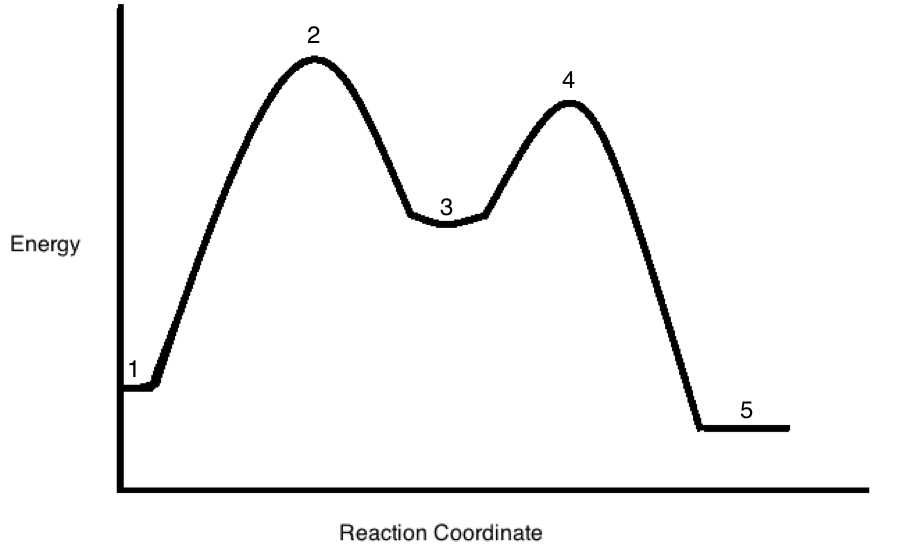
Using NMR, the scientist in the passage determines that there is a negative halide ion present in the products when the reaction reaches step 5. Which of the following factors would tend to raise the energy level at step 5?
For any given chemical reaction, one can draw an energy diagram. Energy diagrams depict the energy levels of the different steps in a reaction, while also indicating the net change in energy and giving clues to relative reaction rate.
Below, a reaction diagram is shown for a reaction that a scientist is studying in a lab. A student began the reaction the evening before, but the scientist is unsure as to the type of the reaction. He cannot find the student’s notes, except for the reaction diagram below.
Using NMR, the scientist in the passage determines that there is a negative halide ion present in the products when the reaction reaches step 5. Which of the following factors would tend to raise the energy level at step 5?
Tap to reveal answer
If the halide was flouride, it would have a negative charge dispersed over a smaller cross sectional area than if it was any of the other halides. Flouride is the smallest possible halide, and thus has the highest energy because it concentrates negative charge on the smallest area.
If the halide was flouride, it would have a negative charge dispersed over a smaller cross sectional area than if it was any of the other halides. Flouride is the smallest possible halide, and thus has the highest energy because it concentrates negative charge on the smallest area.
← Didn't Know|Knew It →