Resistivity
MCAT Chemical and Physical Foundations of Biological Systems · Learn by Concept
Help Questions
MCAT Chemical and Physical Foundations of Biological Systems › Resistivity
An electrician wishes to cut a copper wire 


960m
38m
9.6m
10cm
2.6cm
Explanation
To relate resistance R, resistivity 

Rearranging to isolate the quantity we wish to solve for, L, gives the equation 

Plugging in our numbers gives the answer, 960m.

Which of the following factors would decrease the resistance through an electrical cord?
Increasing the cross-sectional area of the cord
Decreasing the cross-sectional area of the cord
Increasing the length of the cord
Increasing the resistivity
Explanation
The equation for resistance is given by 
From this equation, we can see the best way to decrease resistance is by increasing the cross-sectional area, 


What is the current in a circuit with a 


Explanation
Resistors in serries add according to the formula:

Resistors in parallel add according to the formula:
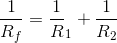
We can find the total equivalent resistance:
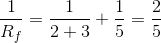

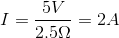
Now we can use Ohm's law to find the current:


Solve: