
Psychological Disorders and Anomalies - MCAT Psychological and Social Foundations
Card 1 of 160
Hallucinations, paranoia, and inappropriate behavior are associated with which of the following mental disorders?
Hallucinations, paranoia, and inappropriate behavior are associated with which of the following mental disorders?
Tap to reveal answer
Schizophrenia is a mental disorder where people perceive things without a stimulation—hallucinations. These people also suffer paranoid delusions, and their behaviors can be totally inappropriate. The development of distinctly separate personalities is called dissociative identity disorder (DID). People with schizophrenia do not have a split personality. People with bipolar disorder alternate between episodes of depression and mania. Trichotillomania is characterized by the repeated urge to pull out body hair. When there is no identifiable physical cause to explain physical disorders that are real to the patient, somatoform disorder may be diagnosed.
Schizophrenia is a mental disorder where people perceive things without a stimulation—hallucinations. These people also suffer paranoid delusions, and their behaviors can be totally inappropriate. The development of distinctly separate personalities is called dissociative identity disorder (DID). People with schizophrenia do not have a split personality. People with bipolar disorder alternate between episodes of depression and mania. Trichotillomania is characterized by the repeated urge to pull out body hair. When there is no identifiable physical cause to explain physical disorders that are real to the patient, somatoform disorder may be diagnosed.
← Didn't Know|Knew It →
People in their late teens and twenties who have incoherent and disorganized speech, hallucinations, and delusions are exhibiting the symptoms of .
People in their late teens and twenties who have incoherent and disorganized speech, hallucinations, and delusions are exhibiting the symptoms of .
Tap to reveal answer
People with schizophrenia have hallucinations, delusions, and difficulty concentrating. Symptoms of schizophrenia typically begin to appear in the late teens and twenties. Social phobias involve fear of being embarrassed in social situations. The most common is fear of public speaking. People with generalized anxiety disorder are frightened of something but are unable to speak about a specific fear. They develop physical fear reactions. Alterations of episodes of depression with episodes of mania is called bipolar disorder. The inability to resist and impulse to perform an action that is harmful to the individual or to others is an impulse control disorder. Examples are kleptomania and pyromania.
People with schizophrenia have hallucinations, delusions, and difficulty concentrating. Symptoms of schizophrenia typically begin to appear in the late teens and twenties. Social phobias involve fear of being embarrassed in social situations. The most common is fear of public speaking. People with generalized anxiety disorder are frightened of something but are unable to speak about a specific fear. They develop physical fear reactions. Alterations of episodes of depression with episodes of mania is called bipolar disorder. The inability to resist and impulse to perform an action that is harmful to the individual or to others is an impulse control disorder. Examples are kleptomania and pyromania.
← Didn't Know|Knew It →
Lithium is a medication that is effective in the treatment of .
Lithium is a medication that is effective in the treatment of .
Tap to reveal answer
The manic and depressive phases of bipolar disorder can be treated with the mood stabilizer lithium. Lithium is used for the prevention of future depression and suicide and for the prevention of future mania. Schizophrenia is treated with antipsychotic medications. Medications to reduce nightmares, insomnia, and startle reactions are used in the treatment of post-traumatic stress disorder. Benzodiazepines and selective serotonin reuptake inhibitors (SSRIs) are used to treat panic disorders. SSRIs are also used to treat obsessive-compulsive disorder.
The manic and depressive phases of bipolar disorder can be treated with the mood stabilizer lithium. Lithium is used for the prevention of future depression and suicide and for the prevention of future mania. Schizophrenia is treated with antipsychotic medications. Medications to reduce nightmares, insomnia, and startle reactions are used in the treatment of post-traumatic stress disorder. Benzodiazepines and selective serotonin reuptake inhibitors (SSRIs) are used to treat panic disorders. SSRIs are also used to treat obsessive-compulsive disorder.
← Didn't Know|Knew It →
A patient goes to her primary care doctor complaining of mood swings affecting her in such a way that she often feels either very "high" or very "low." She denies any thoughts of worthlessness or of hurting herself, doesn't have trouble concentrating on tasks, and has no psychotic episodes when she is "low." When feeling "high," she has increased energy and happiness. Her symptoms are indicative of which of the following mood disorders?
A patient goes to her primary care doctor complaining of mood swings affecting her in such a way that she often feels either very "high" or very "low." She denies any thoughts of worthlessness or of hurting herself, doesn't have trouble concentrating on tasks, and has no psychotic episodes when she is "low." When feeling "high," she has increased energy and happiness. Her symptoms are indicative of which of the following mood disorders?
Tap to reveal answer
Cyclothymic disorder is a mild form of bipolar disorder where a person mood swings over a period of years that go from mild depression to elevated mood and excitement.
Individuals with any form of bipolar disorder will most likely experience some psychotic episodes. During manic episodes, they will have delusions of grandeur, racing ideas and speech, distractibility and high-risk behaviors. They generally sleep and eat less often during these episodes as well. A patient with cyclothymic disorder lacks the vegetative symptoms associated with major depressive disorders. They can concentrate normally and lack both suicidal ideations and feelings of worthlessness when "low."
Cyclothymic disorder is a mild form of bipolar disorder where a person mood swings over a period of years that go from mild depression to elevated mood and excitement.
Individuals with any form of bipolar disorder will most likely experience some psychotic episodes. During manic episodes, they will have delusions of grandeur, racing ideas and speech, distractibility and high-risk behaviors. They generally sleep and eat less often during these episodes as well. A patient with cyclothymic disorder lacks the vegetative symptoms associated with major depressive disorders. They can concentrate normally and lack both suicidal ideations and feelings of worthlessness when "low."
← Didn't Know|Knew It →
People who are impulsive, unstable in mood, and manipulative are exhibiting the symptoms of .
People who are impulsive, unstable in mood, and manipulative are exhibiting the symptoms of .
Tap to reveal answer
Borderline personality disorder is a diagnosis in people who are impulsive, unstable in mood, and manipulative. They can be charming and friendly one minute and angry, irritable, and sarcastic the next. People who need to escape from extreme trauma, most often from sexual or physical abuse in childhood, may develop distinct different personalities. This is termed dissociative identity disorder. People who lie, cheat, steal, and have no sense of responsibility and no anxiety of guilt about their behavior are described as having an antisocial personality disorder. People with schizophrenia experience hallucinations and delusions. Generalized anxiety disorder consists of persistent, excessive worrying and uncontrolled anxiety that has lasted for at least six months.
Borderline personality disorder is a diagnosis in people who are impulsive, unstable in mood, and manipulative. They can be charming and friendly one minute and angry, irritable, and sarcastic the next. People who need to escape from extreme trauma, most often from sexual or physical abuse in childhood, may develop distinct different personalities. This is termed dissociative identity disorder. People who lie, cheat, steal, and have no sense of responsibility and no anxiety of guilt about their behavior are described as having an antisocial personality disorder. People with schizophrenia experience hallucinations and delusions. Generalized anxiety disorder consists of persistent, excessive worrying and uncontrolled anxiety that has lasted for at least six months.
← Didn't Know|Knew It →
A 24 year old male experiences difficulty forming healthy adult relationships. He has extreme reactions when someone disagrees with him, and may scream or accuse people of abandoning or betraying him. He has an explosive temper and can behave in self-destructive ways, such as driving while intoxicated, binge eating, and engaging in self-deprecating speech. His family states that he tends to form unhealthy opinions of others: he will make a new friend who he puts onto a pedestal, then he will demonize that same individual when they fail to meet his expectations.
This individual is exhibiting symptoms of which of the following personality disorders?
A 24 year old male experiences difficulty forming healthy adult relationships. He has extreme reactions when someone disagrees with him, and may scream or accuse people of abandoning or betraying him. He has an explosive temper and can behave in self-destructive ways, such as driving while intoxicated, binge eating, and engaging in self-deprecating speech. His family states that he tends to form unhealthy opinions of others: he will make a new friend who he puts onto a pedestal, then he will demonize that same individual when they fail to meet his expectations.
This individual is exhibiting symptoms of which of the following personality disorders?
Tap to reveal answer
"Borderline personality disorder" is characterized by difficulty regulating behavior or thoughts, extreme fluctuations in mood, unstable relationships due to idealization or demonization, fear of abandonment or other attachment disorders, and impulsive or reckless behavior.
The other choices are incorrect. "Obsessive-compulsive disorder" is typified by repetitive, unwelcome thoughts that compel the individual to perform ritualistic acts. "Paranoid personality disorder" is a condition of pervasive, long-standing paranoia and general mistrust of others. "Schizotypal personality disorder" is an antisocial disorder: individuals experience social anxiety, the urge to isolate themselves from others, and odd behavior or beliefs.
"Borderline personality disorder" is characterized by difficulty regulating behavior or thoughts, extreme fluctuations in mood, unstable relationships due to idealization or demonization, fear of abandonment or other attachment disorders, and impulsive or reckless behavior.
The other choices are incorrect. "Obsessive-compulsive disorder" is typified by repetitive, unwelcome thoughts that compel the individual to perform ritualistic acts. "Paranoid personality disorder" is a condition of pervasive, long-standing paranoia and general mistrust of others. "Schizotypal personality disorder" is an antisocial disorder: individuals experience social anxiety, the urge to isolate themselves from others, and odd behavior or beliefs.
← Didn't Know|Knew It →
Which of the following is not a common symptom in borderline personality disorder?
Which of the following is not a common symptom in borderline personality disorder?
Tap to reveal answer
The DSM IV criteria for diagnosis of borderline personality disorder includes at least five of the following symptoms:
- Extreme reactions to abandonment, real or perceived
- A pattern of tumultuous relationships with family, friends, and romantic interests, often vacillating from extreme idealization to extreme dislike or devaluation.
- Distorted and unstable self-image, which can result in sudden changes in feelings, opinions, values, plans, or goals
- Impulsive and destructive behaviors, such as spending sprees, unsafe sex, substance abuse, reckless driving, and binge eating
- Recurring suicidal behaviors or self-harming behavior
- Intense and highly changeable moods
- Chronic feelings of emptiness and/or boredom
- Inappropriate, intense anger or problems controlling anger
- Having stress-related paranoid thoughts or severe dissociative symptoms, such as feeling cut off from oneself, observing oneself from outside the body, or losing touch with reality.
The DSM IV criteria for diagnosis of borderline personality disorder includes at least five of the following symptoms:
- Extreme reactions to abandonment, real or perceived
- A pattern of tumultuous relationships with family, friends, and romantic interests, often vacillating from extreme idealization to extreme dislike or devaluation.
- Distorted and unstable self-image, which can result in sudden changes in feelings, opinions, values, plans, or goals
- Impulsive and destructive behaviors, such as spending sprees, unsafe sex, substance abuse, reckless driving, and binge eating
- Recurring suicidal behaviors or self-harming behavior
- Intense and highly changeable moods
- Chronic feelings of emptiness and/or boredom
- Inappropriate, intense anger or problems controlling anger
- Having stress-related paranoid thoughts or severe dissociative symptoms, such as feeling cut off from oneself, observing oneself from outside the body, or losing touch with reality.
← Didn't Know|Knew It →
Which of the following is most closely linked to Parkinson's Disease?
Which of the following is most closely linked to Parkinson's Disease?
Tap to reveal answer
Parkinson's is a degenerative neuromuscular disease, often associated with muscular tremors and shaking. In later stages, the neurological symptoms become more evident. While the exact cause of Parkinson's Disease is unknown (it is still considered idiopathic), there are correlations that suggest the cause is linked to the death of dopaminergic neurons in the substantia nigra region of the midbrain. Beta-amyloid protein plaques are also associated with Parkinson's Disease, as well as Alzheimer's Disease.
Parkinson's is a degenerative neuromuscular disease, often associated with muscular tremors and shaking. In later stages, the neurological symptoms become more evident. While the exact cause of Parkinson's Disease is unknown (it is still considered idiopathic), there are correlations that suggest the cause is linked to the death of dopaminergic neurons in the substantia nigra region of the midbrain. Beta-amyloid protein plaques are also associated with Parkinson's Disease, as well as Alzheimer's Disease.
← Didn't Know|Knew It →
Parkinson's disease is a progressive disorder of which system?
Parkinson's disease is a progressive disorder of which system?
Tap to reveal answer
The correct asnwer is the nervous system; this is what causes the tremors commonly associated with Parkinson's disease.
The correct asnwer is the nervous system; this is what causes the tremors commonly associated with Parkinson's disease.
← Didn't Know|Knew It →
Treatment for Alzheimer's disease involves the use of cholinergic drugs that are aimed at .
Treatment for Alzheimer's disease involves the use of cholinergic drugs that are aimed at .
Tap to reveal answer
Cholinergic drugs used for the treatment of Alzheimer's disease are used to improve memory rather than to cure the disease. These drugs can slow the decline in cognitive function. Patients in the early stages of the disease can benefit from reality orientation, which involves the repetition of verbal and nonverbal information to remind the person of names, dates, and other pertinent information. Alzheimer's disease is a progressive degenerative cognitive disorder. Although motor capabilities are assessed, the disease primarily involves loss of cognition, not motor function. If a patient is experiencing sleep disturbances, sleeping during daytime hours is discouraged.
Cholinergic drugs used for the treatment of Alzheimer's disease are used to improve memory rather than to cure the disease. These drugs can slow the decline in cognitive function. Patients in the early stages of the disease can benefit from reality orientation, which involves the repetition of verbal and nonverbal information to remind the person of names, dates, and other pertinent information. Alzheimer's disease is a progressive degenerative cognitive disorder. Although motor capabilities are assessed, the disease primarily involves loss of cognition, not motor function. If a patient is experiencing sleep disturbances, sleeping during daytime hours is discouraged.
← Didn't Know|Knew It →
Which of the following proteins become "tangled" in Alzheimer's disease patients?
Which of the following proteins become "tangled" in Alzheimer's disease patients?
Tap to reveal answer
"Tau proteins," proteins that aid in the cellular transport system of neurons, often become tangled in the brains of Alzheimer's disease, resulting in loss of cellular nutrient and waste transport and eventual cell death.
The other choices are incorrect. "Prion proteins" are found in various prion diseases such as bovine spongiform encephalopathy. "Lewy bodies" are symptomatic of Parkinson's disease, while "C-reactive proteins" are elevated in any condition associated with inflammation.
"Tau proteins," proteins that aid in the cellular transport system of neurons, often become tangled in the brains of Alzheimer's disease, resulting in loss of cellular nutrient and waste transport and eventual cell death.
The other choices are incorrect. "Prion proteins" are found in various prion diseases such as bovine spongiform encephalopathy. "Lewy bodies" are symptomatic of Parkinson's disease, while "C-reactive proteins" are elevated in any condition associated with inflammation.
← Didn't Know|Knew It →
Lithium is a medication that is effective in the treatment of .
Lithium is a medication that is effective in the treatment of .
Tap to reveal answer
The manic and depressive phases of bipolar disorder can be treated with the mood stabilizer lithium. Lithium is used for the prevention of future depression and suicide and for the prevention of future mania. Schizophrenia is treated with antipsychotic medications. Medications to reduce nightmares, insomnia, and startle reactions are used in the treatment of post-traumatic stress disorder. Benzodiazepines and selective serotonin reuptake inhibitors (SSRIs) are used to treat panic disorders. SSRIs are also used to treat obsessive-compulsive disorder.
The manic and depressive phases of bipolar disorder can be treated with the mood stabilizer lithium. Lithium is used for the prevention of future depression and suicide and for the prevention of future mania. Schizophrenia is treated with antipsychotic medications. Medications to reduce nightmares, insomnia, and startle reactions are used in the treatment of post-traumatic stress disorder. Benzodiazepines and selective serotonin reuptake inhibitors (SSRIs) are used to treat panic disorders. SSRIs are also used to treat obsessive-compulsive disorder.
← Didn't Know|Knew It →
A patient goes to her primary care doctor complaining of mood swings affecting her in such a way that she often feels either very "high" or very "low." She denies any thoughts of worthlessness or of hurting herself, doesn't have trouble concentrating on tasks, and has no psychotic episodes when she is "low." When feeling "high," she has increased energy and happiness. Her symptoms are indicative of which of the following mood disorders?
A patient goes to her primary care doctor complaining of mood swings affecting her in such a way that she often feels either very "high" or very "low." She denies any thoughts of worthlessness or of hurting herself, doesn't have trouble concentrating on tasks, and has no psychotic episodes when she is "low." When feeling "high," she has increased energy and happiness. Her symptoms are indicative of which of the following mood disorders?
Tap to reveal answer
Cyclothymic disorder is a mild form of bipolar disorder where a person mood swings over a period of years that go from mild depression to elevated mood and excitement.
Individuals with any form of bipolar disorder will most likely experience some psychotic episodes. During manic episodes, they will have delusions of grandeur, racing ideas and speech, distractibility and high-risk behaviors. They generally sleep and eat less often during these episodes as well. A patient with cyclothymic disorder lacks the vegetative symptoms associated with major depressive disorders. They can concentrate normally and lack both suicidal ideations and feelings of worthlessness when "low."
Cyclothymic disorder is a mild form of bipolar disorder where a person mood swings over a period of years that go from mild depression to elevated mood and excitement.
Individuals with any form of bipolar disorder will most likely experience some psychotic episodes. During manic episodes, they will have delusions of grandeur, racing ideas and speech, distractibility and high-risk behaviors. They generally sleep and eat less often during these episodes as well. A patient with cyclothymic disorder lacks the vegetative symptoms associated with major depressive disorders. They can concentrate normally and lack both suicidal ideations and feelings of worthlessness when "low."
← Didn't Know|Knew It →
If a patient were diagnosed with claustrophobia, then which area of their brain would show increased activity in an MRI study?
If a patient were diagnosed with claustrophobia, then which area of their brain would show increased activity in an MRI study?
Tap to reveal answer
The amygdala, along with the insular cortex and the limbic system, demonstrates hyperactivity when a person experiences high levels of fear and/or anxiety, and would show hyperactivity in a patient with an anxiety disorder.
On the other hand, the other choices are incorrect. For example, Wernicke's area is associated with comprehension of spoken language, while the occipital lobe is associated with visual perception. Last, the parietal lobe helps integrate various forms of sensory input with each other to create an understanding of the world.
The amygdala, along with the insular cortex and the limbic system, demonstrates hyperactivity when a person experiences high levels of fear and/or anxiety, and would show hyperactivity in a patient with an anxiety disorder.
On the other hand, the other choices are incorrect. For example, Wernicke's area is associated with comprehension of spoken language, while the occipital lobe is associated with visual perception. Last, the parietal lobe helps integrate various forms of sensory input with each other to create an understanding of the world.
← Didn't Know|Knew It →
A study done recently showed that several management approaches, in addition to behavioral therapy interventions, may be necessary in preschool-aged children with moderate to severe attention-deficit/hyperactivity disorder (ADHD). That is, medication and some alternative therapies may be needed for preschool-aged children with ADHD who do not respond or do not follow behavior therapy. The researchers evaluated disruptive behavior in 74 children four to five years of age who were followed for 24 months. The children were randomized to either behavior therapy plus placebo or behavior therapy plus methylphenidate, and ADHD-related behaviors were compared. Parents reported ADHD symptoms observed at 6, 12, and 24 months. The researchers also noted several signs and symptoms of adverse effects that may have been due to the medication, such as insomnia, anorexia, irritability, and reduced growth and weight gain. The researchers found the children who received behavior therapy plus methylphenidate had significant reductions in ADHD symptoms at all time points compared to children who received behavior therapy plus placebo.
Severity of ADHD was taken into account by presence of symptoms of marked impairment in social functioning. The researchers eliminated the possible role of delays in social development not specific to ADHD by analyzing children whose symptoms of social functioning impairment clearly resulted from inattention, hyperactivity, and impulsivity. Specifically, inattention was identified as the child wandering off task that was not due to lack of understanding or disobedience; hyperactivity was identified as excessive talking or fidgeting when not appropriate; and impulsivity was identified as hasty actions without forethought by the child and with significant potential to harm the child. Symptoms affecting the relationship and mental health of the child’s parents were also treated as reflective of severity of ADHD. For example, parents who experienced majorly reduced psychological well-being as a result of their child’s behavior reflected severe ADHD, and from the results, parents of children with severe ADHD who received behavior therapy plus methylphenidate reported a significant reduction in feeling unable to handle stress because of child’s behavior.
One of the researchers also found that use of some alternative therapies may be supported when combined with behavior therapy. In particular, there were decreases in hyperactive behaviors in children who were placed on additive-free diets. This finding may be of particular significance because eliminating artificial food additives may be done without risk of safety and avoids the potential adverse effects of medication.
Which conclusion is best supported by the findings in the study?
A study done recently showed that several management approaches, in addition to behavioral therapy interventions, may be necessary in preschool-aged children with moderate to severe attention-deficit/hyperactivity disorder (ADHD). That is, medication and some alternative therapies may be needed for preschool-aged children with ADHD who do not respond or do not follow behavior therapy. The researchers evaluated disruptive behavior in 74 children four to five years of age who were followed for 24 months. The children were randomized to either behavior therapy plus placebo or behavior therapy plus methylphenidate, and ADHD-related behaviors were compared. Parents reported ADHD symptoms observed at 6, 12, and 24 months. The researchers also noted several signs and symptoms of adverse effects that may have been due to the medication, such as insomnia, anorexia, irritability, and reduced growth and weight gain. The researchers found the children who received behavior therapy plus methylphenidate had significant reductions in ADHD symptoms at all time points compared to children who received behavior therapy plus placebo.
Severity of ADHD was taken into account by presence of symptoms of marked impairment in social functioning. The researchers eliminated the possible role of delays in social development not specific to ADHD by analyzing children whose symptoms of social functioning impairment clearly resulted from inattention, hyperactivity, and impulsivity. Specifically, inattention was identified as the child wandering off task that was not due to lack of understanding or disobedience; hyperactivity was identified as excessive talking or fidgeting when not appropriate; and impulsivity was identified as hasty actions without forethought by the child and with significant potential to harm the child. Symptoms affecting the relationship and mental health of the child’s parents were also treated as reflective of severity of ADHD. For example, parents who experienced majorly reduced psychological well-being as a result of their child’s behavior reflected severe ADHD, and from the results, parents of children with severe ADHD who received behavior therapy plus methylphenidate reported a significant reduction in feeling unable to handle stress because of child’s behavior.
One of the researchers also found that use of some alternative therapies may be supported when combined with behavior therapy. In particular, there were decreases in hyperactive behaviors in children who were placed on additive-free diets. This finding may be of particular significance because eliminating artificial food additives may be done without risk of safety and avoids the potential adverse effects of medication.
Which conclusion is best supported by the findings in the study?
Tap to reveal answer
Methylphenidate shows an early response when added to behavior therapy is the correct answer. Attention-deficit/hyperactivity disorder is a neurodevelopmental disorder characterized by persistent patterns of inattention, hyperactivity, and impulsivity. The history must reveal that symptoms of inattention or hyperactivity and impulsivity are present in more than one setting, as symptoms may be absent when the patient is interacting in the clinician's office. Evidence-based behavior therapy should be prescribed as the first line of therapy for preschool-aged children, and stimulant medications may be prescribed for the preschooler with severe ADHD or inadequate response to behavior therapy.
Methylphenidate shows an early response when added to behavior therapy is the correct answer. Attention-deficit/hyperactivity disorder is a neurodevelopmental disorder characterized by persistent patterns of inattention, hyperactivity, and impulsivity. The history must reveal that symptoms of inattention or hyperactivity and impulsivity are present in more than one setting, as symptoms may be absent when the patient is interacting in the clinician's office. Evidence-based behavior therapy should be prescribed as the first line of therapy for preschool-aged children, and stimulant medications may be prescribed for the preschooler with severe ADHD or inadequate response to behavior therapy.
← Didn't Know|Knew It →
A study done recently showed that several management approaches, in addition to behavioral therapy interventions, may be necessary in preschool-aged children with moderate to severe attention-deficit/hyperactivity disorder (ADHD). That is, medication and some alternative therapies may be needed for preschool-aged children with ADHD who do not respond or do not follow behavior therapy. The researchers evaluated disruptive behavior in 74 children four to five years of age who were followed for 24 months. The children were randomized to either behavior therapy plus placebo or behavior therapy plus methylphenidate, and ADHD-related behaviors were compared. Parents reported ADHD symptoms observed at 6, 12, and 24 months. The researchers also noted several signs and symptoms of adverse effects that may have been due to the medication, such as insomnia, anorexia, irritability, and reduced growth and weight gain. The researchers found the children who received behavior therapy plus methylphenidate had significant reductions in ADHD symptoms at all time points compared to children who received behavior therapy plus placebo.
Severity of ADHD was taken into account by presence of symptoms of marked impairment in social functioning. The researchers eliminated the possible role of delays in social development not specific to ADHD by analyzing children whose symptoms of social functioning impairment clearly resulted from inattention, hyperactivity, and impulsivity. Specifically, inattention was identified as the child wandering off task that was not due to lack of understanding or disobedience; hyperactivity was identified as excessive talking or fidgeting when not appropriate; and impulsivity was identified as hasty actions without forethought by the child and with significant potential to harm the child. Symptoms affecting the relationship and mental health of the child’s parents were also treated as reflective of severity of ADHD. For example, parents who experienced majorly reduced psychological well-being as a result of their child’s behavior reflected severe ADHD, and from the results, parents of children with severe ADHD who received behavior therapy plus methylphenidate reported a significant reduction in feeling unable to handle stress because of child’s behavior.
One of the researchers also found that use of some alternative therapies may be supported when combined with behavior therapy. In particular, there were decreases in hyperactive behaviors in children who were placed on additive-free diets. This finding may be of particular significance because eliminating artificial food additives may be done without risk of safety and avoids the potential adverse effects of medication.
Which of the following is not a reasonable recommendation to provide for the management of moderate to severe ADHD?
A study done recently showed that several management approaches, in addition to behavioral therapy interventions, may be necessary in preschool-aged children with moderate to severe attention-deficit/hyperactivity disorder (ADHD). That is, medication and some alternative therapies may be needed for preschool-aged children with ADHD who do not respond or do not follow behavior therapy. The researchers evaluated disruptive behavior in 74 children four to five years of age who were followed for 24 months. The children were randomized to either behavior therapy plus placebo or behavior therapy plus methylphenidate, and ADHD-related behaviors were compared. Parents reported ADHD symptoms observed at 6, 12, and 24 months. The researchers also noted several signs and symptoms of adverse effects that may have been due to the medication, such as insomnia, anorexia, irritability, and reduced growth and weight gain. The researchers found the children who received behavior therapy plus methylphenidate had significant reductions in ADHD symptoms at all time points compared to children who received behavior therapy plus placebo.
Severity of ADHD was taken into account by presence of symptoms of marked impairment in social functioning. The researchers eliminated the possible role of delays in social development not specific to ADHD by analyzing children whose symptoms of social functioning impairment clearly resulted from inattention, hyperactivity, and impulsivity. Specifically, inattention was identified as the child wandering off task that was not due to lack of understanding or disobedience; hyperactivity was identified as excessive talking or fidgeting when not appropriate; and impulsivity was identified as hasty actions without forethought by the child and with significant potential to harm the child. Symptoms affecting the relationship and mental health of the child’s parents were also treated as reflective of severity of ADHD. For example, parents who experienced majorly reduced psychological well-being as a result of their child’s behavior reflected severe ADHD, and from the results, parents of children with severe ADHD who received behavior therapy plus methylphenidate reported a significant reduction in feeling unable to handle stress because of child’s behavior.
One of the researchers also found that use of some alternative therapies may be supported when combined with behavior therapy. In particular, there were decreases in hyperactive behaviors in children who were placed on additive-free diets. This finding may be of particular significance because eliminating artificial food additives may be done without risk of safety and avoids the potential adverse effects of medication.
Which of the following is not a reasonable recommendation to provide for the management of moderate to severe ADHD?
Tap to reveal answer
ADHD symptoms may be associated with artificial food additives in diet, so behavior therapy may be avoided by adhering to additive-free diet is the correct answer. Behavior therapy should be prescribed for all preschool-aged children as treatment for ADHD. Stimulant medications may be prescribed for moderate to severe ADHD and when behavior therapy fails to provide improvement in ADHD symptoms.
ADHD symptoms may be associated with artificial food additives in diet, so behavior therapy may be avoided by adhering to additive-free diet is the correct answer. Behavior therapy should be prescribed for all preschool-aged children as treatment for ADHD. Stimulant medications may be prescribed for moderate to severe ADHD and when behavior therapy fails to provide improvement in ADHD symptoms.
← Didn't Know|Knew It →
Which of the following psychological disorders listed would be categorized as dissociative disorders?
I. Schizophrenia
II. Schizoid personality disorder
III. Depersonalization disorder
IV. Post-traumatic stress disorder
Which of the following psychological disorders listed would be categorized as dissociative disorders?
I. Schizophrenia
II. Schizoid personality disorder
III. Depersonalization disorder
IV. Post-traumatic stress disorder
Tap to reveal answer
Dissociative disorders are characterized by periods of altered mental status (e.g. disruptions in memory, perception, self-identity, and/or awareness) that occur frequently enough to disrupt a person's ability to function normally. They are thought to be potential results of psychological trauma, but may also result from medication and/or drug use. Dissociative identity disorder, dissociative amnesia, and depersonalization disorder are all considered dissociative disorders.
On the other hand, schizophrenia is a psychotic disorder; although it may include occasional episodes of dissociation, the episodes where individuals lose touch with reality are characterized more by delusions and hallucinations, not a loss of memory or awareness. Individuals with schizoid personality disorder—which is a personality disorder, not a dissociative disorder—have little interest in close relationships with others and are generally "cold" or detached in affect. Post-traumatic stress disorder is an anxiety disorder characterized by sudden episodes of worry, unease, apprehension, and fear due to some emotional trigger that causes flashbacks to the traumatic event and hyperarousal during the event.
Dissociative disorders are characterized by periods of altered mental status (e.g. disruptions in memory, perception, self-identity, and/or awareness) that occur frequently enough to disrupt a person's ability to function normally. They are thought to be potential results of psychological trauma, but may also result from medication and/or drug use. Dissociative identity disorder, dissociative amnesia, and depersonalization disorder are all considered dissociative disorders.
On the other hand, schizophrenia is a psychotic disorder; although it may include occasional episodes of dissociation, the episodes where individuals lose touch with reality are characterized more by delusions and hallucinations, not a loss of memory or awareness. Individuals with schizoid personality disorder—which is a personality disorder, not a dissociative disorder—have little interest in close relationships with others and are generally "cold" or detached in affect. Post-traumatic stress disorder is an anxiety disorder characterized by sudden episodes of worry, unease, apprehension, and fear due to some emotional trigger that causes flashbacks to the traumatic event and hyperarousal during the event.
← Didn't Know|Knew It →
Which of the following best represents a class of psychiatric disorders in which an individual knowingly fabricates or exaggerates illness in order to receive medical treatment, sympathy, or care?
Which of the following best represents a class of psychiatric disorders in which an individual knowingly fabricates or exaggerates illness in order to receive medical treatment, sympathy, or care?
Tap to reveal answer
“Factitious disorders” are psychiatric or behavioral conditions in which an individual knowingly fabricates or exaggerates illness in order to receive medical treatment, sympathy, or care. Factitious disorders are distinguished from “hypochondriasis,” “conversion disorders,” and “somatic symptom disorders” in that the individual is consciously creating their symptoms, while in the other disorders listed they are not.
“Factitious disorders” are psychiatric or behavioral conditions in which an individual knowingly fabricates or exaggerates illness in order to receive medical treatment, sympathy, or care. Factitious disorders are distinguished from “hypochondriasis,” “conversion disorders,” and “somatic symptom disorders” in that the individual is consciously creating their symptoms, while in the other disorders listed they are not.
← Didn't Know|Knew It →
Excerpt from "The Chicago Employment Agency and the Immigrant Worker," Grace Abbott, American Journal of Sociology 1908 14:3, 289-305
In the late nineteenth and early twentieth centuries, immigrants poured into the United States without knowledge of English or American customs. They were also usually unaware of the local cost of living or typical wage. These immigrants turned to employment agencies that would help them find work, for a fee. The extreme dependence of immigrants on the employment agencies coupled with their general ignorance of the American system brought about an ethical dilemma for the employment agent in which it became very easy to take advantage of people seeking a job. This resulted in an extreme prejudice directed at immigrants by the American employment system. A study was conducted in the early 1900s gauged the degree of corruption among employment agents and the results of this study have been provided (see Tables 1, 2, and 3)
Table 1
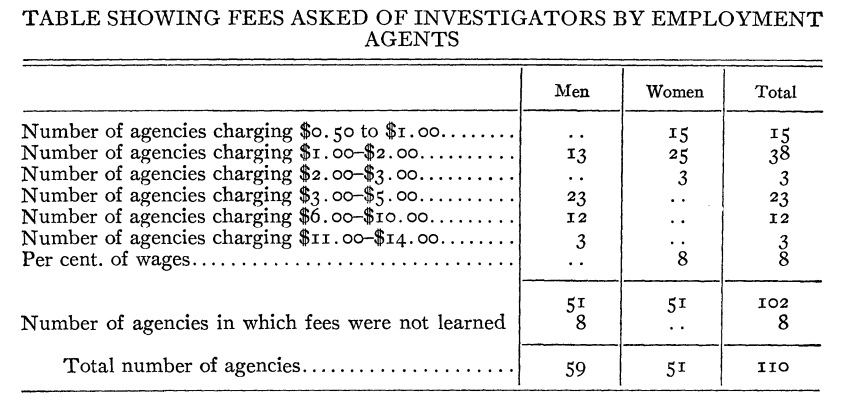
Table 2

Table 3

Levels of depression also increase in areas of high unemployment. The two variables, depression and unemployment, interact with each other via a third variable: stress hormones. In this situation, what type of variable is represented by this third variable?
Excerpt from "The Chicago Employment Agency and the Immigrant Worker," Grace Abbott, American Journal of Sociology 1908 14:3, 289-305
In the late nineteenth and early twentieth centuries, immigrants poured into the United States without knowledge of English or American customs. They were also usually unaware of the local cost of living or typical wage. These immigrants turned to employment agencies that would help them find work, for a fee. The extreme dependence of immigrants on the employment agencies coupled with their general ignorance of the American system brought about an ethical dilemma for the employment agent in which it became very easy to take advantage of people seeking a job. This resulted in an extreme prejudice directed at immigrants by the American employment system. A study was conducted in the early 1900s gauged the degree of corruption among employment agents and the results of this study have been provided (see Tables 1, 2, and 3)
Table 1
Table 2
Table 3
Levels of depression also increase in areas of high unemployment. The two variables, depression and unemployment, interact with each other via a third variable: stress hormones. In this situation, what type of variable is represented by this third variable?
Tap to reveal answer
In this case, unemployment can trigger feelings of stress, in which stress hormones are released, which can lead to depression. The unemployment itself doesn’t directly cause depression, it works through the mediating variable of stress hormones. A confounding variable is one that makes effects of one variable on another unclear. Independent variables are modified manually, but natural stress hormone levels cannot be manually modified. A discrete variable is one that can only have integer values, such as day of the month.
In this case, unemployment can trigger feelings of stress, in which stress hormones are released, which can lead to depression. The unemployment itself doesn’t directly cause depression, it works through the mediating variable of stress hormones. A confounding variable is one that makes effects of one variable on another unclear. Independent variables are modified manually, but natural stress hormone levels cannot be manually modified. A discrete variable is one that can only have integer values, such as day of the month.
← Didn't Know|Knew It →
Which of the following psychological disorders listed would be categorized as dissociative disorders?
I. Schizophrenia
II. Schizoid personality disorder
III. Depersonalization disorder
IV. Post-traumatic stress disorder
Which of the following psychological disorders listed would be categorized as dissociative disorders?
I. Schizophrenia
II. Schizoid personality disorder
III. Depersonalization disorder
IV. Post-traumatic stress disorder
Tap to reveal answer
Dissociative disorders are characterized by periods of altered mental status (e.g. disruptions in memory, perception, self-identity, and/or awareness) that occur frequently enough to disrupt a person's ability to function normally. They are thought to be potential results of psychological trauma, but may also result from medication and/or drug use. Dissociative identity disorder, dissociative amnesia, and depersonalization disorder are all considered dissociative disorders.
On the other hand, schizophrenia is a psychotic disorder; although it may include occasional episodes of dissociation, the episodes where individuals lose touch with reality are characterized more by delusions and hallucinations, not a loss of memory or awareness. Individuals with schizoid personality disorder—which is a personality disorder, not a dissociative disorder—have little interest in close relationships with others and are generally "cold" or detached in affect. Post-traumatic stress disorder is an anxiety disorder characterized by sudden episodes of worry, unease, apprehension, and fear due to some emotional trigger that causes flashbacks to the traumatic event and hyperarousal during the event.
Dissociative disorders are characterized by periods of altered mental status (e.g. disruptions in memory, perception, self-identity, and/or awareness) that occur frequently enough to disrupt a person's ability to function normally. They are thought to be potential results of psychological trauma, but may also result from medication and/or drug use. Dissociative identity disorder, dissociative amnesia, and depersonalization disorder are all considered dissociative disorders.
On the other hand, schizophrenia is a psychotic disorder; although it may include occasional episodes of dissociation, the episodes where individuals lose touch with reality are characterized more by delusions and hallucinations, not a loss of memory or awareness. Individuals with schizoid personality disorder—which is a personality disorder, not a dissociative disorder—have little interest in close relationships with others and are generally "cold" or detached in affect. Post-traumatic stress disorder is an anxiety disorder characterized by sudden episodes of worry, unease, apprehension, and fear due to some emotional trigger that causes flashbacks to the traumatic event and hyperarousal during the event.
← Didn't Know|Knew It →