
Pharmacology - NCLEX-PN
Card 1 of 2292
You are taking care of a patient undergoing chemotherapy for breast cancer and she complains of nausea. Her physician prescribes her ondansetron for nausea relief. What is the mechanism of action of ondansetron?
You are taking care of a patient undergoing chemotherapy for breast cancer and she complains of nausea. Her physician prescribes her ondansetron for nausea relief. What is the mechanism of action of ondansetron?
Tap to reveal answer
The correct answer is "Serotonin 5HT-3 receptor antagonist."
Ondansetron functions by antagonizing the serotonergic 5HT-3 receptors both centrally in the brain and peripherally at vagal nerve endings. It is frequently given as an anti-nausea and anti-emetic agent for patients with cancer undergoing chemotherapy and/or radiation therapy, as well as in post-operative patients, and for patients with gastroenteritis, among other uses.
Ondansetron is neither a full nor a partial agonist of the 5HT-3 receptors, making those answer choices incorrect.
Metaclopramide, which is another anti-nausea agent, is an anatagonist of the dopamine D2 receptor, but ondansetron is not, so this choice is incorrect. Neither metaclopramide nor ondansetron is an agonist of the dopamine D2 receptor.
The correct answer is "Serotonin 5HT-3 receptor antagonist."
Ondansetron functions by antagonizing the serotonergic 5HT-3 receptors both centrally in the brain and peripherally at vagal nerve endings. It is frequently given as an anti-nausea and anti-emetic agent for patients with cancer undergoing chemotherapy and/or radiation therapy, as well as in post-operative patients, and for patients with gastroenteritis, among other uses.
Ondansetron is neither a full nor a partial agonist of the 5HT-3 receptors, making those answer choices incorrect.
Metaclopramide, which is another anti-nausea agent, is an anatagonist of the dopamine D2 receptor, but ondansetron is not, so this choice is incorrect. Neither metaclopramide nor ondansetron is an agonist of the dopamine D2 receptor.
← Didn't Know|Knew It →
You start a patient in the intensive care unit on a drip of phenylephrine, as the patient is persistently hypotensive. You think that this will raise the patient's blood pressure because phenylephrine's primary mechanism of action is which of the following?
You start a patient in the intensive care unit on a drip of phenylephrine, as the patient is persistently hypotensive. You think that this will raise the patient's blood pressure because phenylephrine's primary mechanism of action is which of the following?
Tap to reveal answer
The correct answer is "alpha-1 adrenergic agonist."
Phenylephrine is frequently administered in the intensive care unit setting for patients with hypotension that is refractory to simple fluid resuscitation. It is a vasopressor, as its mechanism of action is to serve as an alpha-1 adrenergic agonist.
The other choices are incorrect, as they represent the primary mechanisms of action of a handful of medications other than phenylephrine.
An example of an alpha-2 adrenergic agonist would be methyldopa.
An example of a beta-1 adrenergic agonist would be dobutamine.
An example of a beta-2 adrenergic agonist would be albuterol.
An example of a beta-1 adrenergic antagonist would be atenolol.
The correct answer is "alpha-1 adrenergic agonist."
Phenylephrine is frequently administered in the intensive care unit setting for patients with hypotension that is refractory to simple fluid resuscitation. It is a vasopressor, as its mechanism of action is to serve as an alpha-1 adrenergic agonist.
The other choices are incorrect, as they represent the primary mechanisms of action of a handful of medications other than phenylephrine.
An example of an alpha-2 adrenergic agonist would be methyldopa.
An example of a beta-1 adrenergic agonist would be dobutamine.
An example of a beta-2 adrenergic agonist would be albuterol.
An example of a beta-1 adrenergic antagonist would be atenolol.
← Didn't Know|Knew It →
You are the nurse taking care of a patient with asthma. The patient reports using his albuterol inhaler about once a month for wheezing and shortness of breath. Albuterol functions by which of the following mechanisms of action?
You are the nurse taking care of a patient with asthma. The patient reports using his albuterol inhaler about once a month for wheezing and shortness of breath. Albuterol functions by which of the following mechanisms of action?
Tap to reveal answer
The correct answer is "Beta-2 adrenergic receptor agonist."
This question tests your knowledge of the mechanism of action of albuterol, a short-acting medication, frequently used in the treatment of acute asthma flares. Albuterol is an agonist of the Beta-2 adrenergic receptor in the bronchial smooth muscle, which helps to dilate the bronchioles, often providing relief to patients who are suffering from asthma flares, as bronchospasm plays a large role in causing their symptoms. Additional effects of albuterol include increased heart rate, increased insulin release, and vasodilation among others.
An example of a beta-1 adrenergic agonist would be dobutamine.
An example of a beta-1 adrenergic antagonist would be atenolol.
An example of a beta-2 adrenergic antagonist would be butoxamine.
An example of an alpha-1 adrenergic agonist would be phenylephrine.
The correct answer is "Beta-2 adrenergic receptor agonist."
This question tests your knowledge of the mechanism of action of albuterol, a short-acting medication, frequently used in the treatment of acute asthma flares. Albuterol is an agonist of the Beta-2 adrenergic receptor in the bronchial smooth muscle, which helps to dilate the bronchioles, often providing relief to patients who are suffering from asthma flares, as bronchospasm plays a large role in causing their symptoms. Additional effects of albuterol include increased heart rate, increased insulin release, and vasodilation among others.
An example of a beta-1 adrenergic agonist would be dobutamine.
An example of a beta-1 adrenergic antagonist would be atenolol.
An example of a beta-2 adrenergic antagonist would be butoxamine.
An example of an alpha-1 adrenergic agonist would be phenylephrine.
← Didn't Know|Knew It →
You are a nurse at a gastroenterology practice and your patient is being started on ranitidine for gastroesophageal reflux disease (GERD). Which of the following describes the mechanism of action of ranitidine?
You are a nurse at a gastroenterology practice and your patient is being started on ranitidine for gastroesophageal reflux disease (GERD). Which of the following describes the mechanism of action of ranitidine?
Tap to reveal answer
The correct answer is "Histamine-2 receptor antagonist."
This question tests your knowledge of the mechanism of action of the commonly prescribed antacid medication, ranitidine. Ranitidine functions by antagonizing the histamine-2 receptors within the parietal cells (acid-producing cells) of the stomach. This helps to reduce acid production, which can provide symptomatic relief to patients who suffer from epigastric burning, discomfort, and pain due to gastroesophageal reflux disease and peptic ulcer disease, among other conditions.
An example of a histamine-1 receptor antagonist would be diphenhydramine.
An example of a beta-2 adrenergic receptor agonist would be albuterol.
An example of a proton pump inhibitor would be omeprazole.
An example of a direct acid neutralizer would be calcium carbonate.
The correct answer is "Histamine-2 receptor antagonist."
This question tests your knowledge of the mechanism of action of the commonly prescribed antacid medication, ranitidine. Ranitidine functions by antagonizing the histamine-2 receptors within the parietal cells (acid-producing cells) of the stomach. This helps to reduce acid production, which can provide symptomatic relief to patients who suffer from epigastric burning, discomfort, and pain due to gastroesophageal reflux disease and peptic ulcer disease, among other conditions.
An example of a histamine-1 receptor antagonist would be diphenhydramine.
An example of a beta-2 adrenergic receptor agonist would be albuterol.
An example of a proton pump inhibitor would be omeprazole.
An example of a direct acid neutralizer would be calcium carbonate.
← Didn't Know|Knew It →
Which of the following is considered a schedule II drug?
Which of the following is considered a schedule II drug?
Tap to reveal answer
Schedule II drugs are monitored drugs that have an accepted medical use and are highly addictive (both physically and psychologically). Schedule II drugs include oxycodone/acetaminophen, fentanyl, and hydromorphone.
Schedule II drugs are monitored drugs that have an accepted medical use and are highly addictive (both physically and psychologically). Schedule II drugs include oxycodone/acetaminophen, fentanyl, and hydromorphone.
← Didn't Know|Knew It →
The nurse is preparing to administer 250,000 units of medication to a patient. The ampule sent from the pharmacy contains 500,000 units/mL. How many mL should the nurse administer?
The nurse is preparing to administer 250,000 units of medication to a patient. The ampule sent from the pharmacy contains 500,000 units/mL. How many mL should the nurse administer?
Tap to reveal answer
The medication dose formula is as follows: Milliliters to be administered = (Dose to be administered)/(Available solution). Thus, the calculation for this problem is (250,000 units)/(500,000 units/mL) = 0.5 mL
The medication dose formula is as follows: Milliliters to be administered = (Dose to be administered)/(Available solution). Thus, the calculation for this problem is (250,000 units)/(500,000 units/mL) = 0.5 mL
← Didn't Know|Knew It →
The nurse is preparing to administer 100,000 units of medication to a patient. The ampule sent from the pharmacy contains 600,000 units/mL. How many mL should the nurse administer?
The nurse is preparing to administer 100,000 units of medication to a patient. The ampule sent from the pharmacy contains 600,000 units/mL. How many mL should the nurse administer?
Tap to reveal answer
The medication dose formula is as follows: Milliliters to be administered = (Dose to be administered)/(Available solution). Thus, the calculation for this problem is (100,000 units)/(600,000 units/mL) = 0 mL mL
The medication dose formula is as follows: Milliliters to be administered = (Dose to be administered)/(Available solution). Thus, the calculation for this problem is (100,000 units)/(600,000 units/mL) = 0 mL mL
← Didn't Know|Knew It →
The nurse is preparing a bag of heparin sodium solution with a mix of 120,000 units/400 mL intravenously. At what rate should the nurse set the infusion pump if intending to deliver 1800 units/hr?
The nurse is preparing a bag of heparin sodium solution with a mix of 120,000 units/400 mL intravenously. At what rate should the nurse set the infusion pump if intending to deliver 1800 units/hr?
Tap to reveal answer
The required rate can be calculated as follows: (Delivered units/hr x mL)/units. Thus, the answer can be calculated as (1800 units/hr x 400 mL)/120,000 units = 6.0 mL/hr
The required rate can be calculated as follows: (Delivered units/hr x mL)/units. Thus, the answer can be calculated as (1800 units/hr x 400 mL)/120,000 units = 6.0 mL/hr
← Didn't Know|Knew It →
Hayden is a 9-year-old boy who has been admitted to the emergency room with a fever. He weighs 71lbs. If the dosing guideline for acetaminophen is  at 4 hour intervals, how many milligrams of acetaminophen should the nurse administer?
Hayden is a 9-year-old boy who has been admitted to the emergency room with a fever. He weighs 71lbs. If the dosing guideline for acetaminophen is
Tap to reveal answer
First convert Hayden's weight from pounds to kilograms. This is done by dividing Hayden's weight by 2.2 because 1 pound is 2.2 kilograms.
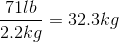
Next set up the equation as follows:
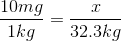
Solve for  :
:


First convert Hayden's weight from pounds to kilograms. This is done by dividing Hayden's weight by 2.2 because 1 pound is 2.2 kilograms.
Next set up the equation as follows:
Solve for
← Didn't Know|Knew It →
Evelynn is a 3-year-old girl who has been bitten by her family's dog. She has had an incision and drainage (I&D) of her left hand to prevent infection and she has been prescribed cefazolin. The guidelines for cefazolin are  . Evelynn weighs 42 lbs. How many milligrams of cefazolin should the nurse administer daily?
Evelynn is a 3-year-old girl who has been bitten by her family's dog. She has had an incision and drainage (I&D) of her left hand to prevent infection and she has been prescribed cefazolin. The guidelines for cefazolin are
Tap to reveal answer
First convert Evelynn's weight from pounds to kilograms. This is done by dividing Evelynn's weight by 2.2 because 1 pound is 2.2 kilograms.
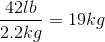
Set up the equation as follows:
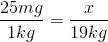
Solve for 


First convert Evelynn's weight from pounds to kilograms. This is done by dividing Evelynn's weight by 2.2 because 1 pound is 2.2 kilograms.
Set up the equation as follows:
Solve for
← Didn't Know|Knew It →
An 11-month-old child weighing 8.6kg enters the emergency room with symptoms of a severe respiratory infection. Her physician suspects bacterial origin and prescribes Ampicillin. The guidelines state that Ampicillin is to be administered as  in a dose q6 hours. Ampicillin comes in 250mg IV solutions of 50 milliliters. How many milliliters should the nurse administer for each dose?
An 11-month-old child weighing 8.6kg enters the emergency room with symptoms of a severe respiratory infection. Her physician suspects bacterial origin and prescribes Ampicillin. The guidelines state that Ampicillin is to be administered as
Tap to reveal answer
The child's weight is already in kilograms. There is no need to change the unit of weight.
Set up the equation as follows
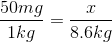
Solve for  :
:


By solving for  , we have determined that the child is to receive
  .
.
Next, divide the dose by 4 because the dose is to be given every 6 hours.
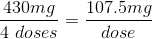
By calculating this number, we have determined that the child should receive a dose of 107.5mg every six hours. If Ampicillin comes packaged with 250mg in 50mL, we can set up an equation to determine how many milliliters we need to reach 107.5mg.
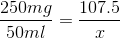
Solve for  :
:


The child's weight is already in kilograms. There is no need to change the unit of weight.
Set up the equation as follows
Solve for
By solving for
Next, divide the dose by 4 because the dose is to be given every 6 hours.
By calculating this number, we have determined that the child should receive a dose of 107.5mg every six hours. If Ampicillin comes packaged with 250mg in 50mL, we can set up an equation to determine how many milliliters we need to reach 107.5mg.
Solve for
← Didn't Know|Knew It →
An infant on his 14th day of life enters the emergency room. He are tachycardic, has poor skin turgor, and is crying without the formation of tears. The nurse knows that this child is showing symptoms of dehydration. The doctor orders fluid replacement of 544ml over 5 hours. What is the drip rate of the infusion?
An infant on his 14th day of life enters the emergency room. He are tachycardic, has poor skin turgor, and is crying without the formation of tears. The nurse knows that this child is showing symptoms of dehydration. The doctor orders fluid replacement of 544ml over 5 hours. What is the drip rate of the infusion?
Tap to reveal answer
Use the following formula to calculate drip rate:
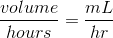
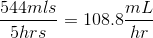
Use the following formula to calculate drip rate:
← Didn't Know|Knew It →
The nurse must administer 1 liter of sodium chloride solution over 8 hours. What is the appropriate rate in milliliters per hour that the nurse must set on the IV pump?
The nurse must administer 1 liter of sodium chloride solution over 8 hours. What is the appropriate rate in milliliters per hour that the nurse must set on the IV pump?
Tap to reveal answer
In order to calculate the proper rate in milliliters per hour  , we must first convert
  to
to  , which is
  . Then, we divide this volume in milliliters by 8 hours to get
  . This can be shown mathematically using dimensional analysis:

In order to calculate the proper rate in milliliters per hour
← Didn't Know|Knew It →
The nurse administers  of piperacillin to a patient with an infection. It must be delivered over 2 hours. The IV has a drop factor of 5. How many drops will fall per minute (rounded to the nearest tenth)
  ?
?
The nurse administers
Tap to reveal answer
The drops per minute equation is:

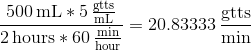
Round to nearest tenth:

The drops per minute equation is:
Round to nearest tenth:
← Didn't Know|Knew It →
The physician orders digoxin  PO QID. The label states:

How many tablets will the nurse administer to the patient for one dose?
The physician orders digoxin
How many tablets will the nurse administer to the patient for one dose?
Tap to reveal answer
First convert  to the same units as the available tablets.

The nurse will administer 1 tab of  digoxin to this patient to fulfill the order of
  digoxin.
First convert
The nurse will administer 1 tab of
← Didn't Know|Knew It →
The nurse prepares to administer naproxen to his patient. The physician has ordered  in divided doses.
The medication label reads  . How many tablets equal the daily dose of this prescription?
The nurse prepares to administer naproxen to his patient. The physician has ordered
The medication label reads
Tap to reveal answer
First, convert the available dose to the dose ordered by the physician.
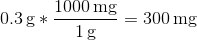
Divide the prescribed daily dose by the dose in each tablet to get the number of tablets that equal the daily dose.
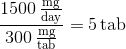
First, convert the available dose to the dose ordered by the physician.
Divide the prescribed daily dose by the dose in each tablet to get the number of tablets that equal the daily dose.
← Didn't Know|Knew It →
The nurse reads orders set by the primary care provider. She has prescribed 6,000 units of heparin Q6H SC for the patient. The label on the heparin vial reads  . How many milliliters will the nurse administer to the patient?
The nurse reads orders set by the primary care provider. She has prescribed 6,000 units of heparin Q6H SC for the patient. The label on the heparin vial reads
Tap to reveal answer
First, establish the ordered dose of 6,000 units. The heparin label reads that  . Use dimensional analysis to solve this problem.

First, establish the ordered dose of 6,000 units. The heparin label reads that
← Didn't Know|Knew It →
The nurse prepares to administer medications to his patients. One order reads  of potassium iodide for expectoration. The label on the medication reads

How many milligrams are contained in this dose?
The nurse prepares to administer medications to his patients. One order reads
How many milligrams are contained in this dose?
Tap to reveal answer
First, convert the ordered dose to the units listed on the available medication.

Then, use this proportion to find the dosage in milligrams.

First, convert the ordered dose to the units listed on the available medication.
Then, use this proportion to find the dosage in milligrams.
← Didn't Know|Knew It →
The nurse prepares an order of  ampicillin IM Q8H. The medication is available in powdered form to be reconstituted with sterile water. The vial contains
  ampicillin and instructs the nurse to reconstitute with
  of sterile water to obtain a concentration of
  ampicillin per milliliter. How many milliliters will the nurse administer per dose?Round to nearest tenth.
The nurse prepares an order of
Tap to reveal answer
Use the proportion  ampicillin per milliliter to find the amount of milliliters the nurse will administer per dose. The ordered amount is
  ampicillin.

Use the proportion
← Didn't Know|Knew It →
The nurse prepares an order of  atropine IM. The label on the available medication reads
  atropine per
  . How many milliliters will the nurse administer?
The nurse prepares an order of
Tap to reveal answer
Use the concentration of the available medication to find the answer. The ordered dose is  and the concentration proportion is
  .
.

Use the concentration of the available medication to find the answer. The ordered dose is
← Didn't Know|Knew It →