
Electromagnetics, Waves, and Optics - Physics
Card 1 of 148
You are given three resistors with known values:


You are asked to create a circuit with a total resistance of between  and
and  . How should you arrange the resistors to accomplish this?
You are given three resistors with known values:
You are asked to create a circuit with a total resistance of between
Tap to reveal answer
This question requires no math to correctly answer! You should not need to 'brute force' it. Although it is designed to appear time consuming, it should be relatively easily once the principle of resistors in parallel is understood. Whenever two resistors are connected in parallel, the net resistance must be less than the resistance of either of the two alone. When resistors are connected in series, the net resistance must be more than the resistance of either alone.
Explanation of correct answer:
 and
and  in parallel, connected to
  in series - It is possible to 'eyeball' this to see that this is at least feasible.
  and
and  in parallel must make a network with an overall resistance less than
  . When added in series with
  (
( ), the overall may fall between
  and
and  . To confirm, one could do the math to calculate the overall resistance, but the point of this question is to use general principles to quickly eliminate the other, incorrect answer choices.
Explanations of incorrect answers:
 ,
,  , and
, and  in parallel - This combination cannot possibly work since the overall resistance must be less than
  (the smallest resistor in parallel).
 and
and  in parallel, connected to
  in series - Regardless of the overall resistance of
  and
and  in parallel, the connection with
  in series makes the total resistance more than
  .
.
 and
and  in parallel;
  is not necessary - Placing
  and
and  in parallel must result in a resistance less than
  .
.
 ,
,  , and
, and  in series - Connecting resistors in series results in an overall resistance greater than that of any one alone. Since
  and
and  are included in series, the sum of the resistances is obviously much greater than what we are asked to produce and this choice can be immediately eliminated.
This question requires no math to correctly answer! You should not need to 'brute force' it. Although it is designed to appear time consuming, it should be relatively easily once the principle of resistors in parallel is understood. Whenever two resistors are connected in parallel, the net resistance must be less than the resistance of either of the two alone. When resistors are connected in series, the net resistance must be more than the resistance of either alone.
Explanation of correct answer:
Explanations of incorrect answers:
← Didn't Know|Knew It →
When a ray of light is reflected off of the surface of another medium, some of the energy from the light is transferred into this medium. As a result, which of the following is true about the reflected light ray?
When a ray of light is reflected off of the surface of another medium, some of the energy from the light is transferred into this medium. As a result, which of the following is true about the reflected light ray?
Tap to reveal answer
For this question, we're told that light is reflected off of the surface of another medium. As a result, the light loses some of its energy, which is transferred into the medium where it reflected.
Because the light has lost some of its energy, we need to determine how the wavelength and frequency of the wave will be affected. To do this, we can recall the equation for the energy of a wave.

Where  is Planck's constant and
  represents the frequency. We can see that when energy is decreased, the frequency also decreases. Thus, we can eliminate two of the answer choices.
To see how the wavelength changes, it's important to recall the relationship that wavelength and frequency have with each other.

Where  is the speed of light and
  is the wavelength. Since the light is still traveling in the same medium, its speed will not change. Thus, as the frequency of the wave decreases, the wavelength has to increase. We can alternatively show how all of these variables are related as follows.
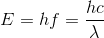
So, in summary, when the energy of light decreases, the frequency will decrease and the wavelength will increase.
For this question, we're told that light is reflected off of the surface of another medium. As a result, the light loses some of its energy, which is transferred into the medium where it reflected.
Because the light has lost some of its energy, we need to determine how the wavelength and frequency of the wave will be affected. To do this, we can recall the equation for the energy of a wave.
Where
To see how the wavelength changes, it's important to recall the relationship that wavelength and frequency have with each other.
Where
So, in summary, when the energy of light decreases, the frequency will decrease and the wavelength will increase.
← Didn't Know|Knew It →
A charged particle traveling along the +x axis enters an electric field directed vertically upward along the +y-axis. If the charged particle experiences a force downward because of this field, what is the sign of the charge on this particle?
A charged particle traveling along the +x axis enters an electric field directed vertically upward along the +y-axis. If the charged particle experiences a force downward because of this field, what is the sign of the charge on this particle?
Tap to reveal answer
Positive charges in an electric field will experience an electric force that is in the same direction as the electric field. If the charge is negative, the force will be in the opposite direction of the electric field. Since the charged particle experiences a force which is opposite to the electric field, the sign of the charge must be negative.
Positive charges in an electric field will experience an electric force that is in the same direction as the electric field. If the charge is negative, the force will be in the opposite direction of the electric field. Since the charged particle experiences a force which is opposite to the electric field, the sign of the charge must be negative.
← Didn't Know|Knew It →
What size resistor should be connected across the terminals of a  battery to produce a current of
  ?
?
What size resistor should be connected across the terminals of a
Tap to reveal answer
Ohm's law is  .
.
In this case,  and
and  .
.
Solving for the resistance,  , we get:

Substitute known values and solve for the unknown resistance:
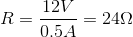
Ohm's law is
In this case,
Solving for the resistance,
Substitute known values and solve for the unknown resistance:
← Didn't Know|Knew It →
A  battery is connected to a small heater with constant resistance
  . How much current flows through the heater?
A
Tap to reveal answer
Ohm's law relates voltage to current and resistance,  . To find the current, we simply divide the voltage by the resistance and get
Ohm's law relates voltage to current and resistance,
← Didn't Know|Knew It →
The picture below shows the electron energy levels of a hydrogen atom.
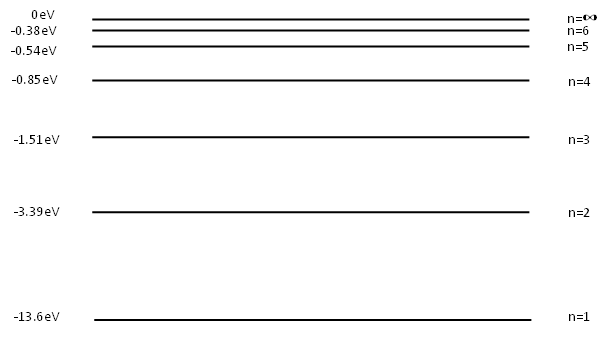
If an electron is excited to the 5th energy level, how many different transitions can it make to return to ground state?
The picture below shows the electron energy levels of a hydrogen atom.
If an electron is excited to the 5th energy level, how many different transitions can it make to return to ground state?
Tap to reveal answer
Electrons don't always drop from the top to the bottom, sometimes they can make 2 or more transitions during the journey. For example, it could drop to the n=4 then to the n=1 levels. Or n=4 to n=2 then n=1. So when you count up all the possible transitions that can be made between n=5 and n=1, you get 10.
Electrons don't always drop from the top to the bottom, sometimes they can make 2 or more transitions during the journey. For example, it could drop to the n=4 then to the n=1 levels. Or n=4 to n=2 then n=1. So when you count up all the possible transitions that can be made between n=5 and n=1, you get 10.
← Didn't Know|Knew It →
Use this circuit diagram for the next question.
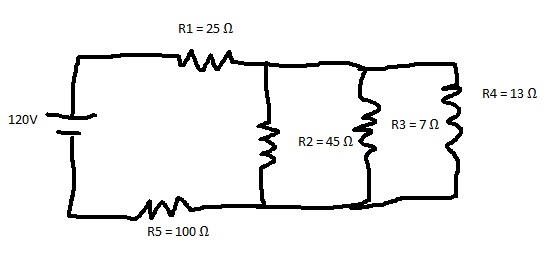
What is the current traveling through the R2 resistor?
Use this circuit diagram for the next question.
What is the current traveling through the R2 resistor?
Tap to reveal answer
So this problem has several steps to it. We need to think backwards. Ultimately we need to know the current going through R2. We will be using Ohms law so we need to know the voltage going through just that resistor.
Because it is in parallel with R3 and R4, all three must have the same voltage. However since it is in series with 2 other resistors, it will not be the voltage from the battery.
Lets reduce the parallel circuit to 1 resistor. Using the formula
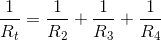 , then remembering to invert the answer yields
 .
.
That resistance is in series with R1 and R5 so to find the current going through each of them we need to add the resistances and use Ohm's law again.
Doing so yields a current of  . This is the current going through the circuit. Now we can find the voltage drop of just our equivalent parallel resistor.
 .
.
So all three of the resistors that are in parallel have a voltage of  going through them.
Now we can go all the way back to the R3 resistor knowing that it has a resistance of  and a voltage of
  . Use Ohm's Law one more time to solve for the current of the R3 resistor.
So this problem has several steps to it. We need to think backwards. Ultimately we need to know the current going through R2. We will be using Ohms law so we need to know the voltage going through just that resistor.
Because it is in parallel with R3 and R4, all three must have the same voltage. However since it is in series with 2 other resistors, it will not be the voltage from the battery.
Lets reduce the parallel circuit to 1 resistor. Using the formula
That resistance is in series with R1 and R5 so to find the current going through each of them we need to add the resistances and use Ohm's law again.
Doing so yields a current of
So all three of the resistors that are in parallel have a voltage of
Now we can go all the way back to the R3 resistor knowing that it has a resistance of
← Didn't Know|Knew It →
Suppose that a circuit with a single resistor is connected to a  battery. If
  of power is generated across this resistor, what is its resistance?
Suppose that a circuit with a single resistor is connected to a
Tap to reveal answer
For this problem, let's first take note of what we know and what we don't. We're given voltage and power, but we're not given resistance or current. Since we have two unknowns, we're going to need two equations.
One of the equations that we can use is the power generated by current flowing through a resistor.

In addition, we also need to use Ohm's law.

With these two equations in mind, we can relate them to one another by isolating the variable for current in one equation and then substituting it into the other one.
Manipulating Ohm's law:

Then substituting this into the power equation:

And rearranging to isolate the variable for resistance:

Now we just need to plug in the values from the question stem to obtain the answer:

For this problem, let's first take note of what we know and what we don't. We're given voltage and power, but we're not given resistance or current. Since we have two unknowns, we're going to need two equations.
One of the equations that we can use is the power generated by current flowing through a resistor.
In addition, we also need to use Ohm's law.
With these two equations in mind, we can relate them to one another by isolating the variable for current in one equation and then substituting it into the other one.
Manipulating Ohm's law:
Then substituting this into the power equation:
And rearranging to isolate the variable for resistance:
Now we just need to plug in the values from the question stem to obtain the answer:
← Didn't Know|Knew It →
You are given three resistors with known values:
You are asked to create a circuit with a total resistance of between and . How should you arrange the resistors to accomplish this?
You are given three resistors with known values:
You are asked to create a circuit with a total resistance of between
Tap to reveal answer
This question requires no math to correctly answer! You should not need to 'brute force' it. Although it is designed to appear time consuming, it should be relatively easily once the principle of resistors in parallel is understood. Whenever two resistors are connected in parallel, the net resistance must be less than the resistance of either of the two alone. When resistors are connected in series, the net resistance must be more than the resistance of either alone.
Explanation of correct answer:
and in parallel, connected to in series - It is possible to 'eyeball' this to see that this is at least feasible. and in parallel must make a network with an overall resistance less than . When added in series with (), the overall may fall between and . To confirm, one could do the math to calculate the overall resistance, but the point of this question is to use general principles to quickly eliminate the other, incorrect answer choices.
Explanations of incorrect answers:
, , and in parallel - This combination cannot possibly work since the overall resistance must be less than (the smallest resistor in parallel).
and in parallel, connected to in series - Regardless of the overall resistance of and in parallel, the connection with in series makes the total resistance more than .
and in parallel; is not necessary - Placing and in parallel must result in a resistance less than .
, , and in series - Connecting resistors in series results in an overall resistance greater than that of any one alone. Since and are included in series, the sum of the resistances is obviously much greater than what we are asked to produce and this choice can be immediately eliminated.
This question requires no math to correctly answer! You should not need to 'brute force' it. Although it is designed to appear time consuming, it should be relatively easily once the principle of resistors in parallel is understood. Whenever two resistors are connected in parallel, the net resistance must be less than the resistance of either of the two alone. When resistors are connected in series, the net resistance must be more than the resistance of either alone.
Explanation of correct answer:
Explanations of incorrect answers:
← Didn't Know|Knew It →
A light ray is traveling through air hits a transparent material at an angle of  from the normal. It is then refracted at
  . What is the speed of light in the material?
A light ray is traveling through air hits a transparent material at an angle of
Tap to reveal answer
This problem requires Snell's Law and the corresponding equation:

We know that the index of refraction of air is:

We also know that:
 and
and 
Now we can plug in these values into the Snell's Law equation to find the index of refraction for the transparent material.

Finally, we need to calculate the speed of light moving through this transparent material now that we know the index of refraction for it. To do that, we need to use this equation:

Where  is the speed of light and
  is the index of refraction. We plug in our known values and get:

This problem requires Snell's Law and the corresponding equation:
We know that the index of refraction of air is:
We also know that:
Now we can plug in these values into the Snell's Law equation to find the index of refraction for the transparent material.
Finally, we need to calculate the speed of light moving through this transparent material now that we know the index of refraction for it. To do that, we need to use this equation:
Where
← Didn't Know|Knew It →
You are given three resistors with known values:
You are asked to create a circuit with a total resistance of between and . How should you arrange the resistors to accomplish this?
You are given three resistors with known values:
You are asked to create a circuit with a total resistance of between
Tap to reveal answer
This question requires no math to correctly answer! You should not need to 'brute force' it. Although it is designed to appear time consuming, it should be relatively easily once the principle of resistors in parallel is understood. Whenever two resistors are connected in parallel, the net resistance must be less than the resistance of either of the two alone. When resistors are connected in series, the net resistance must be more than the resistance of either alone.
Explanation of correct answer:
and in parallel, connected to in series - It is possible to 'eyeball' this to see that this is at least feasible. and in parallel must make a network with an overall resistance less than . When added in series with (), the overall may fall between and . To confirm, one could do the math to calculate the overall resistance, but the point of this question is to use general principles to quickly eliminate the other, incorrect answer choices.
Explanations of incorrect answers:
, , and in parallel - This combination cannot possibly work since the overall resistance must be less than (the smallest resistor in parallel).
and in parallel, connected to in series - Regardless of the overall resistance of and in parallel, the connection with in series makes the total resistance more than .
and in parallel; is not necessary - Placing and in parallel must result in a resistance less than .
, , and in series - Connecting resistors in series results in an overall resistance greater than that of any one alone. Since and are included in series, the sum of the resistances is obviously much greater than what we are asked to produce and this choice can be immediately eliminated.
This question requires no math to correctly answer! You should not need to 'brute force' it. Although it is designed to appear time consuming, it should be relatively easily once the principle of resistors in parallel is understood. Whenever two resistors are connected in parallel, the net resistance must be less than the resistance of either of the two alone. When resistors are connected in series, the net resistance must be more than the resistance of either alone.
Explanation of correct answer:
Explanations of incorrect answers:
← Didn't Know|Knew It →
A resistive heating element can be modeled as a resistor connected across the terminals of a battery.
If the battery is selected to be  , what should the resistance of the heating element be if the radiated power is to total
  ?
?
A resistive heating element can be modeled as a resistor connected across the terminals of a battery.
If the battery is selected to be
Tap to reveal answer
We are asked to calculate the power dissipated through a resistor connected to a battery. We know that  . Substituting the values given above,
 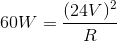 . Solving for R yields
  .
.
We are asked to calculate the power dissipated through a resistor connected to a battery. We know that
← Didn't Know|Knew It →
What is the RMS voltage of a  peak-to-peak AC current?
What is the RMS voltage of a
Tap to reveal answer
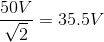
This question requires two steps: the first is to calculate the peak voltage of the AC current, and the second requires conversion of the peak voltage to an RMS voltage. We are told that the current is  peak-to-peak. Thus, the peak voltage is half of this, or
  . By definition, to convert peak voltage to RMS voltage, we must divide the peak voltage by
  :
:
This question requires two steps: the first is to calculate the peak voltage of the AC current, and the second requires conversion of the peak voltage to an RMS voltage. We are told that the current is
← Didn't Know|Knew It →
A  battery is connected to two
  light bulbs that are arrange in parallel. What is the total power dissipated by the light bulbs?
A
Tap to reveal answer
The power dissipated in each light bulb is  . Since there are two light bulbs, the total power dissipated is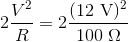
The power dissipated in each light bulb is
← Didn't Know|Knew It →
When a ray of light is reflected off of the surface of another medium, some of the energy from the light is transferred into this medium. As a result, which of the following is true about the reflected light ray?
When a ray of light is reflected off of the surface of another medium, some of the energy from the light is transferred into this medium. As a result, which of the following is true about the reflected light ray?
Tap to reveal answer
For this question, we're told that light is reflected off of the surface of another medium. As a result, the light loses some of its energy, which is transferred into the medium where it reflected.
Because the light has lost some of its energy, we need to determine how the wavelength and frequency of the wave will be affected. To do this, we can recall the equation for the energy of a wave.
Where is Planck's constant and represents the frequency. We can see that when energy is decreased, the frequency also decreases. Thus, we can eliminate two of the answer choices.
To see how the wavelength changes, it's important to recall the relationship that wavelength and frequency have with each other.
Where is the speed of light and is the wavelength. Since the light is still traveling in the same medium, its speed will not change. Thus, as the frequency of the wave decreases, the wavelength has to increase. We can alternatively show how all of these variables are related as follows.
So, in summary, when the energy of light decreases, the frequency will decrease and the wavelength will increase.
For this question, we're told that light is reflected off of the surface of another medium. As a result, the light loses some of its energy, which is transferred into the medium where it reflected.
Because the light has lost some of its energy, we need to determine how the wavelength and frequency of the wave will be affected. To do this, we can recall the equation for the energy of a wave.
Where
To see how the wavelength changes, it's important to recall the relationship that wavelength and frequency have with each other.
Where
So, in summary, when the energy of light decreases, the frequency will decrease and the wavelength will increase.
← Didn't Know|Knew It →
Suppose that a magnetic field is oriented such that it is pointing directly to the left, as in the picture shown below. If a positively charged particle were to begin traveling through this magnetic field to the right, in which direction would the particle's trajectory begin to curve?
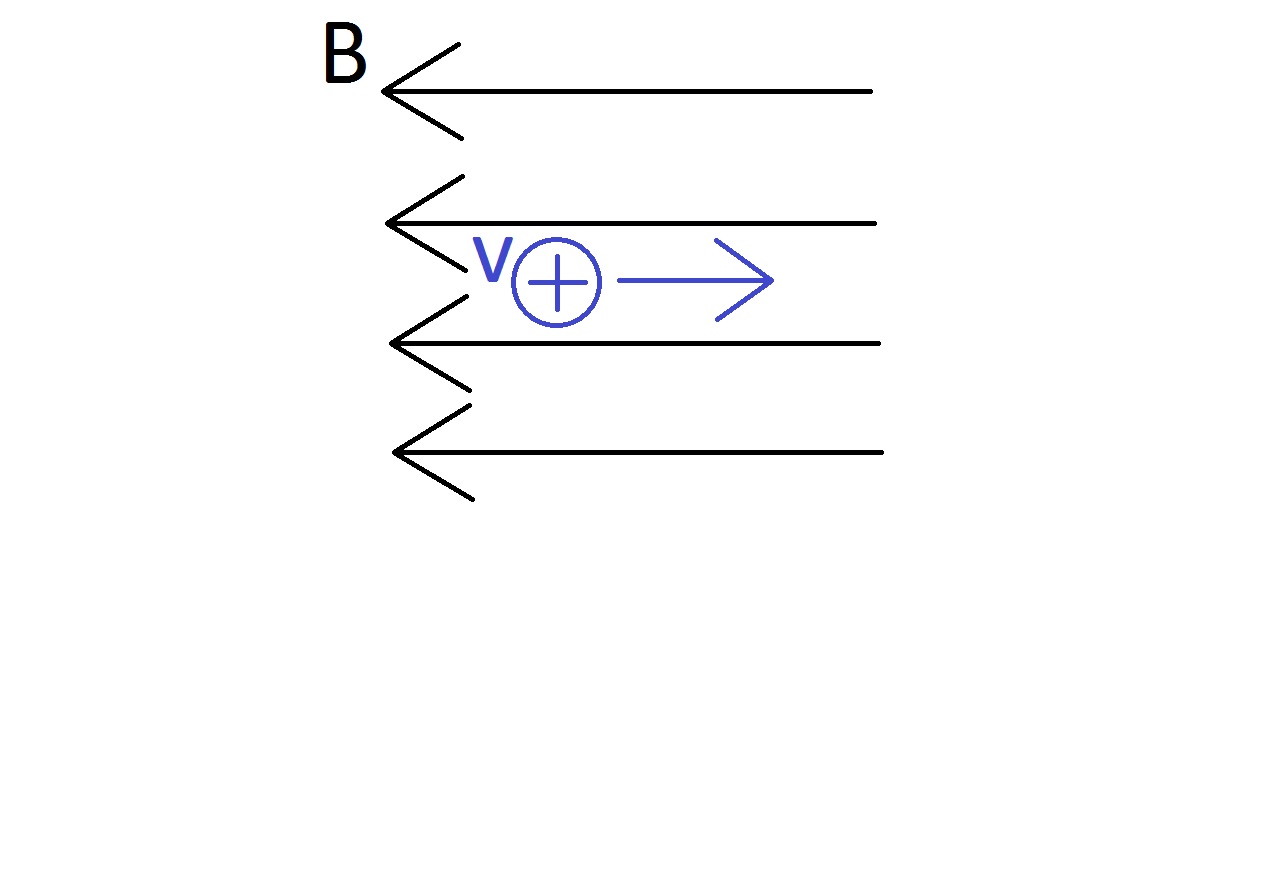
Suppose that a magnetic field is oriented such that it is pointing directly to the left, as in the picture shown below. If a positively charged particle were to begin traveling through this magnetic field to the right, in which direction would the particle's trajectory begin to curve?
Tap to reveal answer
In order to answer this question, it's important to understand the factors that determine the magnetic force experienced by a charge. We can begin by writing out the equation for magnetic force.

As shown in the above equation, the magnetic force is directly proportional to the particle's charge, its velocity, and the strength of the magnetic field itself. But, for the purposes of the this question, the most important factor is the angle of the particle's velocity with respect to the magnetic field.
Notice that if theta is equal to zero, then the sine of theta will be equal to zero as well. This, in turn, will cause the magnetic force to also be zero. This is also true if we were to define theta as  .
.
Since the particle is moving in a direction that is parallel to the magnetic field lines but in the opposite direction, we have a situation in which theta is equal to  . This means that the magnetic force on the particle is zero. As a result, the particle will continue to move through the magnetic field without changing its direction.
In order to answer this question, it's important to understand the factors that determine the magnetic force experienced by a charge. We can begin by writing out the equation for magnetic force.
As shown in the above equation, the magnetic force is directly proportional to the particle's charge, its velocity, and the strength of the magnetic field itself. But, for the purposes of the this question, the most important factor is the angle of the particle's velocity with respect to the magnetic field.
Notice that if theta is equal to zero, then the sine of theta will be equal to zero as well. This, in turn, will cause the magnetic force to also be zero. This is also true if we were to define theta as
Since the particle is moving in a direction that is parallel to the magnetic field lines but in the opposite direction, we have a situation in which theta is equal to
← Didn't Know|Knew It →
When a ray of light is reflected off of the surface of another medium, some of the energy from the light is transferred into this medium. As a result, which of the following is true about the reflected light ray?
When a ray of light is reflected off of the surface of another medium, some of the energy from the light is transferred into this medium. As a result, which of the following is true about the reflected light ray?
Tap to reveal answer
For this question, we're told that light is reflected off of the surface of another medium. As a result, the light loses some of its energy, which is transferred into the medium where it reflected.
Because the light has lost some of its energy, we need to determine how the wavelength and frequency of the wave will be affected. To do this, we can recall the equation for the energy of a wave.
Where is Planck's constant and represents the frequency. We can see that when energy is decreased, the frequency also decreases. Thus, we can eliminate two of the answer choices.
To see how the wavelength changes, it's important to recall the relationship that wavelength and frequency have with each other.
Where is the speed of light and is the wavelength. Since the light is still traveling in the same medium, its speed will not change. Thus, as the frequency of the wave decreases, the wavelength has to increase. We can alternatively show how all of these variables are related as follows.
So, in summary, when the energy of light decreases, the frequency will decrease and the wavelength will increase.
For this question, we're told that light is reflected off of the surface of another medium. As a result, the light loses some of its energy, which is transferred into the medium where it reflected.
Because the light has lost some of its energy, we need to determine how the wavelength and frequency of the wave will be affected. To do this, we can recall the equation for the energy of a wave.
Where
To see how the wavelength changes, it's important to recall the relationship that wavelength and frequency have with each other.
Where
So, in summary, when the energy of light decreases, the frequency will decrease and the wavelength will increase.
← Didn't Know|Knew It →
An x-ray machine emits electromagnetic photons carrying a frequency of  . What is the approximate energy carried by each photon?
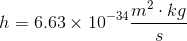
An x-ray machine emits electromagnetic photons carrying a frequency of
Tap to reveal answer
The energy of a photon of a given frequency is determined by the equation
 , where
  is Plank's constant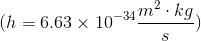
So plug in Plank's constant and the frequency of the x-ray photons to get an energy of very near 
The energy of a photon of a given frequency is determined by the equation
So plug in Plank's constant and the frequency of the x-ray photons to get an energy of very near
← Didn't Know|Knew It →
An x-ray machine emits electromagnetic photons carrying a frequency of . What is the approximate energy carried by each photon?
An x-ray machine emits electromagnetic photons carrying a frequency of
Tap to reveal answer
The energy of a photon of a given frequency is determined by the equation
, where is Plank's constant
So plug in Plank's constant and the frequency of the x-ray photons to get an energy of very near
The energy of a photon of a given frequency is determined by the equation
So plug in Plank's constant and the frequency of the x-ray photons to get an energy of very near
← Didn't Know|Knew It →
A parallel plate capacitor with no dielectric has capacitance  . The distance between the capacitor plates is halved. What is the new capacitance?
A parallel plate capacitor with no dielectric has capacitance
Tap to reveal answer
The capacitance of a parallel plate capacitor is proportional to the inverse of the distance between the plates. If the distance is halved, the capacitance is doubled.
The capacitance of a parallel plate capacitor is proportional to the inverse of the distance between the plates. If the distance is halved, the capacitance is doubled.
← Didn't Know|Knew It →