
Identities and Properties - Pre-Algebra
Card 1 of 372
Which of the following demonstrates the multiplicative inverse property?
Which of the following demonstrates the multiplicative inverse property?
Tap to reveal answer
The multiplicative inverse property states that for some value  ,
,
 .
.
Therefore, the statement demonstrating the multiplicative inverse property is
 .
.
The multiplicative inverse property states that for some value
Therefore, the statement demonstrating the multiplicative inverse property is
← Didn't Know|Knew It →
Which of the following statements demonstrates the identity property of multiplication?
Which of the following statements demonstrates the identity property of multiplication?
Tap to reveal answer
The identity property of multiplication states that there is a number 1, called the multiplicative identity, that can be multiplied by any number to obtain that number. Of the four statements,

demonstrates this property.
The identity property of multiplication states that there is a number 1, called the multiplicative identity, that can be multiplied by any number to obtain that number. Of the four statements,
demonstrates this property.
← Didn't Know|Knew It →
What property can be applied to the following expression?
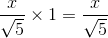
What property can be applied to the following expression?
Tap to reveal answer
The rule for Multiplicative Identity Property is 
Expression given in the question is: 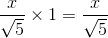
Hence the property is Multiplicative Identity.
The rule for Multiplicative Identity Property is
Expression given in the question is:
Hence the property is Multiplicative Identity.
← Didn't Know|Knew It →
Which equation shows an example of the multiplicative identity property?
Which equation shows an example of the multiplicative identity property?
Tap to reveal answer
The multiplicative identity property means that when something is multiplied by 1 then it will remain the same as the other number.

The multiplicative identity property means that when something is multiplied by 1 then it will remain the same as the other number.
← Didn't Know|Knew It →
Which property does the equation below represent?

Which property does the equation below represent?
Tap to reveal answer
When something is multiplied by the number one it remains the same number. Therefore when multiplying by one it creates its own identity.
Multiplicative Identity Property
When something is multiplied by the number one it remains the same number. Therefore when multiplying by one it creates its own identity.
Multiplicative Identity Property
← Didn't Know|Knew It →
Which of the following displays the multiplicative identity property?
Which of the following displays the multiplicative identity property?
Tap to reveal answer
The multiplicative identity property states that when you multiply a number by 1, the answer is the original number.
Therefore,

displays the multiplicative identity property.
The multiplicative identity property states that when you multiply a number by 1, the answer is the original number.
Therefore,
displays the multiplicative identity property.
← Didn't Know|Knew It →
Which of the following statements demonstrates the inverse property of multiplication?
Which of the following statements demonstrates the inverse property of multiplication?
Tap to reveal answer
The inverse property of multiplication states that for every real number, a number exists, called the multiplicative inverse, such that the number and its inverse have product 1. Of the statements given, only

demonstrates this property.
The inverse property of multiplication states that for every real number, a number exists, called the multiplicative inverse, such that the number and its inverse have product 1. Of the statements given, only
demonstrates this property.
← Didn't Know|Knew It →
Simplify.

Simplify.
Tap to reveal answer
To simplify a compound fraction, multiply the numerator by the reciprocal of the denominator. Remember that a compound fraction can easily be rewritten as a division problem!
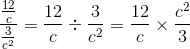
Solve the multiplication.
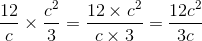
Now we need to reduce the fraction to find our final answer.
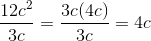
To simplify a compound fraction, multiply the numerator by the reciprocal of the denominator. Remember that a compound fraction can easily be rewritten as a division problem!
Solve the multiplication.
Now we need to reduce the fraction to find our final answer.
← Didn't Know|Knew It →
What is the multiplicative inverse of  where
where 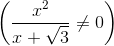
What is the multiplicative inverse of
Tap to reveal answer
The rule for Multiplicative Inverse Property is  where
where  .
.
Using this rule, if
 ,
,
then  is the Mulitplicative inverse, which is
  .
.
After you simplify you get  which is the Multiplicative Inverse.
The rule for Multiplicative Inverse Property is
Using this rule, if
then
After you simplify you get
← Didn't Know|Knew It →
What is the multiplicative inverse of  where
where  ?
?
What is the multiplicative inverse of
Tap to reveal answer
The rule for Multiplicative Inverse Property is
where .
Using this rule, if
 ,
,
then  is the mulitplicative inverse, which is
  .
.
After you simplify you get  which is the multiplicative inverse.
The rule for Multiplicative Inverse Property is
where
Using this rule, if
then
After you simplify you get
← Didn't Know|Knew It →
Which of the following displays the multiplicative inverse property?
Which of the following displays the multiplicative inverse property?
Tap to reveal answer
The mulitplicative inverse property deals with reciprocals. For example, the multiplicative inverse, or reciprocal, of the number 7 is  .
.
The multiplicative inverse property states that a number times its multiplicative inverse equals 1.
Therefore,

displays the multiplicative inverse property.
The mulitplicative inverse property deals with reciprocals. For example, the multiplicative inverse, or reciprocal, of the number 7 is
The multiplicative inverse property states that a number times its multiplicative inverse equals 1.
Therefore,
displays the multiplicative inverse property.
← Didn't Know|Knew It →
Which property does the equation below represent?
Which property does the equation below represent?
Tap to reveal answer
When something is multiplied by the number one it remains the same number. Therefore when multiplying by one it creates its own identity.
Multiplicative Identity Property
When something is multiplied by the number one it remains the same number. Therefore when multiplying by one it creates its own identity.
Multiplicative Identity Property
← Didn't Know|Knew It →
Which of the following displays the multiplicative identity property?
Which of the following displays the multiplicative identity property?
Tap to reveal answer
The multiplicative identity property states that when you multiply a number by 1, the answer is the original number.
Therefore,
displays the multiplicative identity property.
The multiplicative identity property states that when you multiply a number by 1, the answer is the original number.
Therefore,
displays the multiplicative identity property.
← Didn't Know|Knew It →
Which of the following demonstrates the multiplicative inverse property?
Which of the following demonstrates the multiplicative inverse property?
Tap to reveal answer
The multiplicative inverse property states that for some value ,
.
Therefore, the statement demonstrating the multiplicative inverse property is
.
The multiplicative inverse property states that for some value
Therefore, the statement demonstrating the multiplicative inverse property is
← Didn't Know|Knew It →
Which of the following statements demonstrates the identity property of multiplication?
Which of the following statements demonstrates the identity property of multiplication?
Tap to reveal answer
The identity property of multiplication states that there is a number 1, called the multiplicative identity, that can be multiplied by any number to obtain that number. Of the four statements,
demonstrates this property.
The identity property of multiplication states that there is a number 1, called the multiplicative identity, that can be multiplied by any number to obtain that number. Of the four statements,
demonstrates this property.
← Didn't Know|Knew It →
What property can be applied to the following expression?
What property can be applied to the following expression?
Tap to reveal answer
The rule for Multiplicative Identity Property is
Expression given in the question is:
Hence the property is Multiplicative Identity.
The rule for Multiplicative Identity Property is
Expression given in the question is:
Hence the property is Multiplicative Identity.
← Didn't Know|Knew It →
Which equation shows an example of the multiplicative identity property?
Which equation shows an example of the multiplicative identity property?
Tap to reveal answer
The multiplicative identity property means that when something is multiplied by 1 then it will remain the same as the other number.
The multiplicative identity property means that when something is multiplied by 1 then it will remain the same as the other number.
← Didn't Know|Knew It →
Which of the following statements demonstrates the inverse property of multiplication?
Which of the following statements demonstrates the inverse property of multiplication?
Tap to reveal answer
The inverse property of multiplication states that for every real number, a number exists, called the multiplicative inverse, such that the number and its inverse have product 1. Of the statements given, only
demonstrates this property.
The inverse property of multiplication states that for every real number, a number exists, called the multiplicative inverse, such that the number and its inverse have product 1. Of the statements given, only
demonstrates this property.
← Didn't Know|Knew It →
Simplify.
Simplify.
Tap to reveal answer
To simplify a compound fraction, multiply the numerator by the reciprocal of the denominator. Remember that a compound fraction can easily be rewritten as a division problem!
Solve the multiplication.
Now we need to reduce the fraction to find our final answer.
To simplify a compound fraction, multiply the numerator by the reciprocal of the denominator. Remember that a compound fraction can easily be rewritten as a division problem!
Solve the multiplication.
Now we need to reduce the fraction to find our final answer.
← Didn't Know|Knew It →
What is the multiplicative inverse of where
What is the multiplicative inverse of
Tap to reveal answer
The rule for Multiplicative Inverse Property is where .
Using this rule, if
,
then is the Mulitplicative inverse, which is .
After you simplify you get which is the Multiplicative Inverse.
The rule for Multiplicative Inverse Property is
Using this rule, if
then
After you simplify you get
← Didn't Know|Knew It →