
Conic Sections - Pre-Calculus
Card 1 of 1016
Write an equation for a circle.
Determine the equation for a circle in standard form with a radius of  , and centered at the point
  .
.
Write an equation for a circle.
Determine the equation for a circle in standard form with a radius of
Tap to reveal answer
The standard form for the equation of a circle with radius  , and centered at point
  is
is
 .
.
Here,  , so the equation is
 .
.
Note: one way to think of this equation is to remember the Pythagorean Theorem.
If the center is at the origin then the equation is
 .
.
This describes a right triangle for any x and y that satisfy this equation. Here r is the hypotenues, but when all values of x and y are used it stays the same and the points map out a circle with radius r.
The rules of graph translation apply in the same way as with any function. That is they move the origin in the opposite direction by a and/or b.
The standard form for the equation of a circle with radius
Here,
Note: one way to think of this equation is to remember the Pythagorean Theorem.
If the center is at the origin then the equation is
This describes a right triangle for any x and y that satisfy this equation. Here r is the hypotenues, but when all values of x and y are used it stays the same and the points map out a circle with radius r.
The rules of graph translation apply in the same way as with any function. That is they move the origin in the opposite direction by a and/or b.
← Didn't Know|Knew It →
Determine the equation of the circle in standard form from its graph.

Determine the equation of the circle in standard form from its graph.
Tap to reveal answer
The center of the circle is  .
.
Find the horizontal distance from the center to the edge of the circle. At the center  , at the edge
  . The difference is
  . This is the radius.

Plug these values:  into the standard form for the equation of a circle.

This gives
 .
.
The center of the circle is
Find the horizontal distance from the center to the edge of the circle. At the center
Plug these values:
This gives
← Didn't Know|Knew It →
Express the following equation for a circle in standard form:

Express the following equation for a circle in standard form:
Tap to reveal answer
Remember that the standard form for the equation of a circle is given by the following formula:

Where the point (h,k) gives the center of the circle, and r is the radius. We can see from the form in which the equation is expressed in the problem that the only thing different with our form is that the terms on the left side of the equation are divided by 4. With some algebra, we'll multiply both sides by 4 to eliminate the 4's from the left side of equation:


Now we can see that our equation is the same as the formula for a circle in standard form, where (h,k) is (3,-2) and r=4.
Remember that the standard form for the equation of a circle is given by the following formula:
Where the point (h,k) gives the center of the circle, and r is the radius. We can see from the form in which the equation is expressed in the problem that the only thing different with our form is that the terms on the left side of the equation are divided by 4. With some algebra, we'll multiply both sides by 4 to eliminate the 4's from the left side of equation:
Now we can see that our equation is the same as the formula for a circle in standard form, where (h,k) is (3,-2) and r=4.
← Didn't Know|Knew It →
Given the following equation for a circle, determine the coordinates of its center, as well as the coordinates of the four points directly, above, below, to the left, and to the right of the center:
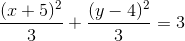
Given the following equation for a circle, determine the coordinates of its center, as well as the coordinates of the four points directly, above, below, to the left, and to the right of the center:
Tap to reveal answer
First we must express the equation in standard form we can determine what the radius of our circle will be. The standard form for the equation of a circle is given as follows:

Where the point (h,k) gives the center of the circle and r is the radius of the circle, which can be easily determined by taking the square root of  once the equation is in standard form. Our first step is to multiply both sides of the equation by 3 to cancel the division by 3 on the left side:


Now we can see that our equation is in standard form, where h=-5 and k=4, which tells us the coordinates of the center of the circle:

We can also determine the radius of the circle by taking the square root of  :
:

Now that we know the center of the circle is at (-5,4), and that its radius is 3, we can find the points directly above and below the center by adding 3 to its y-coordinate, and then subtracting 3, respectively, giving us:
 and
and 
Similarly, to find the points directly to the left and to the right of the center, we subtract 3 from its x-coordinate, and then add 3, respectively, giving us:
 and
and 
First we must express the equation in standard form we can determine what the radius of our circle will be. The standard form for the equation of a circle is given as follows:
Where the point (h,k) gives the center of the circle and r is the radius of the circle, which can be easily determined by taking the square root of
Now we can see that our equation is in standard form, where h=-5 and k=4, which tells us the coordinates of the center of the circle:
We can also determine the radius of the circle by taking the square root of
Now that we know the center of the circle is at (-5,4), and that its radius is 3, we can find the points directly above and below the center by adding 3 to its y-coordinate, and then subtracting 3, respectively, giving us:
Similarly, to find the points directly to the left and to the right of the center, we subtract 3 from its x-coordinate, and then add 3, respectively, giving us:
← Didn't Know|Knew It →
Which of the following is an equation for a circle written in standard form?
Which of the following is an equation for a circle written in standard form?
Tap to reveal answer
Remember that in order for the equation of a circle to be in standard form, it must be written in the following way:

Where the point (h,k) tells us where the center of the circle is, and r is the radius of the circle. From our answer choices, we can see that the following is the only equation in which there are no fractions and there is addition of terms and not subtraction, which means it is in the standard form shown above:

For this circle, the center would be at (2,-3), and the radius would be 3.
Remember that in order for the equation of a circle to be in standard form, it must be written in the following way:
Where the point (h,k) tells us where the center of the circle is, and r is the radius of the circle. From our answer choices, we can see that the following is the only equation in which there are no fractions and there is addition of terms and not subtraction, which means it is in the standard form shown above:
For this circle, the center would be at (2,-3), and the radius would be 3.
← Didn't Know|Knew It →
Graph the circle indicated by the equation

Graph the circle indicated by the equation
Tap to reveal answer
We must begin by recalling the general formula for the equation of a circle.

Where circle has center of coordinates  and radius of
  .
.
That means that looking at our equation, we can see that the center is  .
.
If  , then taking the square roots gives us a radius of 2.
We then look at our possible choices. Only two are centered at  . Of these two, one has a radius of 2 while one has a radius of 4. We want the former.
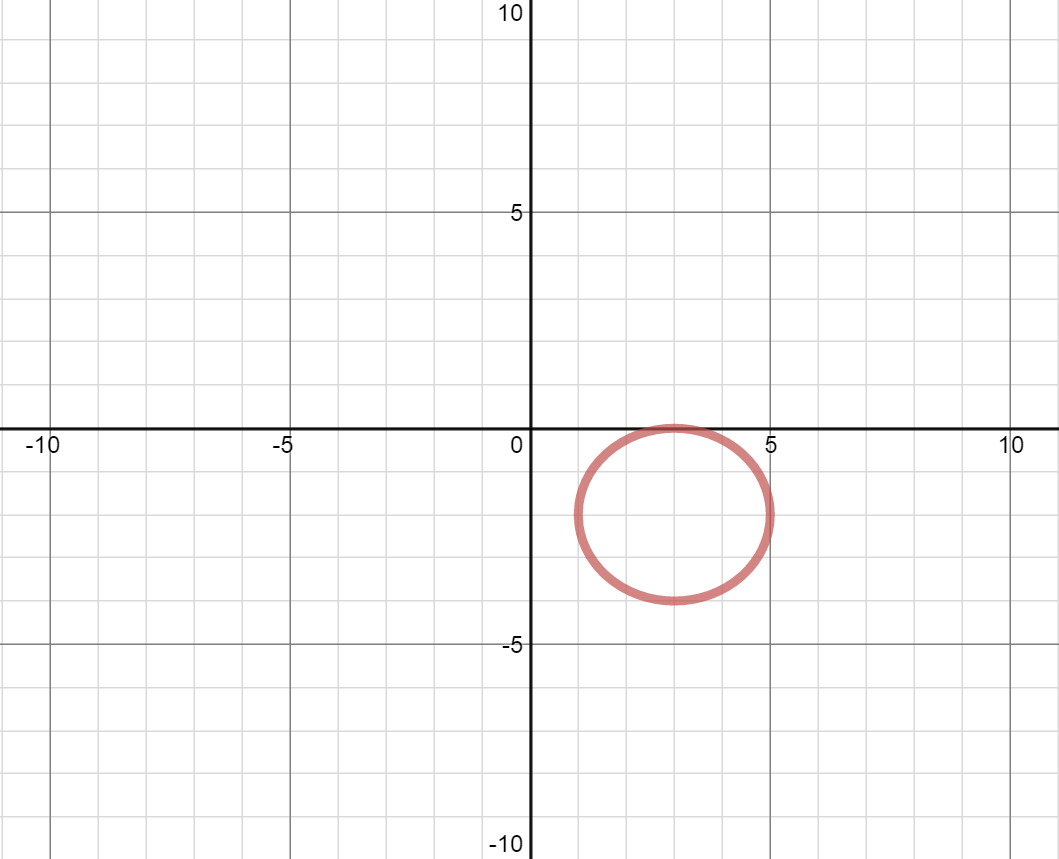
We must begin by recalling the general formula for the equation of a circle.
Where circle has center of coordinates
That means that looking at our equation, we can see that the center is
If
We then look at our possible choices. Only two are centered at
← Didn't Know|Knew It →
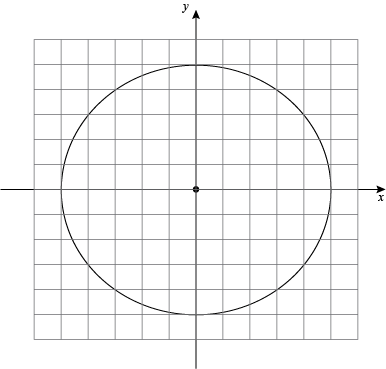
If each mark on the graph represents  units, what is the equation of the circle?
If each mark on the graph represents
Tap to reveal answer
Since the circle is centered at  we use the most basic form for the equation for a circle:
 .
.
Given the circle has a radius of  marks, which represent
  units each, the circle has a radius of
  units.
We then plug in  for
for  :
:
 and simplify:
  .
.
Since the circle is centered at
Given the circle has a radius of
We then plug in
← Didn't Know|Knew It →
Write the equation for a circle centered at  passing through the point
  .
.
Write the equation for a circle centered at
Tap to reveal answer
The equation for a circle in general is  for a circle with center
  and radius
  . We know that the center
  is
is  and that one of the points
  is
is  , so we can determine
  by plugging these values in:


Now we can generalize the equation as 
The equation for a circle in general is
Now we can generalize the equation as
← Didn't Know|Knew It →
What is the equation of a circle with radius of  and center of
  ?
?
What is the equation of a circle with radius of
Tap to reveal answer
Recall that the equation of a circle is  for
for  the center and
  the radius.
In this case, we have  as the center.
Note the negatives in the formula and be careful simpilfying.
When we are done, we have:


which gives us our answer when simplified.
Recall that the equation of a circle is
In this case, we have
Note the negatives in the formula and be careful simpilfying.
When we are done, we have:
which gives us our answer when simplified.
← Didn't Know|Knew It →
Which choice would be the circle  in standard form?
Which choice would be the circle
Tap to reveal answer
To find the standard form of this equation, we have to complete the square for both x and y. It's easiest to do this if we group together the y terms first, then the left terms, and subtract the constant from both sides:
original:  subtract 1 from both sides; group x and y

To make the y terms into a square, we have to add 1, since half of 2 is 1, and  .
.
To make the x terms into a square, we have to add 9, since half of -6 is -3, and  :
:

Now we just have to re-write the y and x terms as the squares that they are, and simplify the right side:

To find the standard form of this equation, we have to complete the square for both x and y. It's easiest to do this if we group together the y terms first, then the left terms, and subtract the constant from both sides:
original:
To make the y terms into a square, we have to add 1, since half of 2 is 1, and
To make the x terms into a square, we have to add 9, since half of -6 is -3, and
Now we just have to re-write the y and x terms as the squares that they are, and simplify the right side:
← Didn't Know|Knew It →
Give the center and radius for the circle  .
.
Give the center and radius for the circle
Tap to reveal answer
To determine the center and radius, put this equation into standard form. Standard form is  , where
  is the center and
  is the radius.
First, group the y terms together and the x terms together, and subtract 37 from both sides:

We're leaving a space after these terms because we're completing the square. To make the y terms into a square, we need to add 49, since half of -14 is -7, and 
To make the x terms into a square, we need to add 4, since half of -4 is -2, and 
We'll need to add these to both sides to keep both sides equal:

Now we can re-write the quadratics on the left as squares, and simplify the right side:

Interpreting this equation, we can see that the center would be at  and the radius is
To determine the center and radius, put this equation into standard form. Standard form is
First, group the y terms together and the x terms together, and subtract 37 from both sides:
We're leaving a space after these terms because we're completing the square. To make the y terms into a square, we need to add 49, since half of -14 is -7, and
To make the x terms into a square, we need to add 4, since half of -4 is -2, and
We'll need to add these to both sides to keep both sides equal:
Now we can re-write the quadratics on the left as squares, and simplify the right side:
Interpreting this equation, we can see that the center would be at
← Didn't Know|Knew It →
Write the equation for  in standard form.
Write the equation for
Tap to reveal answer
To write this in standard form, we will have to complete the square for both x and y. To do this more easily, group the x terms, then the y terms, and then subtract 43 from both sides:

To complete the square for x, we have to add  to both sides; to complete the square for y, we have to add
  to both sides:

Condense the left side and add together the numbers on the right:

To write this in standard form, we will have to complete the square for both x and y. To do this more easily, group the x terms, then the y terms, and then subtract 43 from both sides:
To complete the square for x, we have to add
Condense the left side and add together the numbers on the right:
← Didn't Know|Knew It →
Which point is NOT on the circle defined by  ?
?
Which point is NOT on the circle defined by
Tap to reveal answer
The point  is the center of the circle - it is not on the circle.
We can test to see if the other points are actually on the circle by plugging in their x and y values into the equation. For example, to verify that
 is actually on the circle, we can plug in
  for x and
  for y:



 this is true, so that point is on the circle.
The point
We can test to see if the other points are actually on the circle by plugging in their x and y values into the equation. For example, to verify that
← Didn't Know|Knew It →
Which best describes the point  and the circle
  ?
?
Which best describes the point
Tap to reveal answer
To quickly figure this out, we can plug in 5 for x and -2 for y and see what happens:



Since the value is greater than 9, this point is outside the radius of this circle.
To quickly figure this out, we can plug in 5 for x and -2 for y and see what happens:
Since the value is greater than 9, this point is outside the radius of this circle.
← Didn't Know|Knew It →
Write the standard equation of the circle.

Write the standard equation of the circle.
Tap to reveal answer
Group the x and y terms on one side of the equation and the constant on the other.

Complete the square by taking half of the middle number for each variable and squaring it. Add the number to the other side of the equation.


Group the x and y terms on one side of the equation and the constant on the other.
Complete the square by taking half of the middle number for each variable and squaring it. Add the number to the other side of the equation.
← Didn't Know|Knew It →
Find the equation of the circle if it is centered at  and has a radius of
  units.
Find the equation of the circle if it is centered at
Tap to reveal answer
The equation of a circle centered at  with radius
  units in standard form is

For the circle ceentered at  with radius
  units has the equation

The equation of a circle centered at
For the circle ceentered at
← Didn't Know|Knew It →
Find the equation of the circle if it is centered at  and has a radius of
  units.
Find the equation of the circle if it is centered at
Tap to reveal answer
The equation of a circle centered at with radius units in standard form is
For the circle ceentered at  with radius
  units has the equation

or

The equation of a circle centered at
For the circle ceentered at
or
← Didn't Know|Knew It →
 is a point on a circle whose center is at
  . What is the standard equation of this circle?
Tap to reveal answer
The standard form of the equation of a circle is

where the center of the circle resides at the point  .
.
Given the center of a circle and a point on the rim of the circle, one can use the distance formula to find the radius.

Now plug in the point for the center and radius into the standard equation of a circle:

The standard form of the equation of a circle is
where the center of the circle resides at the point
Given the center of a circle and a point on the rim of the circle, one can use the distance formula to find the radius.
Now plug in the point for the center and radius into the standard equation of a circle:
← Didn't Know|Knew It →
Write the equation for  in standard form
Write the equation for
Tap to reveal answer
To determine the standard-form equation, we'll have to complete the square for both x and y. It will be really helpful to re-group our terms to do that:

Adding 9 will complete the square for x, since 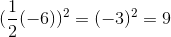
Adding 16 will complete the square for y, since 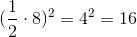

Now we just need to simplify. Re-write the left side as two binomials squared, and add the numbers on the right side:

To determine the standard-form equation, we'll have to complete the square for both x and y. It will be really helpful to re-group our terms to do that:
Adding 9 will complete the square for x, since
Adding 16 will complete the square for y, since
Now we just need to simplify. Re-write the left side as two binomials squared, and add the numbers on the right side:
← Didn't Know|Knew It →
Determine the equation of a circle whose center is at  and radius is
  .
.
Determine the equation of a circle whose center is at
Tap to reveal answer
To solve, simply use the formula for a circle as given below.

Thus, our answer is:

To solve, simply use the formula for a circle as given below.
Thus, our answer is:
← Didn't Know|Knew It →