
Special Functions - Pre-Calculus
Card 1 of 36
Let
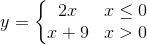
What does  equal when
  ?
?
Let
What does
Tap to reveal answer
Because 3>0 we plug the x value into the bottom equation.



Because 3>0 we plug the x value into the bottom equation.
← Didn't Know|Knew It →
Let
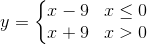
What does  equal when
  ?
?
Let
What does
Tap to reveal answer
Because  we use the first equation.

Therefore, plugging in x=0 into the above equation we get the following,
 .
.
Because
Therefore, plugging in x=0 into the above equation we get the following,
← Didn't Know|Knew It →
Determine the value of  if the function is
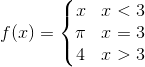
Determine the value of
Tap to reveal answer
In order to determine the value of  of the function we set
The value comes from the function in the first row of the piecewise function, and as such

In order to determine the value of
The value comes from the function in the first row of the piecewise function, and as such
← Didn't Know|Knew It →
Determine the value of if the function is
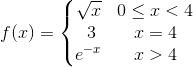
Determine the value of
Tap to reveal answer
In order to determine the value of of the function we set
The value comes from the function in the first row of the piecewise function, and as such

In order to determine the value of
The value comes from the function in the first row of the piecewise function, and as such
← Didn't Know|Knew It →
For the function  defined below, what is the value of
  when
when  ?
?

For the function 


Tap to reveal answer
Evaluate the function for  . Based on the domains of the three given expressions, you would use
  , since
  is greater than or equal to
  .
.

Evaluate the function for 


← Didn't Know|Knew It →
Evaluate: 
Evaluate:
Tap to reveal answer
Cancel the absolute value sign by separating the function  into its positive and negative counterparts.


Evaluate the first scenario.


Evaluate the second scenario.



The correct answer is:

Cancel the absolute value sign by separating the function
Evaluate the first scenario.
Evaluate the second scenario.
The correct answer is:
← Didn't Know|Knew It →
Which of the following is a point on the following function?

Which of the following is a point on the following function?
Tap to reveal answer
One way to approach this problem would be to plug in each answer and see what works. However, I would be a little more strategic and eliminate any options that don't make sense.
Our y value will never be negative, so eliminate any options with a negative y-value.
Try (0,0) really quick, since it's really easy

The only point that makes sense is (5,83), therefore it is the correct answer

One way to approach this problem would be to plug in each answer and see what works. However, I would be a little more strategic and eliminate any options that don't make sense.
Our y value will never be negative, so eliminate any options with a negative y-value.
Try (0,0) really quick, since it's really easy
The only point that makes sense is (5,83), therefore it is the correct answer
← Didn't Know|Knew It →
If  , then what is the value of
  when
when  ?
?
If 
Tap to reveal answer
We evaluate for 



Since the absolute value of any number represents its magnitude from  and is therefore always positive, the final answer would be
We evaluate for
Since the absolute value of any number represents its magnitude from 
← Didn't Know|Knew It →
Which of the following is a point on the following function?
Which of the following is a point on the following function?
Tap to reveal answer
One way to approach this problem would be to plug in each answer and see what works. However, I would be a little more strategic and eliminate any options that don't make sense.
Our y value will never be negative, so eliminate any options with a negative y-value.
Try (0,0) really quick, since it's really easy
The only point that makes sense is (5,83), therefore it is the correct answer
One way to approach this problem would be to plug in each answer and see what works. However, I would be a little more strategic and eliminate any options that don't make sense.
Our y value will never be negative, so eliminate any options with a negative y-value.
Try (0,0) really quick, since it's really easy
The only point that makes sense is (5,83), therefore it is the correct answer
← Didn't Know|Knew It →
Evaluate:
Evaluate:
Tap to reveal answer
Cancel the absolute value sign by separating the function into its positive and negative counterparts.
Evaluate the first scenario.
Evaluate the second scenario.
The correct answer is:
Cancel the absolute value sign by separating the function
Evaluate the first scenario.
Evaluate the second scenario.
The correct answer is:
← Didn't Know|Knew It →
If , then what is the value of when ?
If
Tap to reveal answer
We evaluate for
Since the absolute value of any number represents its magnitude from and is therefore always positive, the final answer would be
We evaluate for
Since the absolute value of any number represents its magnitude from
← Didn't Know|Knew It →
Let
What does equal when ?
Let
What does
Tap to reveal answer
Because 3>0 we plug the x value into the bottom equation.
Because 3>0 we plug the x value into the bottom equation.
← Didn't Know|Knew It →
Let
What does equal when ?
Let
What does
Tap to reveal answer
Because we use the first equation.
Therefore, plugging in x=0 into the above equation we get the following,
.
Because
Therefore, plugging in x=0 into the above equation we get the following,
← Didn't Know|Knew It →
Determine the value of if the function is
Determine the value of
Tap to reveal answer
In order to determine the value of of the function we set
The value comes from the function in the first row of the piecewise function, and as such
In order to determine the value of
The value comes from the function in the first row of the piecewise function, and as such
← Didn't Know|Knew It →
Determine the value of if the function is
Determine the value of
Tap to reveal answer
In order to determine the value of of the function we set
The value comes from the function in the first row of the piecewise function, and as such
In order to determine the value of
The value comes from the function in the first row of the piecewise function, and as such
← Didn't Know|Knew It →
For the function defined below, what is the value of when ?
For the function
Tap to reveal answer
Evaluate the function for . Based on the domains of the three given expressions, you would use , since is greater than or equal to .
Evaluate the function for
← Didn't Know|Knew It →
If  is the greatest integer function, what is the value of
  ?
?
If
Tap to reveal answer
The greatest integer function takes an input and produces the greatest integer less than the input. Thus, the output is always smaller than the input and is an integer itself. Since our input was  , we are looking for an integer less than this, which must be
  since any smaller integer would by definition not be "greatest".
The greatest integer function takes an input and produces the greatest integer less than the input. Thus, the output is always smaller than the input and is an integer itself. Since our input was
← Didn't Know|Knew It →
If is the greatest integer function, what is the value of ?
If
Tap to reveal answer
The greatest integer function takes an input and produces the greatest integer less than the input. Thus, the output is always smaller than the input and is an integer itself. Since our input was , we are looking for an integer less than this, which must be since any smaller integer would by definition not be "greatest".
The greatest integer function takes an input and produces the greatest integer less than the input. Thus, the output is always smaller than the input and is an integer itself. Since our input was
← Didn't Know|Knew It →
Which of the following is a point on the following function?
Which of the following is a point on the following function?
Tap to reveal answer
One way to approach this problem would be to plug in each answer and see what works. However, I would be a little more strategic and eliminate any options that don't make sense.
Our y value will never be negative, so eliminate any options with a negative y-value.
Try (0,0) really quick, since it's really easy
The only point that makes sense is (5,83), therefore it is the correct answer
One way to approach this problem would be to plug in each answer and see what works. However, I would be a little more strategic and eliminate any options that don't make sense.
Our y value will never be negative, so eliminate any options with a negative y-value.
Try (0,0) really quick, since it's really easy
The only point that makes sense is (5,83), therefore it is the correct answer
← Didn't Know|Knew It →
Evaluate:
Evaluate:
Tap to reveal answer
Cancel the absolute value sign by separating the function into its positive and negative counterparts.
Evaluate the first scenario.
Evaluate the second scenario.
The correct answer is:
Cancel the absolute value sign by separating the function
Evaluate the first scenario.
Evaluate the second scenario.
The correct answer is:
← Didn't Know|Knew It →