
Graph a Polynomial Function
Pre-Calculus · Learn by Concept
Help Questions
Pre-Calculus › Graph a Polynomial Function
Give the 

Round to the nearest tenth, if applicable.


The graph has no 
Explanation
The 


The 

Graph the function and identify the roots.


Explanation
This question tests one's ability to graph a polynomial function.
For the purpose of Common Core Standards, "graph polynomial functions, identifying zeros when suitable factorizations are available, and showing end behavior" falls within the Cluster C of "Analyze Functions Using Different Representations" concept (CCSS.MATH.CONTENT.HSF-IF.C.7).
Knowing the standard and the concept for which it relates to, we can now do the step-by-step process to solve the problem in question.
Step 1: Use algebraic technique to factor the function.
Recognize that the binomial is a perfect square for which the following formula can be used

since

thus the simplified, factored form is,

Step 2: Identify the roots of the function.
To find the roots of a function set its factored form equal to zero and solve for the possible x values.


Step 3: Create a table of 

The values in the table are found by substituting in the x values into the function as follows.

Step 4: Plot the points on a coordinate grid and connect them with a smooth curve.
Graph the function and identify its roots.


Explanation
This question tests one's ability to graph a polynomial function.
For the purpose of Common Core Standards, "graph polynomial functions, identifying zeros when suitable factorizations are available, and showing end behavior" falls within the Cluster C of "Analyze Functions Using Different Representations" concept (CCSS.MATH.CONTENT.HSF-IF.C.7).
Knowing the standard and the concept for which it relates to, we can now do the step-by-step process to solve the problem in question.
Step 1: Use algebraic technique to factor the function.
Recognize that the binomial is a perfect square for which the following formula can be used

since

thus the simplified, factored form is,

Step 2: Identify the roots of the function.
To find the roots of a function set its factored form equal to zero and solve for the possible x values.


Step 3: Create a table of

The values in the table are found by substituting in the x values into the function as follows.

Step 4: Plot the points on a coordinate grid and connect them with a smooth curve.
Graph the function and identify its roots.


Explanation
This question tests one's ability to graph a polynomial function.
For the purpose of Common Core Standards, "graph polynomial functions, identifying zeros when suitable factorizations are available, and showing end behavior" falls within the Cluster C of "Analyze Functions Using Different Representations" concept (CCSS.MATH.CONTENT.HSF-IF.C.7).
Knowing the standard and the concept for which it relates to, we can now do the step-by-step process to solve the problem in question.
Step 1: Use algebraic technique to factor the function.
Recognize that the binomial is a perfect square for which the following formula can be used
since

thus the simplified, factored form is,

Step 2: Identify the roots of the function.
To find the roots of a function set its factored form equal to zero and solve for the possible x values.


Step 3: Create a table of

The values in the table are found by substituting in the x values into the function as follows.

Step 4: Plot the points on a coordinate grid and connect them with a smooth curve.
Which of the following is an accurate graph of 
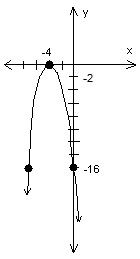
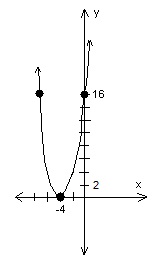
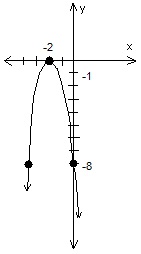
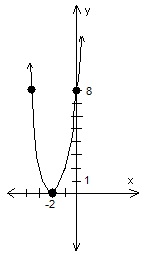
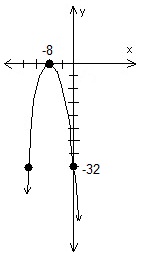
Explanation


Solving 




The resulting x-axis intercept is: 
Setting 



The resulting y-axis intercept is:

Graph the following function and identify the zeros.


Explanation
This question tests one's ability to graph a polynomial function.
For the purpose of Common Core Standards, "graph polynomial functions, identifying zeros when suitable factorizations are available, and showing end behavior" falls within the Cluster C of "Analyze Functions Using Different Representations" concept (CCSS.MATH.CONTENT.HSF-IF.C.7).
Knowing the standard and the concept for which it relates to, we can now do the step-by-step process to solve the problem in question.
Step 1: Use algebraic technique to factor the function.

Separating the function into two parts...

Factoring a negative one from the second set results in...

Factoring out 

The new factored form of the function is,

Now, recognize that the first binomial is a perfect square for which the following formula can be used

since

thus the simplified, factored form is,

Step 2: Identify the roots of the function.
To find the roots of a function set its factored form equal to zero and solve for the possible x values.

Step 3: Create a table of

The values in the table are found by substituting in the x values into the function as follows.

Step 4: Plot the points on a coordinate grid and connect them with a smooth curve.