
Algebra - PSAT Math
Card 1 of 5075
(√(8) / -x ) < 2. Which of the following values could be x?
(√(8) / -x ) < 2. Which of the following values could be x?
Tap to reveal answer
The equation simplifies to x > -1.41. -1 is the answer.
The equation simplifies to x > -1.41. -1 is the answer.
← Didn't Know|Knew It →
If f(x) = 5x – 10, then what is the value of 5(f(10)) – 10?
If f(x) = 5x – 10, then what is the value of 5(f(10)) – 10?
Tap to reveal answer
The first step is to find what f(10) equals, so f(10)=5(10) – 10 = 40. Then substitute 40 into the second equation: 5(40) – 10 = 200 – 10 = 190.
190 is the correct answer
The first step is to find what f(10) equals, so f(10)=5(10) – 10 = 40. Then substitute 40 into the second equation: 5(40) – 10 = 200 – 10 = 190.
190 is the correct answer
← Didn't Know|Knew It →
f(x) = 0.1x + 7
g(x) = 1000x + 4
What is g(f(100))?
f(x) = 0.1x + 7
g(x) = 1000x + 4
What is g(f(100))?
Tap to reveal answer
First find the value of f(100) = 0.1(100) + 7 = 10 + 7 = 17
Then find g(17) = 1000(17) + 4 = 17000 + 4 = 17004.
First find the value of f(100) = 0.1(100) + 7 = 10 + 7 = 17
Then find g(17) = 1000(17) + 4 = 17000 + 4 = 17004.
← Didn't Know|Knew It →
The rate of a gym membership costs p dollars the first month and m dollars per month every month thereafter. Which of the following represents the total cost of the gym membership for n months, if n is a positive integer?
The rate of a gym membership costs p dollars the first month and m dollars per month every month thereafter. Which of the following represents the total cost of the gym membership for n months, if n is a positive integer?
Tap to reveal answer
The one-time first-month cost is p, and the monthly cost is m, which gets multipled by every month but the first (of which there are n -1). The total cost is the first-month cost of p, plus the monthly cost for (i.e. times) n -1 months, which makes the total cost equal to p + m (n -1).
The one-time first-month cost is p, and the monthly cost is m, which gets multipled by every month but the first (of which there are n -1). The total cost is the first-month cost of p, plus the monthly cost for (i.e. times) n -1 months, which makes the total cost equal to p + m (n -1).
← Didn't Know|Knew It →
- If f(x) = (x + 4)/(x – 4) for all integers except x = 4, which of the following has the lowest value?
- If f(x) = (x + 4)/(x – 4) for all integers except x = 4, which of the following has the lowest value?
Tap to reveal answer
Plug each value for x into the above equation and solve for f(x). f(1) provides the lowest value –5/3
Plug each value for x into the above equation and solve for f(x). f(1) provides the lowest value –5/3
← Didn't Know|Knew It →
If n and p are positive and 100_n_3_p_-1 = 25_n_, what is n-2 in terms of p ?
If n and p are positive and 100_n_3_p_-1 = 25_n_, what is n-2 in terms of p ?
Tap to reveal answer
To solve this problem, we look for an operation to perform on both sides that will leave n-2 by itself on one side. Dividing both sides by 25_n_-3 would leave n-2 by itself on the right side of the equqation, as shown below:
100n3p–1/25n–3 = 25n/25n–3
Remember that when dividing terms with the same base, we subtract the exponents, so the equation can be written as 100n0p–1/25 = n–2
Finally, we simplify to find 4_p–_1 = _n–_2.
To solve this problem, we look for an operation to perform on both sides that will leave n-2 by itself on one side. Dividing both sides by 25_n_-3 would leave n-2 by itself on the right side of the equqation, as shown below:
100n3p–1/25n–3 = 25n/25n–3
Remember that when dividing terms with the same base, we subtract the exponents, so the equation can be written as 100n0p–1/25 = n–2
Finally, we simplify to find 4_p–_1 = _n–_2.
← Didn't Know|Knew It →
If 7y = 4x - 12, then x =
If 7y = 4x - 12, then x =
Tap to reveal answer
Adding 12 to both sides and dividing by 4 yields (7y+12)/4.
Adding 12 to both sides and dividing by 4 yields (7y+12)/4.
← Didn't Know|Knew It →
Which of the statements describes the solution set for **–**7(x + 3) = **–**7x + 20 ?
Which of the statements describes the solution set for **–**7(x + 3) = **–**7x + 20 ?
Tap to reveal answer
By distribution we obtain **–**7x – 21 = – 7x + 20. This equation is never possibly true.
By distribution we obtain **–**7x – 21 = – 7x + 20. This equation is never possibly true.
← Didn't Know|Knew It →
If a(x) = 2x3 + x, and b(x) = –2x, what is a(b(2))?
If a(x) = 2x3 + x, and b(x) = –2x, what is a(b(2))?
Tap to reveal answer
When functions are set up within other functions like in this problem, the function closest to the given variable is performed first. The value obtained from this function is then plugged in as the variable in the outside function. Since b(x) = –2x, and x = 2, the value we obtain from b(x) is –4. We then plug this value in for x in the a(x) function. So a(x) then becomes 2(–43) + (–4), which equals –132.
When functions are set up within other functions like in this problem, the function closest to the given variable is performed first. The value obtained from this function is then plugged in as the variable in the outside function. Since b(x) = –2x, and x = 2, the value we obtain from b(x) is –4. We then plug this value in for x in the a(x) function. So a(x) then becomes 2(–43) + (–4), which equals –132.
← Didn't Know|Knew It →
What is f(–3) if f(x) = _x_2 + 5?
What is f(–3) if f(x) = _x_2 + 5?
Tap to reveal answer
f(–3) = (–3)2 + 5 = 9 + 5 = 14
f(–3) = (–3)2 + 5 = 9 + 5 = 14
← Didn't Know|Knew It →
A rowing team paddles upstream at a rate of 10 miles every 2 hours and downstream at a rate of 27 miles every 3 hours. Assuming they are paddling at the same rate up and downstream, what is the speed of the water?
A rowing team paddles upstream at a rate of 10 miles every 2 hours and downstream at a rate of 27 miles every 3 hours. Assuming they are paddling at the same rate up and downstream, what is the speed of the water?
Tap to reveal answer
Upstream: p – w = (10/2) or p – w = 5 miles/hour
Downstream: p + w = (27/3) or p + w = 9 miles/hour
Then we add the two equations together to cancel out the w's. After adding we see
2p = 14
p = 7 miles/hour where p is the rate of the paddling. We plug p into the equation to find
w = 2 miles/hour where w is the rate of the stream's water.
Upstream: p – w = (10/2) or p – w = 5 miles/hour
Downstream: p + w = (27/3) or p + w = 9 miles/hour
Then we add the two equations together to cancel out the w's. After adding we see
2p = 14
p = 7 miles/hour where p is the rate of the paddling. We plug p into the equation to find
w = 2 miles/hour where w is the rate of the stream's water.
← Didn't Know|Knew It →
Tim is two years older than his twin sisters, Rachel and Claire. The sum of their ages is 65. How old is Tim?
Tim is two years older than his twin sisters, Rachel and Claire. The sum of their ages is 65. How old is Tim?
Tap to reveal answer
The answer is 23.
Since Rachel and Claire are twins they are the same age. We will use the variable r to represent both Rachel and Claire's ages.
From the question we can form two equations. They are:
t = r + 2 and 65 = t + 2r
lets plug the first equation into the second to solve for r.
65 = (r + 2) + 2r
65 = 3r +2
63 = 3r
r = 21 This means Rachel and Claire are 21 years old. Plug this into the equation so
t = 23 Tim is 23 years old.
The answer is 23.
Since Rachel and Claire are twins they are the same age. We will use the variable r to represent both Rachel and Claire's ages.
From the question we can form two equations. They are:
t = r + 2 and 65 = t + 2r
lets plug the first equation into the second to solve for r.
65 = (r + 2) + 2r
65 = 3r +2
63 = 3r
r = 21 This means Rachel and Claire are 21 years old. Plug this into the equation so
t = 23 Tim is 23 years old.
← Didn't Know|Knew It →
If f(x) = 5x/a, and g(x) = ax/10, what is f(2) + g(5)?
If f(x) = 5x/a, and g(x) = ax/10, what is f(2) + g(5)?
Tap to reveal answer
(20+a2) / 2a is the answer. Find a common denominator to add the 2 fractions after plugging in the values. So we get 10/a + a/2 after plugging in the values. The lowest common denominator would be 2a. Mutiply 10/a by 2/2, and multiply a/2 by a/a. The new equation appears as 20/2a + a2/2a. Add them together to get (20 + a2)/2a.
(20+a2) / 2a is the answer. Find a common denominator to add the 2 fractions after plugging in the values. So we get 10/a + a/2 after plugging in the values. The lowest common denominator would be 2a. Mutiply 10/a by 2/2, and multiply a/2 by a/a. The new equation appears as 20/2a + a2/2a. Add them together to get (20 + a2)/2a.
← Didn't Know|Knew It →
(√(4) + √(16))2 = ?
(√(4) + √(16))2 = ?
Tap to reveal answer
If we use order of operations (PEMDAS), the answer is 36.
If we use order of operations (PEMDAS), the answer is 36.
← Didn't Know|Knew It →
x * y = –a, a – x = 2a. What is y?
x * y = –a, a – x = 2a. What is y?
Tap to reveal answer
Use the second equation to find x in terms of a. Plug it back in the second equation, that will give you 1 = y.
Use the second equation to find x in terms of a. Plug it back in the second equation, that will give you 1 = y.
← Didn't Know|Knew It →
The projected sales of a movie are given by the function s(p) = 3000/(2_p_ + a) where s is the number of movies sold, in thousands; p is the price per movie, in dollars; and a is a constant. If according to projections, 75,000 cartidges will be sold at $15 each, how many movies are sold at $20 each?
The projected sales of a movie are given by the function s(p) = 3000/(2_p_ + a) where s is the number of movies sold, in thousands; p is the price per movie, in dollars; and a is a constant. If according to projections, 75,000 cartidges will be sold at $15 each, how many movies are sold at $20 each?
Tap to reveal answer
You set up the equation to solve for a.
75 = 3000/(2(15) + a)
a = 10
You then set up the formula again for each movie costing $20, s(20)= 3000/(2(20) + 10), and solve for x, the number sold, giving you 60.
You set up the equation to solve for a.
75 = 3000/(2(15) + a)
a = 10
You then set up the formula again for each movie costing $20, s(20)= 3000/(2(20) + 10), and solve for x, the number sold, giving you 60.
← Didn't Know|Knew It →
Half of one hundred divided by five and multiplied by one-tenth is .
Half of one hundred divided by five and multiplied by one-tenth is .
Tap to reveal answer
Let's take this step by step. "Half of one hundred" is 100/2 = 50. Then "half of one hundred divided by five" is 50/5 = 10. "Multiplied by one-tenth" really is the same as dividing by ten, so the last step gives us 10/10 = 1.
Let's take this step by step. "Half of one hundred" is 100/2 = 50. Then "half of one hundred divided by five" is 50/5 = 10. "Multiplied by one-tenth" really is the same as dividing by ten, so the last step gives us 10/10 = 1.
← Didn't Know|Knew It →
Let x&y be defined as (x – y)xy . What is the value of –1_&_2?
Let x&y be defined as (x – y)xy . What is the value of –1_&_2?
Tap to reveal answer
We are told that x&y = (x – y)xy .
–1&2 = (–1 – 2)(–1)(2) = (–3)–2
To simplify this, we can make use of the property of exponents which states that a– b = 1/(ab ).
(–3)–2 = 1/(–3)2 = 1/9
The answer is 1/9.
We are told that x&y = (x – y)xy .
–1&2 = (–1 – 2)(–1)(2) = (–3)–2
To simplify this, we can make use of the property of exponents which states that a– b = 1/(ab ).
(–3)–2 = 1/(–3)2 = 1/9
The answer is 1/9.
← Didn't Know|Knew It →
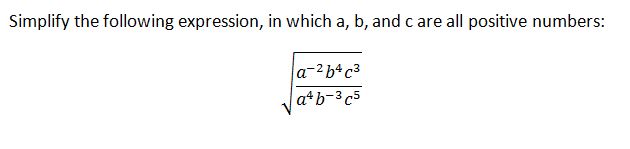
Tap to reveal answer
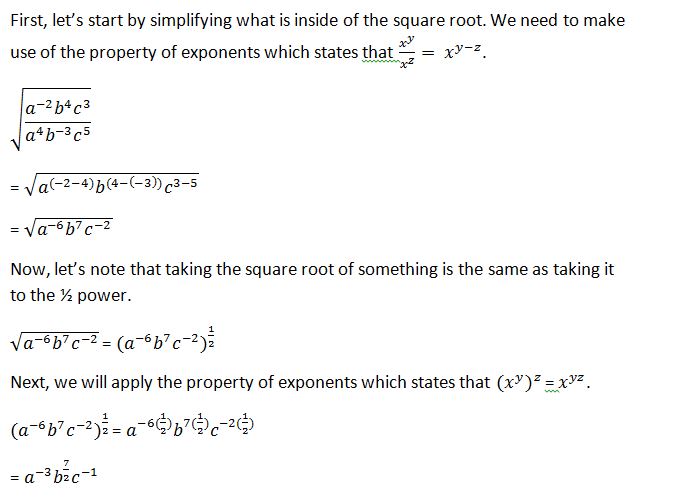
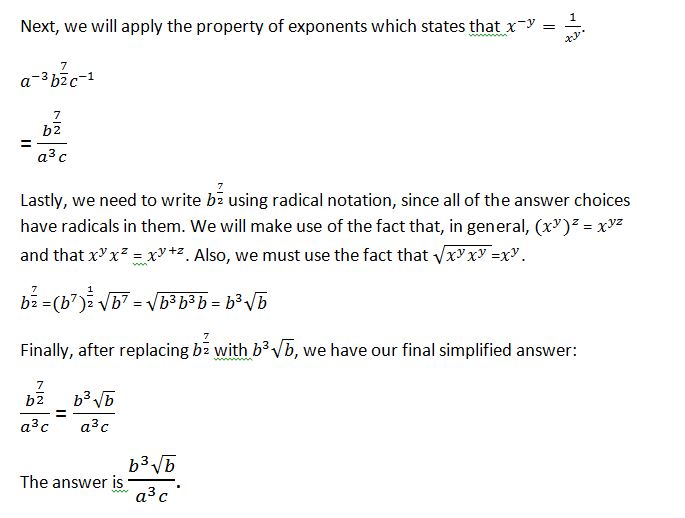
← Didn't Know|Knew It →
54 / 25 =
54 / 25 =
Tap to reveal answer
25 = 5 * 5 = 52. Then 54 / 25 = 54 / 52.
Now we can subtract the exponents because the operation is division. 54 / 52 = 54 – 2 = 52 = 25. The answer is therefore 25.
25 = 5 * 5 = 52. Then 54 / 25 = 54 / 52.
Now we can subtract the exponents because the operation is division. 54 / 52 = 54 – 2 = 52 = 25. The answer is therefore 25.
← Didn't Know|Knew It →