
Decimals - PSAT Math
Card 1 of 322
simplify: 0.2 ÷ 0.04
simplify: 0.2 ÷ 0.04
Tap to reveal answer
0.2 ÷ 0.04 <- easiest way to approach is to move the decimal to the right (the same amount of spaces on each side) so that the decimal disappears
since 0.04 has 2 spaces and 0.2 only has 1, move the decimal 2 spaces to the right on each side
0.2 ÷ 0.04 = 20 ÷ 4 = 5
0.2 ÷ 0.04 <- easiest way to approach is to move the decimal to the right (the same amount of spaces on each side) so that the decimal disappears
since 0.04 has 2 spaces and 0.2 only has 1, move the decimal 2 spaces to the right on each side
0.2 ÷ 0.04 = 20 ÷ 4 = 5
← Didn't Know|Knew It →
If the cost of 20 equally priced pencils cost $5.80, then at the same rate what is the greatest number of pencils you can purchase for $50?
If the cost of 20 equally priced pencils cost $5.80, then at the same rate what is the greatest number of pencils you can purchase for $50?
Tap to reveal answer
Remeber for this problem that you cannot spend more than $50. First find the price of each pencil by 5.80/20 = 29 cents. And then use this to do 50/0.29 = 172.41. So the greatest number of pencils you can purchase for $50 is 172 pencils.
Remeber for this problem that you cannot spend more than $50. First find the price of each pencil by 5.80/20 = 29 cents. And then use this to do 50/0.29 = 172.41. So the greatest number of pencils you can purchase for $50 is 172 pencils.
← Didn't Know|Knew It →
Simplify:

Simplify:
Tap to reveal answer
Multiply both the numerator and denominator by some power of 10 to get rid of the decimals; in this case, multiply both by 10,000.
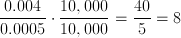
Multiply both the numerator and denominator by some power of 10 to get rid of the decimals; in this case, multiply both by 10,000.
← Didn't Know|Knew It →
Charlie has charges on his credit card of $63.70, $37.32, and $81.78. If he pays down half his bill at once, and then pays the rest in four equal monthly installments, how much is each monthly installment?
Charlie has charges on his credit card of $63.70, $37.32, and $81.78. If he pays down half his bill at once, and then pays the rest in four equal monthly installments, how much is each monthly installment?
Tap to reveal answer
Adding all the charges together and dividing by 2 yields $91.40. Dividing this by 4 yields a monthly installment of $22.85.
Adding all the charges together and dividing by 2 yields $91.40. Dividing this by 4 yields a monthly installment of $22.85.
← Didn't Know|Knew It →
Which number has 2.8 as its reciprocal?
Which number has 2.8 as its reciprocal?
Tap to reveal answer
The number that has 2.8 as its reciprocal is, in return, the reciprocal of 2.8.
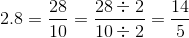
The reciprocal of this can be found by switching the numerator and the denominator. This is  .
.
The number that has 2.8 as its reciprocal is, in return, the reciprocal of 2.8.
The reciprocal of this can be found by switching the numerator and the denominator. This is
← Didn't Know|Knew It →
23 grams of sodium are equal to  atoms. How many atoms comprise one milligram of sodium?
(Select the closest answer)
23 grams of sodium are equal to
(Select the closest answer)
Tap to reveal answer
23 grams are equal to 23,000 milligrams, so to find the number of atoms in one milligram, divide:
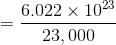
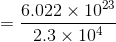
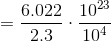

23 grams are equal to 23,000 milligrams, so to find the number of atoms in one milligram, divide:
← Didn't Know|Knew It →
Order the following decimals in order from least to greatest:
2.1, 6.9, 4.8, 5.2, 8.5
Order the following decimals in order from least to greatest:
2.1, 6.9, 4.8, 5.2, 8.5
Tap to reveal answer
Look at the ones place first, ignoring the decimal. The order from greatest to least is 2, 4, 5, 6, and 8. Because none of the numbers in the ones place are the same, it doesn't matter what the decimal will be on these numbers- the order will remain the same. The order is 2.1, 4.8, 5.2, 6.9, 8.5.
Look at the ones place first, ignoring the decimal. The order from greatest to least is 2, 4, 5, 6, and 8. Because none of the numbers in the ones place are the same, it doesn't matter what the decimal will be on these numbers- the order will remain the same. The order is 2.1, 4.8, 5.2, 6.9, 8.5.
← Didn't Know|Knew It →
Which of these decimals are the greatest?

Which of these decimals are the greatest?
Tap to reveal answer
look at the first decimal place; 0.2 and 0.201 are the largest.
0.2 = 0.200 and 0.201 > 0.200
0.201 is the greatest given decimal.
look at the first decimal place; 0.2 and 0.201 are the largest.
0.2 = 0.200 and 0.201 > 0.200
0.201 is the greatest given decimal.
← Didn't Know|Knew It →
Which of these decimals has the least value?
Which of these decimals has the least value?
Tap to reveal answer
Trailing zeros at the end of a decimal do not increase or decrease the value of a given decimal. However, zeros that appear after the decimal point and precede a non-zero number decrease the value of the number.
Trailing zeros at the end of a decimal do not increase or decrease the value of a given decimal. However, zeros that appear after the decimal point and precede a non-zero number decrease the value of the number.
← Didn't Know|Knew It →
Which of the following is the greatest in value?
Which of the following is the greatest in value?
Tap to reveal answer
Turn the fractions into decimals to easily compare them. You can do this quickly on your calculator.
 is approximately 2.667, so this is the largest number.
Turn the fractions into decimals to easily compare them. You can do this quickly on your calculator.
← Didn't Know|Knew It →
In the number 5,783.2935, what is the digit in the hundredths place?
In the number 5,783.2935, what is the digit in the hundredths place?
Tap to reveal answer
The digit in the hundredths place is the one two decimal places to the right of the decimal. That digit is 9. Do not confuse the hundredths with the hundreds place, which is three spaces to the left of the decimal.
The answer is 9.
The digit in the hundredths place is the one two decimal places to the right of the decimal. That digit is 9. Do not confuse the hundredths with the hundreds place, which is three spaces to the left of the decimal.
The answer is 9.
← Didn't Know|Knew It →
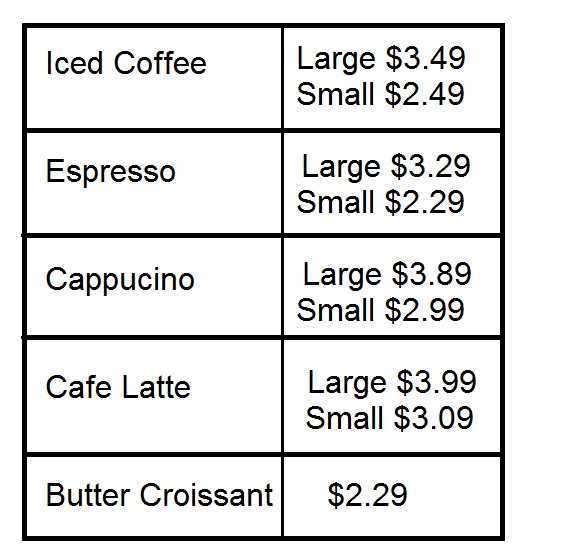
Five friends go to a coffee shop, the menu for which is above. Each has a coupon that is good for one dollar off the price of a butter croissant with the purchase of a large drink, or fifty cents off the price of a butter croissant with the purchase of a small drink.
Mick buys one large iced coffee and one butter croissant.
Keith buys one small iced coffee and one butter croissant.
Bill buys one large cappucino and one butter croissant.
Charlie buys one small cappucino and one butter croissant.
Brian buys two butter croissants.
Who will pay the most, if everyone who can use his coupon does?
Five friends go to a coffee shop, the menu for which is above. Each has a coupon that is good for one dollar off the price of a butter croissant with the purchase of a large drink, or fifty cents off the price of a butter croissant with the purchase of a small drink.
Mick buys one large iced coffee and one butter croissant.
Keith buys one small iced coffee and one butter croissant.
Bill buys one large cappucino and one butter croissant.
Charlie buys one small cappucino and one butter croissant.
Brian buys two butter croissants.
Who will pay the most, if everyone who can use his coupon does?
Tap to reveal answer
Mick orders a large drink, so he uses his coupon to save a dollar off his croissant. He will pay

Bill orders a large drink, so he uses his coupon to save a dollar off his croissant. He will pay

Keith orders a small drink, so he uses his coupon to save fifty cents off his croissant. He will pay

Charlie orders a small drink, so he uses his coupon to save fifty cents off his croissant. He will pay

Brian does not buy a coffee, so he will not use his coupon. He will pay full price for both croissants, which will be

Bill pays the most.
Mick orders a large drink, so he uses his coupon to save a dollar off his croissant. He will pay
Bill orders a large drink, so he uses his coupon to save a dollar off his croissant. He will pay
Keith orders a small drink, so he uses his coupon to save fifty cents off his croissant. He will pay
Charlie orders a small drink, so he uses his coupon to save fifty cents off his croissant. He will pay
Brian does not buy a coffee, so he will not use his coupon. He will pay full price for both croissants, which will be
Bill pays the most.
← Didn't Know|Knew It →
What is the median of the following numbers:  ,
,  ,
,  ,
,  , and
, and  ?
?
What is the median of the following numbers:
Tap to reveal answer
The median of a given set of numbers is the number that occurs precisely in the middle of all the numbers when they are put in numerical order. Thus, in order to find the median of this set of numbers, you must first put then in order from least to greatest, then find the number in the middle (the third number, in this set of five).
Numerical order for these numbers is:
2.74, 3,33, 3.45, 3.56, 3.89
Thus, the median is 3.45.
The median of a given set of numbers is the number that occurs precisely in the middle of all the numbers when they are put in numerical order. Thus, in order to find the median of this set of numbers, you must first put then in order from least to greatest, then find the number in the middle (the third number, in this set of five).
Numerical order for these numbers is:
2.74, 3,33, 3.45, 3.56, 3.89
Thus, the median is 3.45.
← Didn't Know|Knew It →
Write 0.45 as a fraction.
Write 0.45 as a fraction.
Tap to reveal answer
.45 is equivalent to 45 out of 100, or  .
.
Divide both the numerator and denominator by 5 to simplify the fraction:

.45 is equivalent to 45 out of 100, or
Divide both the numerator and denominator by 5 to simplify the fraction:
← Didn't Know|Knew It →
Express as a fraction: 
Express as a fraction:
Tap to reveal answer
Let 
Then

and

Subtract:




Let
Then
and
Subtract:
← Didn't Know|Knew It →
45.728 x 3.2 = ?
45.728 x 3.2 = ?
Tap to reveal answer
Multiply the numbers out in long format, then move the decimal point over the total number of decimal points in the two numbers (3 in the first, 1 in the second, so 4 total):
45.728 * 3.2 = 91456
91456 + 1371840 = 1,463,296 → 146.3296
Or just count the decimal points in the answer and make sure it's 4.
Multiply the numbers out in long format, then move the decimal point over the total number of decimal points in the two numbers (3 in the first, 1 in the second, so 4 total):
45.728 * 3.2 = 91456
91456 + 1371840 = 1,463,296 → 146.3296
Or just count the decimal points in the answer and make sure it's 4.
← Didn't Know|Knew It →
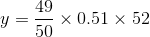
If  is 25% of
  , what is the closest integer to the value of __
 _?
_?
If
Tap to reveal answer
We can approximate the value of y pretty quickly:
y ≈ 1(0.50)(52) = 26
Since y = 0.25x = (1/4)x we know that x = 4y ≈ 4(26) = 104
We can approximate the value of y pretty quickly:
y ≈ 1(0.50)(52) = 26
Since y = 0.25x = (1/4)x we know that x = 4y ≈ 4(26) = 104
← Didn't Know|Knew It →

Tap to reveal answer
It's much easier to work with whole numbers, so we'll ignore the decimals for the first step: 5 x 12 = 60
Now look at the decimals. To add them back in, think of 60 as 60.0. Now move the decimal point four places to the left: 0.5 x 0.012 = .0060 = .006
It's much easier to work with whole numbers, so we'll ignore the decimals for the first step: 5 x 12 = 60
Now look at the decimals. To add them back in, think of 60 as 60.0. Now move the decimal point four places to the left: 0.5 x 0.012 = .0060 = .006
← Didn't Know|Knew It →
At the farmer's market, oranges are $0.30 each, apples are $0.25 each, bananas are $0.40 each, and tomatoes are $0.60 each. If Scott buys 3 oranges, 7 apples, 4 bananas, and 8 tomatoes, how much does he spend?
At the farmer's market, oranges are $0.30 each, apples are $0.25 each, bananas are $0.40 each, and tomatoes are $0.60 each. If Scott buys 3 oranges, 7 apples, 4 bananas, and 8 tomatoes, how much does he spend?
Tap to reveal answer
To find out how much Scott spends, we need to multiply the quantity of each fruit by its price and add them all up.
3 * $0.30 + 7 * $0.25 + 4 * $0.40 + 8 * $0.60 = $9.05
To find out how much Scott spends, we need to multiply the quantity of each fruit by its price and add them all up.
3 * $0.30 + 7 * $0.25 + 4 * $0.40 + 8 * $0.60 = $9.05
← Didn't Know|Knew It →
At the store, green fabric costs $4.53 a yard. How much does 3.8 yards of green fabric cost? (Round to two decimal places.)
At the store, green fabric costs $4.53 a yard. How much does 3.8 yards of green fabric cost? (Round to two decimal places.)
Tap to reveal answer
This is a simple multiplication problem involving decimals. Simply multiply 4.53 by 3.8:

Now, round to the nearest two decimal places, giving an answer of 17.21.
This is a simple multiplication problem involving decimals. Simply multiply 4.53 by 3.8:
Now, round to the nearest two decimal places, giving an answer of 17.21.
← Didn't Know|Knew It →