
Linear / Rational / Variable Equations - PSAT Math
Card 1 of 490
Consider the equation

Which of the following is true?
Consider the equation
Which of the following is true?
Tap to reveal answer
Multiply both sides by LCD  :
:


or

There are two solutions of unlike sign.
Multiply both sides by LCD
or
There are two solutions of unlike sign.
← Didn't Know|Knew It →
Find the solution to the following equation if x = 3:
y = (4x2 - 2)/(9 - x2)
Find the solution to the following equation if x = 3:
y = (4x2 - 2)/(9 - x2)
Tap to reveal answer
Substituting 3 in for x, you will get 0 in the denominator of the fraction. It is not possible to have 0 be the denominator for a fraction so there is no possible solution to this equation.
Substituting 3 in for x, you will get 0 in the denominator of the fraction. It is not possible to have 0 be the denominator for a fraction so there is no possible solution to this equation.
← Didn't Know|Knew It →
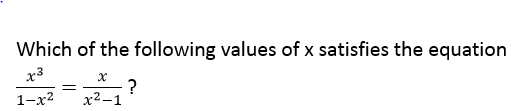
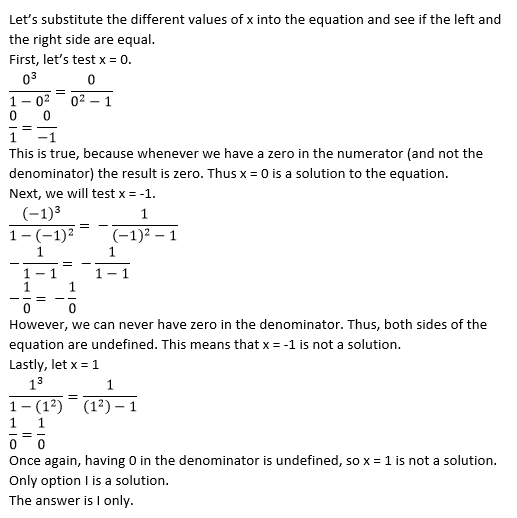
I. x = 0
II. x = –1
III. x = 1
I. x = 0
II. x = –1
III. x = 1
Tap to reveal answer
← Didn't Know|Knew It →
Tap to reveal answer
← Didn't Know|Knew It →


Tap to reveal answer
A fraction is considered undefined when the denominator equals 0. Set the denominator equal to zero and solve for the variable.


A fraction is considered undefined when the denominator equals 0. Set the denominator equal to zero and solve for the variable.
← Didn't Know|Knew It →
Consider the equation

Which of the following is true?
Consider the equation
Which of the following is true?
Tap to reveal answer
Multiply the equation on both sides by LCM  :
:


or


Substitution confirms that these are the solutions.
There are two solutions of unlike sign.
Multiply the equation on both sides by LCM
or
Substitution confirms that these are the solutions.
There are two solutions of unlike sign.
← Didn't Know|Knew It →
All of the following equations have no solution except for which one?
All of the following equations have no solution except for which one?
Tap to reveal answer
Since all of the equations have the same symbols save for one number, the problem is essentially as follows:
For what value of  does the equation

have a solution set other than the empty set?
We can simplify as follows:


If  and
and  are not equivalent expressions, the solution set is the empty set. If
  and
and  are equivalent expressions, the solution set is the set of all real numbers; this happens if and only if:


Therefore, the only equation among the given choices whose solution set is not the empty set is the equation

which is the correct choice.
Since all of the equations have the same symbols save for one number, the problem is essentially as follows:
For what value of
have a solution set other than the empty set?
We can simplify as follows:
If
Therefore, the only equation among the given choices whose solution set is not the empty set is the equation
which is the correct choice.
← Didn't Know|Knew It →
Which of the following equations has no solution?
Which of the following equations has no solution?
Tap to reveal answer
The problem is basically asking for what value of  the equation

has no solution.
We can simplify as folllows:


Since the absolute value of a number must be nonnegative, regardless of the value of  , this equation can never have a solution. Therefore, the correct response is that none of the given equations has a solution.
The problem is basically asking for what value of
has no solution.
We can simplify as folllows:
Since the absolute value of a number must be nonnegative, regardless of the value of
← Didn't Know|Knew It →
Which of the following equations has no real solutions?
Which of the following equations has no real solutions?
Tap to reveal answer
We can examine each individually.


This equation has a solution.


This equation has a solution.


This equation has a solution.


This equation has no solution, since a fourth root of a number must be nonnegative.
The correct choice is  .
.
We can examine each individually.
This equation has a solution.
This equation has a solution.
This equation has a solution.
This equation has no solution, since a fourth root of a number must be nonnegative.
The correct choice is
← Didn't Know|Knew It →
Solve  .
.
Solve
Tap to reveal answer
By definition, the absolute value of an expression can never be less than 0. Therefore, there are no solutions to the above expression.
By definition, the absolute value of an expression can never be less than 0. Therefore, there are no solutions to the above expression.
← Didn't Know|Knew It →
Find the solution to the following equation if x = 3:
y = (4x2 - 2)/(9 - x2)
Find the solution to the following equation if x = 3:
y = (4x2 - 2)/(9 - x2)
Tap to reveal answer
Substituting 3 in for x, you will get 0 in the denominator of the fraction. It is not possible to have 0 be the denominator for a fraction so there is no possible solution to this equation.
Substituting 3 in for x, you will get 0 in the denominator of the fraction. It is not possible to have 0 be the denominator for a fraction so there is no possible solution to this equation.
← Didn't Know|Knew It →
I. x = 0
II. x = –1
III. x = 1
I. x = 0
II. x = –1
III. x = 1
Tap to reveal answer
← Didn't Know|Knew It →
Tap to reveal answer
← Didn't Know|Knew It →
Tap to reveal answer
A fraction is considered undefined when the denominator equals 0. Set the denominator equal to zero and solve for the variable.
A fraction is considered undefined when the denominator equals 0. Set the denominator equal to zero and solve for the variable.
← Didn't Know|Knew It →
Consider the equation
Which of the following is true?
Consider the equation
Which of the following is true?
Tap to reveal answer
Multiply the equation on both sides by LCM :
or
Substitution confirms that these are the solutions.
There are two solutions of unlike sign.
Multiply the equation on both sides by LCM
or
Substitution confirms that these are the solutions.
There are two solutions of unlike sign.
← Didn't Know|Knew It →
Consider the equation
Which of the following is true?
Consider the equation
Which of the following is true?
Tap to reveal answer
Multiply both sides by LCD :
or
There are two solutions of unlike sign.
Multiply both sides by LCD
or
There are two solutions of unlike sign.
← Didn't Know|Knew It →
All of the following equations have no solution except for which one?
All of the following equations have no solution except for which one?
Tap to reveal answer
Since all of the equations have the same symbols save for one number, the problem is essentially as follows:
For what value of does the equation
have a solution set other than the empty set?
We can simplify as follows:
If and are not equivalent expressions, the solution set is the empty set. If and are equivalent expressions, the solution set is the set of all real numbers; this happens if and only if:
Therefore, the only equation among the given choices whose solution set is not the empty set is the equation
which is the correct choice.
Since all of the equations have the same symbols save for one number, the problem is essentially as follows:
For what value of
have a solution set other than the empty set?
We can simplify as follows:
If
Therefore, the only equation among the given choices whose solution set is not the empty set is the equation
which is the correct choice.
← Didn't Know|Knew It →
Which of the following equations has no solution?
Which of the following equations has no solution?
Tap to reveal answer
The problem is basically asking for what value of the equation
has no solution.
We can simplify as folllows:
Since the absolute value of a number must be nonnegative, regardless of the value of , this equation can never have a solution. Therefore, the correct response is that none of the given equations has a solution.
The problem is basically asking for what value of
has no solution.
We can simplify as folllows:
Since the absolute value of a number must be nonnegative, regardless of the value of
← Didn't Know|Knew It →
Which of the following equations has no real solutions?
Which of the following equations has no real solutions?
Tap to reveal answer
We can examine each individually.
This equation has a solution.
This equation has a solution.
This equation has a solution.
This equation has no solution, since a fourth root of a number must be nonnegative.
The correct choice is .
We can examine each individually.
This equation has a solution.
This equation has a solution.
This equation has a solution.
This equation has no solution, since a fourth root of a number must be nonnegative.
The correct choice is
← Didn't Know|Knew It →
Solve .
Solve
Tap to reveal answer
By definition, the absolute value of an expression can never be less than 0. Therefore, there are no solutions to the above expression.
By definition, the absolute value of an expression can never be less than 0. Therefore, there are no solutions to the above expression.
← Didn't Know|Knew It →