
Triangles - PSAT Math
Card 1 of 1001
If triangle ABC has vertices (0, 0), (6, 0), and (2, 3) in the xy-plane, what is the area of ABC?
If triangle ABC has vertices (0, 0), (6, 0), and (2, 3) in the xy-plane, what is the area of ABC?
Tap to reveal answer
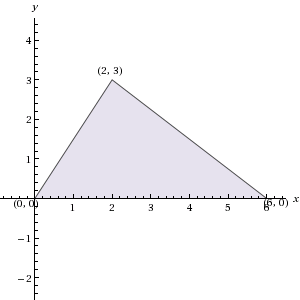
Sketching ABC in the xy-plane, as pictured here, we see that it has base 6 and height 3. Since the formula for the area of a triangle is 1/2 * base * height, the area of ABC is 1/2 * 6 * 3 = 9.
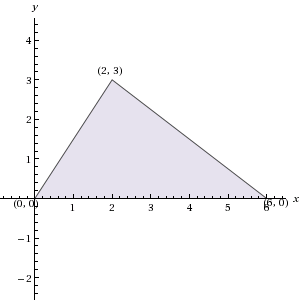
Sketching ABC in the xy-plane, as pictured here, we see that it has base 6 and height 3. Since the formula for the area of a triangle is 1/2 * base * height, the area of ABC is 1/2 * 6 * 3 = 9.
← Didn't Know|Knew It →
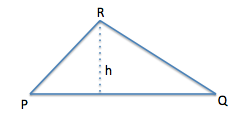
The height,  , of triangle
  in the figure is one-fourth the length of
  . In terms of h, what is the area of triangle
  ?
?
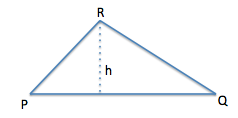
The height, 


Tap to reveal answer
If  *
* , then the length of
  must be
  .
.
Using the formula for the area of a triangle ( ), with
  , the area of the triangle must be
  .
.
If
Using the formula for the area of a triangle (
← Didn't Know|Knew It →
A triangle with two equal angles is called a(n) .
A triangle with two equal angles is called a(n) .
Tap to reveal answer
An isoceles triangle is a triangle that has at least two congruent sides (and therefore, at least two congruent angles as well).
An isoceles triangle is a triangle that has at least two congruent sides (and therefore, at least two congruent angles as well).
← Didn't Know|Knew It →
An isosceles triangle has an area of 12. If the ratio of the base to the height is 3:2, what is the length of the two equal sides?
An isosceles triangle has an area of 12. If the ratio of the base to the height is 3:2, what is the length of the two equal sides?
Tap to reveal answer
Area of a triangle is ½ x base x height. Since base:height = 3:2, base = 1.5 height. Area = 12 = ½ x 1.5 height x height or 24/1.5 = height2. Height = 4. Base = 1.5 height = 6. Half the base and the height form the legs of a right triangle, with an equal leg of the isosceles triangle as the hypotenuse. This is a 3-4-5 right triangle.
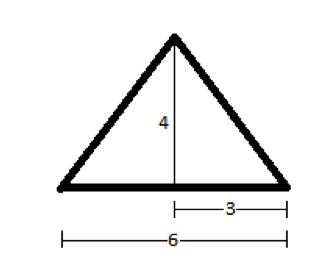
Area of a triangle is ½ x base x height. Since base:height = 3:2, base = 1.5 height. Area = 12 = ½ x 1.5 height x height or 24/1.5 = height2. Height = 4. Base = 1.5 height = 6. Half the base and the height form the legs of a right triangle, with an equal leg of the isosceles triangle as the hypotenuse. This is a 3-4-5 right triangle.
← Didn't Know|Knew It →
Two sides of a triangle each have length 6. All of the following could be the length of the third side EXCEPT
Two sides of a triangle each have length 6. All of the following could be the length of the third side EXCEPT
Tap to reveal answer
This question is about the Triangle Inequality, which states that in a triangle with two sides A and B, the third side must be greater than the absolute value of the difference between A and B and smaller than the sum of A and B.
Applying the Triangle Inequality to this problem, we see that the third side must be greater than the absolute value of the difference between the other two sides, which is |6-6|=0, and smaller than the sum of the two other sides, which is 6+6=12. The only answer choice that does not satisfy this range of possible values is 12 since the third side must be LESS than 12.
This question is about the Triangle Inequality, which states that in a triangle with two sides A and B, the third side must be greater than the absolute value of the difference between A and B and smaller than the sum of A and B.
Applying the Triangle Inequality to this problem, we see that the third side must be greater than the absolute value of the difference between the other two sides, which is |6-6|=0, and smaller than the sum of the two other sides, which is 6+6=12. The only answer choice that does not satisfy this range of possible values is 12 since the third side must be LESS than 12.
← Didn't Know|Knew It →
You are given triangles  and
and  , with
  and
and  . Which of these statements, along with what you are given, is not enough to prove that
  ?
?
I)  and
and  have the same perimeter
II) 
III) 
You are given triangles
I)
II)
III)
Tap to reveal answer
If  and
and  have the same perimeter,
  , and
, and  , it follows that
  . The three triangles have the same sidelengths, setting the conditions for the Side-Side-Side Congruence Postulate.
If  , then, since the sum of the degree measures of both triangles is the same (180 degrees), it follows that
  . Since
  and
and  are congruent included angles of congruent sides, this sets the conditions for the SAS Congruence Postulate.
In both of the above cases, it follows that  .
.
However, similarly to the previous situation, if  , then it follows that
  , meaning that we have congruent sides and congruent nonincluded angles. However, this is not sufficient to prove congruence.
"Statement III" is the correct response.
If
If
In both of the above cases, it follows that
However, similarly to the previous situation, if
"Statement III" is the correct response.
← Didn't Know|Knew It →
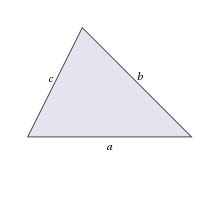
If a = 7 and b = 4, which of the following could be the perimeter of the triangle?
I. 11
II. 15
III. 25
If a = 7 and b = 4, which of the following could be the perimeter of the triangle?
I. 11
II. 15
III. 25
Tap to reveal answer
Consider the perimeter of a triangle:
P = a + b + c
Since we know a and b, we can find c.
In I:
11 = 7 + 4 + c
11 = 11 + c
c = 0
Note that if c = 0, the shape is no longer a trial. Thus, we can eliminate I.
In II:
15 = 7 + 4 + c
15 = 11 + c
c = 4.
This is plausible given that the other sides are 7 and 4.
In III:
25 = 7 + 4 + c
25 = 11 + c
c = 14.
It is not possible for one side of a triangle to be greater than the sum of both of the other sides, so eliminate III.
Thus we are left with only II.
Consider the perimeter of a triangle:
P = a + b + c
Since we know a and b, we can find c.
In I:
11 = 7 + 4 + c
11 = 11 + c
c = 0
Note that if c = 0, the shape is no longer a trial. Thus, we can eliminate I.
In II:
15 = 7 + 4 + c
15 = 11 + c
c = 4.
This is plausible given that the other sides are 7 and 4.
In III:
25 = 7 + 4 + c
25 = 11 + c
c = 14.
It is not possible for one side of a triangle to be greater than the sum of both of the other sides, so eliminate III.
Thus we are left with only II.
← Didn't Know|Knew It →
Find the height of a triangle if the area of the triangle = 18 and the base = 4.
Find the height of a triangle if the area of the triangle = 18 and the base = 4.
Tap to reveal answer
The area of a triangle = (1/2)bh where b is base and h is height. 18 = (1/2)4h which gives us 36 = 4h so h =9.
The area of a triangle = (1/2)bh where b is base and h is height. 18 = (1/2)4h which gives us 36 = 4h so h =9.
← Didn't Know|Knew It →
The area of square ABCD is 50% greater than the perimeter of the equilateral triangle EFG. If the area of square ABCD is equal to 45, then what is the area of EFG?
The area of square ABCD is 50% greater than the perimeter of the equilateral triangle EFG. If the area of square ABCD is equal to 45, then what is the area of EFG?
Tap to reveal answer
If the area of ABCD is equal to 45, then the perimeter of EFG is equal to x * 1.5 = 45. 45 / 1.5 = 30, so the perimeter of EFG is equal to 30. This means that each side is equal to 10.
The height of the equilateral triangle EFG creates two 30-60-90 triangles, each with a hypotenuse of 10 and a short side equal to 5. We know that the long side of 30-60-90 triangle (here the height of EFG) is equal to √3 times the short side, or 5√3.
We then apply the formula for the area of a triangle, which is 1/2 * b * h. We get 1/2 * 10 * 5√3 = 5 * 5√3 = 25√ 3.
In general, the height of an equilateral triangle is equal to √3 / 2 times a side of the equilateral triangle. The area of an equilateral triangle is equal to 1/2 * √3s/ 2 * s = √3s2/4.
If the area of ABCD is equal to 45, then the perimeter of EFG is equal to x * 1.5 = 45. 45 / 1.5 = 30, so the perimeter of EFG is equal to 30. This means that each side is equal to 10.
The height of the equilateral triangle EFG creates two 30-60-90 triangles, each with a hypotenuse of 10 and a short side equal to 5. We know that the long side of 30-60-90 triangle (here the height of EFG) is equal to √3 times the short side, or 5√3.
We then apply the formula for the area of a triangle, which is 1/2 * b * h. We get 1/2 * 10 * 5√3 = 5 * 5√3 = 25√ 3.
In general, the height of an equilateral triangle is equal to √3 / 2 times a side of the equilateral triangle. The area of an equilateral triangle is equal to 1/2 * √3s/ 2 * s = √3s2/4.
← Didn't Know|Knew It →
What is the area of an equilateral triangle with sides 12 cm?
What is the area of an equilateral triangle with sides 12 cm?
Tap to reveal answer
An equilateral triangle has three congruent sides and results in three congruent angles. This figure results in two special right triangles back to back: 30° – 60° – 90° giving sides of x - x √3 – 2x in general. The height of the triangle is the x √3 side. So Atriangle = 1/2 bh = 1/2 * 12 * 6√3 = 36√3 cm2.
An equilateral triangle has three congruent sides and results in three congruent angles. This figure results in two special right triangles back to back: 30° – 60° – 90° giving sides of x - x √3 – 2x in general. The height of the triangle is the x √3 side. So Atriangle = 1/2 bh = 1/2 * 12 * 6√3 = 36√3 cm2.
← Didn't Know|Knew It →
An equilateral triangle has a perimeter of 18. What is its area?
An equilateral triangle has a perimeter of 18. What is its area?
Tap to reveal answer
Recall that an equilateral triangle also obeys the rules of isosceles triangles. That means that our triangle can be represented as having a height that bisects both the opposite side and the angle from which the height is "dropped." For our triangle, this can be represented as:
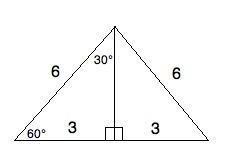
Now, although we do not yet know the height, we do know from our 30-60-90 regular triangle that the side opposite the 60° angle is √3 times the length of the side across from the 30° angle. Therefore, we know that the height is 3√3.
Now, the area of a triangle is (1/2)bh. If the height is 3√3 and the base is 6, then the area is (1/2) * 6 * 3√3 = 3 * 3√3 = 9√(3).
Recall that an equilateral triangle also obeys the rules of isosceles triangles. That means that our triangle can be represented as having a height that bisects both the opposite side and the angle from which the height is "dropped." For our triangle, this can be represented as:
Now, although we do not yet know the height, we do know from our 30-60-90 regular triangle that the side opposite the 60° angle is √3 times the length of the side across from the 30° angle. Therefore, we know that the height is 3√3.
Now, the area of a triangle is (1/2)bh. If the height is 3√3 and the base is 6, then the area is (1/2) * 6 * 3√3 = 3 * 3√3 = 9√(3).
← Didn't Know|Knew It →

Tap to reveal answer




← Didn't Know|Knew It →
A right triangle has one side equal to 5 and its hypotenuse equal to 14. Its third side is equal to:
A right triangle has one side equal to 5 and its hypotenuse equal to 14. Its third side is equal to:
Tap to reveal answer
The Pythagorean Theorem gives us _a_2 + _b_2 = _c_2 for a right triangle, where c is the hypotenuse and a and b are the smaller sides. Here a is equal to 5 and c is equal to 14, so _b_2 = 142 – 52 = 171. Therefore b is equal to the square root of 171 or approximately 13.07.
The Pythagorean Theorem gives us _a_2 + _b_2 = _c_2 for a right triangle, where c is the hypotenuse and a and b are the smaller sides. Here a is equal to 5 and c is equal to 14, so _b_2 = 142 – 52 = 171. Therefore b is equal to the square root of 171 or approximately 13.07.
← Didn't Know|Knew It →
Which of the following could NOT be the lengths of the sides of a right triangle?
Which of the following could NOT be the lengths of the sides of a right triangle?
Tap to reveal answer
We use the Pythagorean Theorem and we calculate that 25 + 49 is not equal to 100.
All of the other answer choices observe the theorem _a_2 + _b_2 = _c_2
We use the Pythagorean Theorem and we calculate that 25 + 49 is not equal to 100.
All of the other answer choices observe the theorem _a_2 + _b_2 = _c_2
← Didn't Know|Knew It →
Which set of sides could make a right triangle?
Which set of sides could make a right triangle?
Tap to reveal answer
By virtue of the Pythagorean Theorem, in a right triangle the sum of the squares of the smaller two sides equals the square of the largest side. Only 9, 12, and 15 fit this rule.
By virtue of the Pythagorean Theorem, in a right triangle the sum of the squares of the smaller two sides equals the square of the largest side. Only 9, 12, and 15 fit this rule.
← Didn't Know|Knew It →
A right triangle with a base of 12 and hypotenuse of 15 is shown below. Find x.
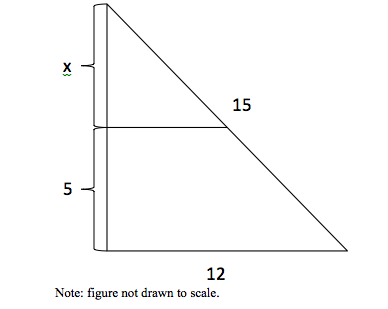
A right triangle with a base of 12 and hypotenuse of 15 is shown below. Find x.
Tap to reveal answer
Using the Pythagorean Theorem, the height of the right triangle is found to be = √(〖15〗2 –〖12〗2) = 9, so x=9 – 5=4
Using the Pythagorean Theorem, the height of the right triangle is found to be = √(〖15〗2 –〖12〗2) = 9, so x=9 – 5=4
← Didn't Know|Knew It →
A right triangle has sides of 36 and 39(hypotenuse). Find the length of the third side
A right triangle has sides of 36 and 39(hypotenuse). Find the length of the third side
Tap to reveal answer
use the pythagorean theorem:
a2 + b2 = c2 ; a and b are sides, c is the hypotenuse
a2 + 1296 = 1521
a2 = 225
a = 15
use the pythagorean theorem:
a2 + b2 = c2 ; a and b are sides, c is the hypotenuse
a2 + 1296 = 1521
a2 = 225
a = 15
← Didn't Know|Knew It →
Bob the Helicopter is at 30,000 ft. above sea level, and as viewed on a map his airport is 40,000 ft. away. If Bob travels in a straight line to his airport at 250 feet per second, how many minutes will it take him to arrive?
Bob the Helicopter is at 30,000 ft. above sea level, and as viewed on a map his airport is 40,000 ft. away. If Bob travels in a straight line to his airport at 250 feet per second, how many minutes will it take him to arrive?
Tap to reveal answer
Draw a right triangle with a height of 30,000 ft. and a base of 40,000 ft. The hypotenuse, or distance travelled, is then 50,000ft using the Pythagorean Theorem. Then dividing distance by speed will give us time, which is 200 seconds, or 3 minutes and 20 seconds.
Draw a right triangle with a height of 30,000 ft. and a base of 40,000 ft. The hypotenuse, or distance travelled, is then 50,000ft using the Pythagorean Theorem. Then dividing distance by speed will give us time, which is 200 seconds, or 3 minutes and 20 seconds.
← Didn't Know|Knew It →
A right triangle has two sides, 9 and x, and a hypotenuse of 15. What is x?
A right triangle has two sides, 9 and x, and a hypotenuse of 15. What is x?
Tap to reveal answer
We can use the Pythagorean Theorem to solve for x.
92 + _x_2 = 152
81 + _x_2 = 225
_x_2 = 144
x = 12
We can use the Pythagorean Theorem to solve for x.
92 + _x_2 = 152
81 + _x_2 = 225
_x_2 = 144
x = 12
← Didn't Know|Knew It →
The area of a right traingle is 42. One of the legs has a length of 12. What is the length of the other leg?
The area of a right traingle is 42. One of the legs has a length of 12. What is the length of the other leg?
Tap to reveal answer

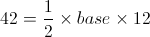


← Didn't Know|Knew It →