
Cubes - PSAT Math
Card 1 of 245
A cube is inscribed in a sphere of radius 1 such that all 8 vertices of the cube are on the surface of the sphere. What is the length of the diagonal of the cube?
A cube is inscribed in a sphere of radius 1 such that all 8 vertices of the cube are on the surface of the sphere. What is the length of the diagonal of the cube?
Tap to reveal answer
Since the diagonal of the cube is a line segment that goes through the center of the cube (and also the circumscribed sphere), it is clear that the diagonal of the cube is also the diameter of the sphere. Since the radius = 1, the diameter = 2.
Since the diagonal of the cube is a line segment that goes through the center of the cube (and also the circumscribed sphere), it is clear that the diagonal of the cube is also the diameter of the sphere. Since the radius = 1, the diameter = 2.
← Didn't Know|Knew It →
What is the length of the diagonal of a cube with volume of 512 in3?
What is the length of the diagonal of a cube with volume of 512 in3?
Tap to reveal answer
The first thing necessary is to determine the dimensions of the cube. This can be done using the volume formula for cubes: V = _s_3, where s is the length of the cube. For our data, this is:
_s_3 = 512, or (taking the cube root of both sides), s = 8.
The distance from corner to corner of the cube will be equal to the distance between (0,0,0) and (8,8,8). The distance formula for three dimensions is very similar to that of 2 dimensions (and hence like the Pythagorean Theorem):
d = √( (_x_1 – _x_2)2 + (_y_1 – _y_2)2 + (_z_1 – _z_2)2)
Or for our simpler case:
d = √( (x)2 + (y)2 + (z)2) = √( (s)2 + (s)2 + (s)2) = √( (8)2 + (8)2 + (8)2) = √( 64 + 64 + 64) = √(64 * 3) = 8√(3)
The first thing necessary is to determine the dimensions of the cube. This can be done using the volume formula for cubes: V = _s_3, where s is the length of the cube. For our data, this is:
_s_3 = 512, or (taking the cube root of both sides), s = 8.
The distance from corner to corner of the cube will be equal to the distance between (0,0,0) and (8,8,8). The distance formula for three dimensions is very similar to that of 2 dimensions (and hence like the Pythagorean Theorem):
d = √( (_x_1 – _x_2)2 + (_y_1 – _y_2)2 + (_z_1 – _z_2)2)
Or for our simpler case:
d = √( (x)2 + (y)2 + (z)2) = √( (s)2 + (s)2 + (s)2) = √( (8)2 + (8)2 + (8)2) = √( 64 + 64 + 64) = √(64 * 3) = 8√(3)
← Didn't Know|Knew It →
If a cube is 3” on all sides, what is the length of the diagonal of the cube?
If a cube is 3” on all sides, what is the length of the diagonal of the cube?
Tap to reveal answer
General formula for the diagonal of a cube if each side of the cube = s
Use Pythagorean Theorem to get the diagonal across the base:
s2 + s2 = h2
And again use Pythagorean Theorem to get cube’s diagonal, then solve for d:
h2 + s2 = d2
s2 + s2 + s2 = d2
3 * s2 = d2
d = √ (3 * s2) = s √3
So, if s = 3 then the answer is 3√3
General formula for the diagonal of a cube if each side of the cube = s
Use Pythagorean Theorem to get the diagonal across the base:
s2 + s2 = h2
And again use Pythagorean Theorem to get cube’s diagonal, then solve for d:
h2 + s2 = d2
s2 + s2 + s2 = d2
3 * s2 = d2
d = √ (3 * s2) = s √3
So, if s = 3 then the answer is 3√3
← Didn't Know|Knew It →
What is the length of the diagonal of a cube with volume of 1728 in3?
What is the length of the diagonal of a cube with volume of 1728 in3?
Tap to reveal answer
The first thing necessary is to determine the dimensions of the cube. This can be done using the volume formula for cubes: V = _s_3, where s is the length of the cube. For our data, this is:
_s_3 = 1728, or (taking the cube root of both sides), s = 12.
The distance from corner to corner of the cube will be equal to the distance between (0,0,0) and (12,12,12). The distance formula for three dimensions is very similar to that of 2 dimensions (and hence like the Pythagorean theorem):
d = √( (_x_1 – _x_2)2 + (_y_1 – _y_2)2 + (_z_1 – _z_2)2)
Or, for our simpler case:
d = √( (x)2 + (y)2 + (z)2) = √( (s)2 + (s)2 + (s)2) = √( (12)2 + (12)2 + (12)2) = √( 144 + 144 + 144) = √(3 * 144) = 12√(3) = 12√(3)
The first thing necessary is to determine the dimensions of the cube. This can be done using the volume formula for cubes: V = _s_3, where s is the length of the cube. For our data, this is:
_s_3 = 1728, or (taking the cube root of both sides), s = 12.
The distance from corner to corner of the cube will be equal to the distance between (0,0,0) and (12,12,12). The distance formula for three dimensions is very similar to that of 2 dimensions (and hence like the Pythagorean theorem):
d = √( (_x_1 – _x_2)2 + (_y_1 – _y_2)2 + (_z_1 – _z_2)2)
Or, for our simpler case:
d = √( (x)2 + (y)2 + (z)2) = √( (s)2 + (s)2 + (s)2) = √( (12)2 + (12)2 + (12)2) = √( 144 + 144 + 144) = √(3 * 144) = 12√(3) = 12√(3)
← Didn't Know|Knew It →
What is the length of the diagonal of a cube with surface area of 294 in2?
What is the length of the diagonal of a cube with surface area of 294 in2?
Tap to reveal answer
The first thing necessary is to determine the dimensions of the cube. This can be done using the surface area formula for cubes: A = 6_s_2, where s is the length of the cube. For our data, this is:
6_s_2 = 294
_s_2 = 49
(taking the square root of both sides) s = 7
The distance from corner to corner of the cube will be equal to the distance between (0,0,0) and (7,7,7). The distance formula for three dimensions is very similar to that of 2 dimensions (and hence like the Pythagorean Theorem):
d = √((_x_1 – _x_2)2 + (_y_1 – _y_2)2 + (_z_1 – _z_2)2)
Or for our simpler case:
d = √((x)2 + (y)2 + (z)2) = √( (s)2 + (s)2 + (s)2) = √( (7)2 + (7)2 + (7)2) = √( 49 + 49 + 49) = √(49 * 3) = 7√(3)
The first thing necessary is to determine the dimensions of the cube. This can be done using the surface area formula for cubes: A = 6_s_2, where s is the length of the cube. For our data, this is:
6_s_2 = 294
_s_2 = 49
(taking the square root of both sides) s = 7
The distance from corner to corner of the cube will be equal to the distance between (0,0,0) and (7,7,7). The distance formula for three dimensions is very similar to that of 2 dimensions (and hence like the Pythagorean Theorem):
d = √((_x_1 – _x_2)2 + (_y_1 – _y_2)2 + (_z_1 – _z_2)2)
Or for our simpler case:
d = √((x)2 + (y)2 + (z)2) = √( (s)2 + (s)2 + (s)2) = √( (7)2 + (7)2 + (7)2) = √( 49 + 49 + 49) = √(49 * 3) = 7√(3)
← Didn't Know|Knew It →
A rectangular prism has a volume of 144 and a surface area of 192. If the shortest edge is 3, what is the length of the longest diagonal through the prism?
A rectangular prism has a volume of 144 and a surface area of 192. If the shortest edge is 3, what is the length of the longest diagonal through the prism?
Tap to reveal answer
The volume of a rectangular prism is  .
.
We are told that the shortest edge is 3. Let us call this the height.
We now have  , or
, or  .
.


Now we replace variables by known values:

Now we have:


We have thus determined that the other two edges of the rectangular prism will be 4 and 12. We now need to find the longest diagonal. This is equal to:

If you do not remember how to find this directly, you can also do it in steps. You first find the diagonal across one of the sides (in the plane), by using the Pythagorean Theorem. For example, we choose the side with edges 3 and 4. This diagonal will be:

We then use a plane with one side given by the diagonal we just found (length 5) and the other given by the distance of the 3rd edge (length 12).
This diagonal is then  .
.
The volume of a rectangular prism is
We are told that the shortest edge is 3. Let us call this the height.
We now have
Now we replace variables by known values:
Now we have:
We have thus determined that the other two edges of the rectangular prism will be 4 and 12. We now need to find the longest diagonal. This is equal to:
If you do not remember how to find this directly, you can also do it in steps. You first find the diagonal across one of the sides (in the plane), by using the Pythagorean Theorem. For example, we choose the side with edges 3 and 4. This diagonal will be:
We then use a plane with one side given by the diagonal we just found (length 5) and the other given by the distance of the 3rd edge (length 12).
This diagonal is then
← Didn't Know|Knew It →
A cubic box has sides of length x. Another cubic box has sides of length 4_x_. How many of the boxes with length x could fit in one of the larger boxes with side length 4_x_?
A cubic box has sides of length x. Another cubic box has sides of length 4_x_. How many of the boxes with length x could fit in one of the larger boxes with side length 4_x_?
Tap to reveal answer
The volume of a cubic box is given by (side length)3. Thus, the volume of the larger box is (4_x_)3 = 64_x_3, while the volume of the smaller box is _x_3. Divide the volume of the larger box by that of the smaller box, (64_x_3)/(_x_3) = 64.
The volume of a cubic box is given by (side length)3. Thus, the volume of the larger box is (4_x_)3 = 64_x_3, while the volume of the smaller box is _x_3. Divide the volume of the larger box by that of the smaller box, (64_x_3)/(_x_3) = 64.
← Didn't Know|Knew It →
I have a hollow cube with 3” sides suspended inside a larger cube of 9” sides. If I fill the larger cube with water and the hollow cube remains empty yet suspended inside, what volume of water was used to fill the larger cube?
I have a hollow cube with 3” sides suspended inside a larger cube of 9” sides. If I fill the larger cube with water and the hollow cube remains empty yet suspended inside, what volume of water was used to fill the larger cube?
Tap to reveal answer
Determine the volume of both cubes and then subtract the smaller from the larger. The large cube volume is 9” * 9” * 9” = 729 in3 and the small cube is 3” * 3” * 3” = 27 in3. The difference is 702 in3.
Determine the volume of both cubes and then subtract the smaller from the larger. The large cube volume is 9” * 9” * 9” = 729 in3 and the small cube is 3” * 3” * 3” = 27 in3. The difference is 702 in3.
← Didn't Know|Knew It →
A cube weighs 5 pounds. How much will a different cube of the same material weigh if the sides are 3 times as long?
A cube weighs 5 pounds. How much will a different cube of the same material weigh if the sides are 3 times as long?
Tap to reveal answer
A cube that has three times as long sides is 3x3x3=27 times bigger than the original. Therefore, the answer is 5x27= 135.
A cube that has three times as long sides is 3x3x3=27 times bigger than the original. Therefore, the answer is 5x27= 135.
← Didn't Know|Knew It →
If the volume of a cube is 50 cubic feet, what is the volume when the sides double in length?
If the volume of a cube is 50 cubic feet, what is the volume when the sides double in length?
Tap to reveal answer
Using S as the side length in the original cube, the original is s*s*s. Doubling one side and tripling the other gives 2s*2s*2s for a new volume formula for 8s*s*s, showing that the new volume is 8x greater than the original.
Using S as the side length in the original cube, the original is s*s*s. Doubling one side and tripling the other gives 2s*2s*2s for a new volume formula for 8s*s*s, showing that the new volume is 8x greater than the original.
← Didn't Know|Knew It →
A cube is inscribed inside a sphere of radius 1 such that each of the eight vertices of the cube lie on the surface of the sphere. What is the volume of the cube?
A cube is inscribed inside a sphere of radius 1 such that each of the eight vertices of the cube lie on the surface of the sphere. What is the volume of the cube?
Tap to reveal answer
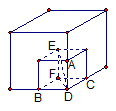
To make this problem easier to solve, we can inscribe a smaller square in the cube. In the diagram above, points  are midpoints of the edges of the inscribed cube. Therefore point
  , a vertex of the smaller cube, is also the center of the sphere. Point
  lies on the circumference of the sphere, so
  .
.  is also the hypotenuse of right triangle
  . Similarly,
  is the hypotenuse of right triangle
  . If we let
  , then, by the properties of a right triangle,
  .
.
Using the Pythagorean Theorem, we can now solve for  :
:




Since the side of the inscribed cube is  , the volume is
  .
.
To make this problem easier to solve, we can inscribe a smaller square in the cube. In the diagram above, points
Using the Pythagorean Theorem, we can now solve for
Since the side of the inscribed cube is
← Didn't Know|Knew It →
A cube has 2 faces painted red and the remaining faces painted green. The total area of the green faces is 36 square inches. What is the volume of the cube in cubic inches?
A cube has 2 faces painted red and the remaining faces painted green. The total area of the green faces is 36 square inches. What is the volume of the cube in cubic inches?
Tap to reveal answer
Cubes have 6 faces. If 2 are red, then 4 must be green. We are told that the total area of the green faces is 36 square inches, so we divide the total area of the green faces by the number of green faces (which is 4) to get the area of each green face: 36/4 = 9 square inches. Since each of the 6 faces of a cube have the same size, we know that each edge of the cube is √9 = 3 inches. Therefore the volume of the cube is 3 in x 3 in x 3 in = 27 cubic inches.
Cubes have 6 faces. If 2 are red, then 4 must be green. We are told that the total area of the green faces is 36 square inches, so we divide the total area of the green faces by the number of green faces (which is 4) to get the area of each green face: 36/4 = 9 square inches. Since each of the 6 faces of a cube have the same size, we know that each edge of the cube is √9 = 3 inches. Therefore the volume of the cube is 3 in x 3 in x 3 in = 27 cubic inches.
← Didn't Know|Knew It →
If a waterproof box is 50cm in length, 20cm in depth, and 30cm in height, how much water will overflow if 35 liters of water are poured into the box?
If a waterproof box is 50cm in length, 20cm in depth, and 30cm in height, how much water will overflow if 35 liters of water are poured into the box?
Tap to reveal answer
The volume of the box is 50 * 20 * 30 cm = 30,000 cm3.
1cm3 = 1mL, 30,000 cm3 = 30,000mL = 30 L.
Because the volume of the box is only 30 L, 5 L of the 35 L will not fit into the box.
The volume of the box is 50 * 20 * 30 cm = 30,000 cm3.
1cm3 = 1mL, 30,000 cm3 = 30,000mL = 30 L.
Because the volume of the box is only 30 L, 5 L of the 35 L will not fit into the box.
← Didn't Know|Knew It →
Kim from Idaho can only stack bales of hay in her barn for 3 hours before she needs a break. She stacks the bales at a rate of 2 bales per minute, 3 bales high with 5 bales in a single row. How many full rows will she have at the end of her stacking?
Kim from Idaho can only stack bales of hay in her barn for 3 hours before she needs a break. She stacks the bales at a rate of 2 bales per minute, 3 bales high with 5 bales in a single row. How many full rows will she have at the end of her stacking?
Tap to reveal answer
She will stack 360 bales in 3 hours. One row requires 15 bales. 360 divided by 15 is 24.
She will stack 360 bales in 3 hours. One row requires 15 bales. 360 divided by 15 is 24.
← Didn't Know|Knew It →
A cube has a volume of  . What is the volume of cube with sides that are twice as long?
A cube has a volume of
Tap to reveal answer
The volume of a cube is  .
.
If each side of the cube is  , then the volume will be
  .
.
If we double each side, then each side would be  and the volume would be
  .
.
The volume of a cube is
If each side of the cube is
If we double each side, then each side would be
← Didn't Know|Knew It →
If a cube has its edges increased by a factor of 5, what is the ratio of the new volume to the old volume?
If a cube has its edges increased by a factor of 5, what is the ratio of the new volume to the old volume?
Tap to reveal answer
A cubic volume is  . Let the original sides be 1, so that the original volume is 1. Then find the volume if the sides measure 5. This new volume is 125. Therefore, the ratio of new volume to old volume is 125: 1.
A cubic volume is
← Didn't Know|Knew It →
How many smaller boxes with a dimensions of 1 by 5 by 5 can fit into cube shaped box with a surface area of 150?
How many smaller boxes with a dimensions of 1 by 5 by 5 can fit into cube shaped box with a surface area of 150?
Tap to reveal answer
There surface are of a cube is 6 times the area of one face of the cube , therefore 


a is equal to an edge of the cube
the volume of the cube is 
The problem states that the dimensions of the smaller boxes are 1 x 5 x 5, the volume of one of the smaller boxes is 25.
Therefore, 125/25 = 5 small boxes
There surface are of a cube is 6 times the area of one face of the cube , therefore
a is equal to an edge of the cube
the volume of the cube is
The problem states that the dimensions of the smaller boxes are 1 x 5 x 5, the volume of one of the smaller boxes is 25.
Therefore, 125/25 = 5 small boxes
← Didn't Know|Knew It →
If a cube has a surface area of  , what is the difference between the volume of the cube and the surface area of the cube?
If a cube has a surface area of
Tap to reveal answer
If the surface area is  , then the area of one face must be
  . Therefore, the length of one edge must be
  This means that the volume of the cube is
  . We can now solve with:

If the surface area is
← Didn't Know|Knew It →
If a cube is 3” on all sides, what is the length of the diagonal of the cube?
If a cube is 3” on all sides, what is the length of the diagonal of the cube?
Tap to reveal answer
General formula for the diagonal of a cube if each side of the cube = s
Use Pythagorean Theorem to get the diagonal across the base:
s2 + s2 = h2
And again use Pythagorean Theorem to get cube’s diagonal, then solve for d:
h2 + s2 = d2
s2 + s2 + s2 = d2
3 * s2 = d2
d = √ (3 * s2) = s √3
So, if s = 3 then the answer is 3√3
General formula for the diagonal of a cube if each side of the cube = s
Use Pythagorean Theorem to get the diagonal across the base:
s2 + s2 = h2
And again use Pythagorean Theorem to get cube’s diagonal, then solve for d:
h2 + s2 = d2
s2 + s2 + s2 = d2
3 * s2 = d2
d = √ (3 * s2) = s √3
So, if s = 3 then the answer is 3√3
← Didn't Know|Knew It →
A cube is inscribed in a sphere of radius 1 such that all 8 vertices of the cube are on the surface of the sphere. What is the length of the diagonal of the cube?
A cube is inscribed in a sphere of radius 1 such that all 8 vertices of the cube are on the surface of the sphere. What is the length of the diagonal of the cube?
Tap to reveal answer
Since the diagonal of the cube is a line segment that goes through the center of the cube (and also the circumscribed sphere), it is clear that the diagonal of the cube is also the diameter of the sphere. Since the radius = 1, the diameter = 2.
Since the diagonal of the cube is a line segment that goes through the center of the cube (and also the circumscribed sphere), it is clear that the diagonal of the cube is also the diameter of the sphere. Since the radius = 1, the diameter = 2.
← Didn't Know|Knew It →