
How to find domain and range of the inverse of a relation
PSAT Math · Learn by Concept
Help Questions
PSAT Math › How to find domain and range of the inverse of a relation
What is the range of the function y = _x_2 + 2?
all real numbers
y ≥ 2
{–2, 2}
{2}
undefined
Explanation
The range of a function is the set of y-values that a function can take. First let's find the domain. The domain is the set of x-values that the function can take. Here the domain is all real numbers because no x-value will make this function undefined. (Dividing by 0 is an example of an operation that would make the function undefined.)
So if any value of x can be plugged into y = _x_2 + 2, can y take any value also? Not quite! The smallest value that y can ever be is 2. No matter what value of x is plugged in, y = _x_2 + 2 will never produce a number less than 2. Therefore the range is y ≥ 2.
What is the smallest value that belongs to the range of the function 


Explanation
We need to be careful here not to confuse the domain and range of a function. The problem specifically concerns the range of the function, which is the set of possible numbers of 

Notice that 



This means that when 



As we can see, as 


The answer is 
Given the relation below, identify the domain of the inverse of the relation.



The inverse of the relation does not exist.
Explanation

The domain of the inverse of a relation is the same as the range of the original relation. In other words, the y-values of the relation are the x-values of the inverse.
For the original relation, the range is: 
Thus, the domain for the inverse relation will also be 
If 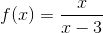


Explanation
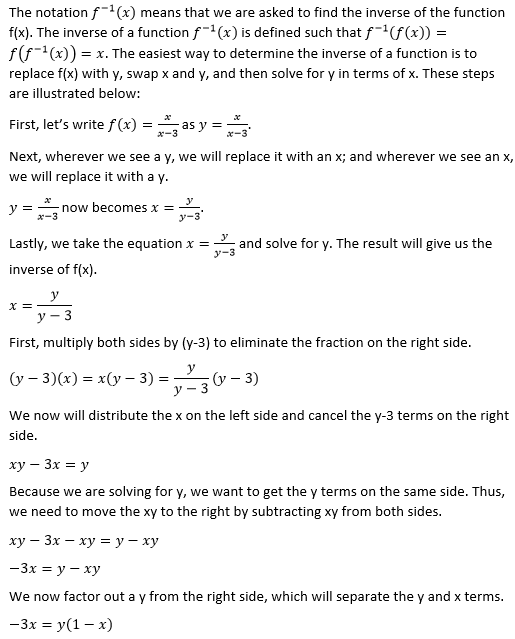
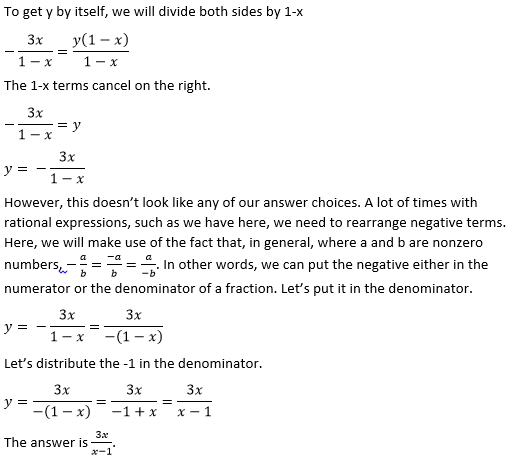
What is the range of the function y = _x_2 + 2?
y ≥ 2
all real numbers
{–2, 2}
{2}
undefined
Explanation
The range of a function is the set of y-values that a function can take. First let's find the domain. The domain is the set of x-values that the function can take. Here the domain is all real numbers because no x-value will make this function undefined. (Dividing by 0 is an example of an operation that would make the function undefined.)
So if any value of x can be plugged into y = _x_2 + 2, can y take any value also? Not quite! The smallest value that y can ever be is 2. No matter what value of x is plugged in, y = _x_2 + 2 will never produce a number less than 2. Therefore the range is y ≥ 2.
Which of the following values of x is not in the domain of the function y = (2_x –_ 1) / (x_2 – 6_x + 9) ?
–1/2
1/2
0
2
3
Explanation
Values of x that make the denominator equal zero are not included in the domain. The denominator can be simplified to (x – 3)2, so the value that makes it zero is 3.
Given the relation below:
{(1, 2), (3, 4), (5, 6), (7, 8)}
Find the range of the inverse of the relation.
{1, 2, 3, 4}
{5, 6, 7, 8}
{1, 3, 5, 7}
{2, 4, 6, 8}
the inverse of the relation does not exist
Explanation
The domain of a relation is the same as the range of the inverse of the relation. In other words, the x-values of the relation are the y-values of the inverse.
If 





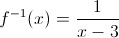
Explanation


To find the inverse simply exchange 


So we get 
