
Exponents and Logarithms - SAT Math
Card 0 of 180
Rewrite as a single logarithmic expression:

Rewrite as a single logarithmic expression:
Using the properties of logarithms
 and
and 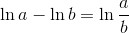 ,
,
we simplify as follows:


Using the properties of logarithms
we simplify as follows:
Compare your answer with the correct one above
How many elements are in a set that has exactly 128 subsets?
How many elements are in a set that has exactly 128 subsets?
A set with  elements has
  subsets.
Solve:


A set with
Solve:
Compare your answer with the correct one above
Solve: 
Solve:
In order to solve this problem, covert 27 to the correct base and power.

Since  , the correct answer is
  .
.
In order to solve this problem, covert 27 to the correct base and power.
Since
Compare your answer with the correct one above
Simplify 
Simplify
When an exponent is raised by another exponent, we just multiply the powers.

When an exponent is raised by another exponent, we just multiply the powers.
Compare your answer with the correct one above
Simplify:

Simplify:
When adding exponents, we don't add the exponents or multiply out the bases. Our goal is to see if we can factor anything. We do see three  . Let's factor.
 Remember when multiplying exponents, we just add the powers.
When adding exponents, we don't add the exponents or multiply out the bases. Our goal is to see if we can factor anything. We do see three
Compare your answer with the correct one above
Solve and simplify.

Solve and simplify.
 Another way to write this is
  . The only number that makes
  is
is  .
.
Compare your answer with the correct one above
Simplify:

Simplify:
 is the same as
  . Let's factor out
  . It's the same as
  . Therefore
  which is the answer to our question.
Compare your answer with the correct one above
Simplify:

Simplify:
When dealing with subtraction in regards to logarithms, it's the same as dividing the numbers.

When dealing with subtraction in regards to logarithms, it's the same as dividing the numbers.
Compare your answer with the correct one above
Simplify:

Simplify:
When dealing with addition in regards to logarithms, it's the same as multiplying the numbers.

When dealing with addition in regards to logarithms, it's the same as multiplying the numbers.
Compare your answer with the correct one above
Solve:  when
when  .
.
Solve:
Power rule says when an exponent is raised to another exponent, you must multiply the exponents.
So  and our expression is now
  .
.
Plug in the given value to get
 .
.
Power rule says when an exponent is raised to another exponent, you must multiply the exponents.
So
Plug in the given value to get
Compare your answer with the correct one above
Simplify 
Simplify
One of the properties of log is that 
Applying that principle to this problem:

Simplifying the log base 10


Plug in the values to the first equation:

One of the properties of log is that
Applying that principle to this problem:
Simplifying the log base 10
Plug in the values to the first equation:
Compare your answer with the correct one above
Solve for  (round to the nearest hundredth):

Solve for
Take the natural logarithm of both sides:


By Logarithm of a Power Rule, the above becomes

After distributing, solve for  :
:


Factor out the left side, then divide:


Substituting the values of the logarithms:


This rounds to 0.45.
Take the natural logarithm of both sides:
By Logarithm of a Power Rule, the above becomes
After distributing, solve for
Factor out the left side, then divide:
Substituting the values of the logarithms:
This rounds to 0.45.
Compare your answer with the correct one above
Solve for  :
:

Solve for
 , so the equation

can be rewritten as:

By the Power of a Power rule:

It follows that

Solving for  :
:


can be rewritten as:
By the Power of a Power rule:
It follows that
Solving for
Compare your answer with the correct one above


By the Power of a Power and Product of Power Rules, we can rewrite this equation as


Substitute  for
for  ; the resulting equation is the quadratic equation
 ,
,
which can be written in standard form by subtracting  from both sides:


The quadratic trinomial fits the perfect square trinomial pattern:


By the square root principle,


Substituting  for
for  :
:


By the Power of a Power and Product of Power Rules, we can rewrite this equation as
Substitute
which can be written in standard form by subtracting
The quadratic trinomial fits the perfect square trinomial pattern:
By the square root principle,
Substituting
Compare your answer with the correct one above
Evaluate: 
Evaluate:
An exponential base raised to the natural log will eliminate, leaving only the terms of the power. This is a log rule that can be used to simplify the expression.

Distribute the x variable through the binomial.

The answer is: 
An exponential base raised to the natural log will eliminate, leaving only the terms of the power. This is a log rule that can be used to simplify the expression.
Distribute the x variable through the binomial.
The answer is:
Compare your answer with the correct one above
Solve for  :
:

Give the solution to the nearest hundredth.
Solve for
Give the solution to the nearest hundredth.
One way is to take the common logarithm of both sides and solve:


One way is to take the common logarithm of both sides and solve:
Compare your answer with the correct one above
Solve for  :
:

Give your answer to the nearest hundredth.
Solve for
Give your answer to the nearest hundredth.
Take the common logarithm of both sides and solve for  :
:


Take the common logarithm of both sides and solve for
Compare your answer with the correct one above
Solve for  :
:

Give your answer to the nearest hundredth.
Solve for
Give your answer to the nearest hundredth.


Take the common logarithm of both sides and solve for  :
:


Take the common logarithm of both sides and solve for
Compare your answer with the correct one above
Solve for  :
:

Give your answer to the nearest hundredth.
Solve for
Give your answer to the nearest hundredth.
Take the natural logarithm of both sides and solve for  :
:


Take the natural logarithm of both sides and solve for
Compare your answer with the correct one above
To the nearest hundredth, solve for  :
:

To the nearest hundredth, solve for
Take the common logarithm of both sides, then solve the resulting linear equation.


Take the common logarithm of both sides, then solve the resulting linear equation.
Compare your answer with the correct one above