
How to find the solution to an inequality with multiplication
SAT Math · Learn by Concept
Help Questions
SAT Math › How to find the solution to an inequality with multiplication
We have 




Explanation

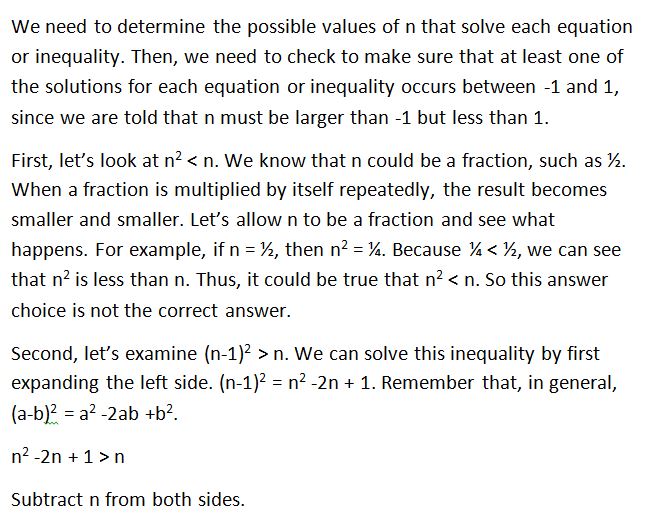
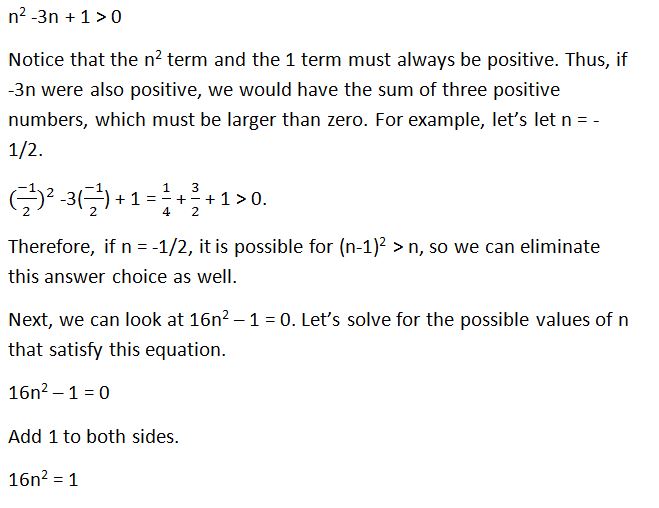
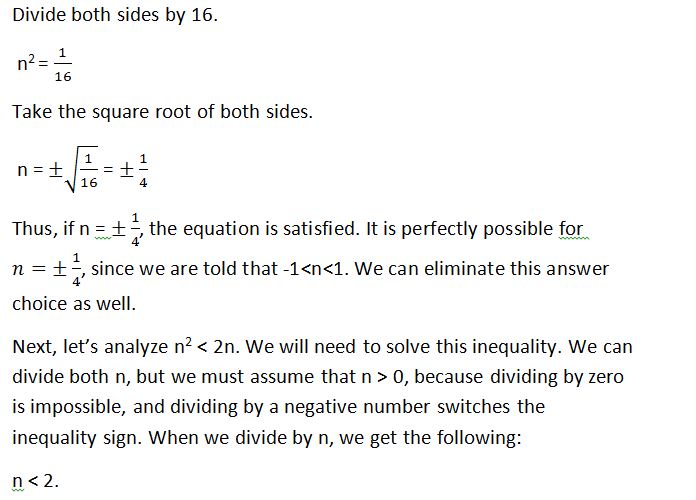
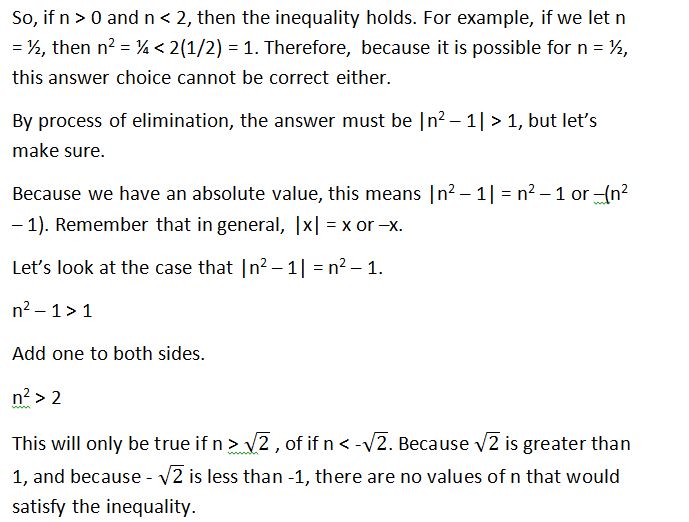
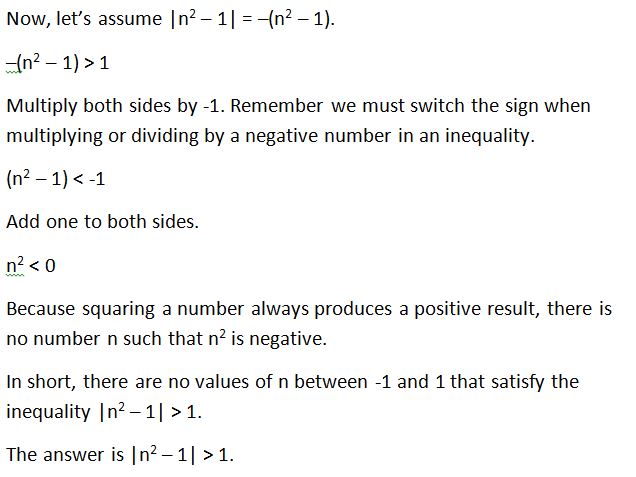
If –1 < n < 1, all of the following could be true EXCEPT:
n2 < n
|n2 - 1| > 1
(n-1)2 > n
16n2 - 1 = 0
n2 < 2n
Explanation
Fill in the circle with either 


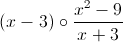

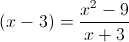
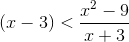
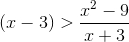
None of the other answers are correct.
The rational expression is undefined.
Explanation
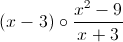
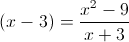
Let us simplify the second expression. We know that:

So we can cancel out as follows:

Give the solution set of this inequality:


The set of all real numbers
Explanation
The absolute value inequality

can be rewritten as the compound inequality


Solve each inequality separately, using the properties of inequality to isolate the variable on the left side:

Subtract 17 from both sides:


Divide both sides by 


which in interval notation is

The same steps are performed with the other inequality:


which in interval notation is 
The correct response is the union of these two sets, which is

Find the maximum value of 


Explanation
First step is to rewrite


Next step is to find the vertices of the bounded region. We do this by plugging in the x bounds into the 
The vertices are


Now we plug each coordinate into 


So the maximum value is

What value must 


Explanation


Add 

Multiply each side of the inequality by 

Multiply each side of the inequality by 

Divide each side of the inequality by 

You can now change the fraction on the right side of the inequality to decimal form.

The correct answer is 

(√(8) / -x ) < 2. Which of the following values could be x?
All of the answers choices are valid.
-4
-3
-2
-1
Explanation
The equation simplifies to x > -1.41. -1 is the answer.
Solve for x






