
Numbers and Operations - SSAT Middle Level: Quantitative
Card 1 of 5772

Tap to reveal answer
I think the easiest way to do this problem is to make a common denominator. 4 is the smallest common denominator.
 is equivalent to
  .
.
When you add  and
and  you get
  .
.
 reduces to
  and is equivalent to
  .
.
I think the easiest way to do this problem is to make a common denominator. 4 is the smallest common denominator.
When you add
← Didn't Know|Knew It →
Add the fractions below.

Add the fractions below.
Tap to reveal answer
First, we need to find a common denominator. In this case, we can convert both denominators to  .
.

Now we can add the numerators.
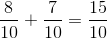
Both the numerator and denominator are divisible by  , so we can simplify.
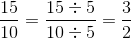
First, we need to find a common denominator. In this case, we can convert both denominators to
Now we can add the numerators.
Both the numerator and denominator are divisible by
← Didn't Know|Knew It →
Find the sum: 
Find the sum:
Tap to reveal answer
Add the fractions by writing each with the lowest common denominator, which is  .
.

Add the integers: 
Now add the two sums: 
Add the fractions by writing each with the lowest common denominator, which is
Add the integers:
Now add the two sums:
← Didn't Know|Knew It →
Evaluate:

Evaluate:
Tap to reveal answer
The sum of two numbers of unlike sign is the difference of their absolute values, with the sign of the "dominant" number (the positive number here) affixed:

Subtract vertically by aligning the decimal points, making sure you append the 3.2 with a placeholder zero:


This is the correct choice.
The sum of two numbers of unlike sign is the difference of their absolute values, with the sign of the "dominant" number (the positive number here) affixed:
Subtract vertically by aligning the decimal points, making sure you append the 3.2 with a placeholder zero:
This is the correct choice.
← Didn't Know|Knew It →

Tap to reveal answer
When adding fractions, both denominators must be the same. A quick and easy way to do this is to multiply the numerator and the denominator of each fraction by the other fraction's denominator:
 and
and 
The  is multiplied by 6 on both ends because the denominator of
  is 6. Likewise,
  is multiplied by 3 on both ends because the denominator of
  is 3. The problem should now look like this:

Remember to reduce. 15 and 18 are both divisible by 3.

Your answer is  .
.
When adding fractions, both denominators must be the same. A quick and easy way to do this is to multiply the numerator and the denominator of each fraction by the other fraction's denominator:
The
Remember to reduce. 15 and 18 are both divisible by 3.
Your answer is
← Didn't Know|Knew It →

Tap to reveal answer
Add the numerators:


Add the numerators:
← Didn't Know|Knew It →
Evaluate:

Evaluate:
Tap to reveal answer
Rewrite these numbers as improper fractions.


Now evaluate:


 , so
, so

Rewrite these numbers as improper fractions.
Now evaluate:
← Didn't Know|Knew It →
Solve:

Solve:
Tap to reveal answer
The least common multiple of 2 and 9 is 18.


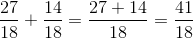
The least common multiple of 2 and 9 is 18.
← Didn't Know|Knew It →
Add:

Add:
Tap to reveal answer
Rewrite using the lowest comon denominator. Since  :
:

Rewrite using the lowest comon denominator. Since
← Didn't Know|Knew It →
Add:

Add:
Tap to reveal answer
Rewrite using the lowest comon denominator. Since  :
:


Rewrite using the lowest comon denominator. Since
← Didn't Know|Knew It →
Which of the following expressions is equal to  ?
?
Which of the following expressions is equal to
Tap to reveal answer
Rewrite both numbers as decimals:
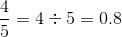 , so
, so 
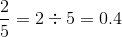 , so
, so 
Add the decimals vertically, lining up the decimal points:


Rewrite both numbers as decimals:
Add the decimals vertically, lining up the decimal points:
← Didn't Know|Knew It →

Tap to reveal answer
Add the numerators:
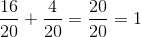
Add the numerators:
← Didn't Know|Knew It →
Sally has one-half of a pepperoni pizza remaining after lunch, while Ted has only one-fifth of the same size pizza remaining. If they combine their pizza, what fraction of a whole pepperoni pizza do they have?
Sally has one-half of a pepperoni pizza remaining after lunch, while Ted has only one-fifth of the same size pizza remaining. If they combine their pizza, what fraction of a whole pepperoni pizza do they have?
Tap to reveal answer
In this story problem we are able to see that we are having to do something with fractions. Story problems can be tricky so let's try to transform this story into an equation. First lets take out the fractions we see in the problem.
One-half we know can be shown as  .
.
One-fifth we also know is shown as  .
.
Those are the only two fractions we are having to work with. Next let's examine what the story wants us to do with the fractinos. The key word in this problem is combine, that means we are going to add our fractions together.

This is what the story problem looks like when we turn it into an equation.
Next, since we are adding fractions we need to have a common denominator. Our denominators are 2 and 5. To have a common denominator we must have a multiple of 2 and 5 that both are able to go into. Think of a number that both 2 and 5 can both go into... Was 10 the number you came up with?
Let's use 10 as our common denominator. So how many times does 2 have to be multiplied to give us 10? (5). We need to multiply the numerator and the denominator of one half by five.

The fraction is still the same, but we had to do this for a common denominator.
We need to still change our other fraction, how many times does 5 go into 10? (2)

We now have common denominators so all we have to do is add the numerators across and keep the denominator as 10. So  , and the denominator remains 10, giving us the answer...
In this story problem we are able to see that we are having to do something with fractions. Story problems can be tricky so let's try to transform this story into an equation. First lets take out the fractions we see in the problem.
One-half we know can be shown as
One-fifth we also know is shown as
Those are the only two fractions we are having to work with. Next let's examine what the story wants us to do with the fractinos. The key word in this problem is combine, that means we are going to add our fractions together.
This is what the story problem looks like when we turn it into an equation.
Next, since we are adding fractions we need to have a common denominator. Our denominators are 2 and 5. To have a common denominator we must have a multiple of 2 and 5 that both are able to go into. Think of a number that both 2 and 5 can both go into... Was 10 the number you came up with?
Let's use 10 as our common denominator. So how many times does 2 have to be multiplied to give us 10? (5). We need to multiply the numerator and the denominator of one half by five.
The fraction is still the same, but we had to do this for a common denominator.
We need to still change our other fraction, how many times does 5 go into 10? (2)
We now have common denominators so all we have to do is add the numerators across and keep the denominator as 10. So
← Didn't Know|Knew It →
Add the following fractions and simplify, if possible.

Add the following fractions and simplify, if possible.
Tap to reveal answer
In order to add fractions with different denominators, first find a common denominator of the fractions by finding the least common multiple. The least common multiple of these denominators is:
 and
and  .
.
Because  already has the required denominator, nothing needs to be done to
  .
.
Since the  in
in  needs to be multiplied by
  in order to get
  as the deonominator, multiply the numberator of
  by
by  .
.
The "new" addition problem is now:  .
.
The answer to this question is therefore  .
.
Because  and
and  do not have a common factor, the answer cannot be simplified.
In order to add fractions with different denominators, first find a common denominator of the fractions by finding the least common multiple. The least common multiple of these denominators is:
Because
Since the
The "new" addition problem is now:
The answer to this question is therefore
Because
← Didn't Know|Knew It →
Add the fractions below:

Add the fractions below:
Tap to reveal answer
To add fractions with different denominators, first the fractions should be rewritten as equivalent fractions with the same denominators. The simplest common denominator to get is the product of the denominators (i.e.  , in this question). However, the best denominator to use is the least common denominator, which is the least common multiple of the denominators (which is 12 in this case).


Now the denominators are equal and we can add the numerators:

which can be written as:

To add fractions with different denominators, first the fractions should be rewritten as equivalent fractions with the same denominators. The simplest common denominator to get is the product of the denominators (i.e.
Now the denominators are equal and we can add the numerators:
which can be written as:
← Didn't Know|Knew It →
Add the fractions below:

Add the fractions below:
Tap to reveal answer
To add fractions with different denominators, first the fractions should be rewritten as equivalent fractions with the same denominators. The simplest common denominator to get is the product of the denominators (i.e.  , in this case). However, the best denominator to use is the least common denominator, which is 12 in this question. So we can write:

As the denominators are equal, we can add the numerators:

or:

To add fractions with different denominators, first the fractions should be rewritten as equivalent fractions with the same denominators. The simplest common denominator to get is the product of the denominators (i.e.
As the denominators are equal, we can add the numerators:
or:
← Didn't Know|Knew It →
Evaluate:

Evaluate:
Tap to reveal answer
At first, we should add the first two mixed numbers. This is best done by writing writing them vertically and adding integers and fraction parts (Note: denominators are the same).


So we have:

We can rewrite them vertically:


At first, we should add the first two mixed numbers. This is best done by writing writing them vertically and adding integers and fraction parts (Note: denominators are the same).
So we have:
We can rewrite them vertically:
← Didn't Know|Knew It →
What is the simplest form of the result:

What is the simplest form of the result:
Tap to reveal answer
Denominators are the same, so we can add and subtract the numerators:


The fraction can be reduced to lowest terms by dividing the numerator and the denominator by their greatest common factor which is 5 in this case. So we get:

Since the greatest common factor of 1 and 3 is 1,  is in lowest terms.
Denominators are the same, so we can add and subtract the numerators:
The fraction can be reduced to lowest terms by dividing the numerator and the denominator by their greatest common factor which is 5 in this case. So we get:
Since the greatest common factor of 1 and 3 is 1,
← Didn't Know|Knew It →
Add:

Add:
Tap to reveal answer
The least common denominator of 5 and 7 is 35. Use this as the denominator for both fractions and change the numerators accordingly:


The least common denominator of 5 and 7 is 35. Use this as the denominator for both fractions and change the numerators accordingly:
← Didn't Know|Knew It →
Add: 
Add:
Tap to reveal answer
Rewrite the fractions with the common denominator  , and add numerators:

Rewrite the fractions with the common denominator
← Didn't Know|Knew It →