
How to find the nth term of an arithmetic sequence
SSAT Upper Level: Quantitative · Learn by Concept
Help Questions
SSAT Upper Level: Quantitative › How to find the nth term of an arithmetic sequence
An arithmetic sequence begins as follows:

Which of the following is the first term greater than 100?
The forty-first term
The forty-second term
The forty-third term
The forty-fourth term
The fortieth term
Explanation
The common difference of the sequence is

so the 

To find out the minimum value for which 


The forty-first term is the correct response.
An arithmetic sequence begins as follows:

Which of the following is the first term greater than 100?
The forty-eighth term
The forty-ninth term
The fiftieth term
The forty-seventh term
The fifty-first term
Explanation
The common difference of the sequence is

so the 

To find out the minimum value for which 


The correct response is the forty-eighth term.
An arithmetic sequence begins as follows:

Which of the following terms is the first positive term in the sequence?
The fortieth term
The thirty-ninth term
The thirty-eighth term
The thirty-seventh term
The sequence has no positive terms.
Explanation
The common difference of the sequence is

so the

To find out the minimum value for which 


The first positive term is the fortieth term.
The first two terms of an arithmetic sequence are 1,000 and 997, in that order. What is the seventieth term?


Explanation
The first term is 
The common difference is

The seventieth term is

An arithmetic sequence begins as follows:
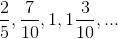
Give the thirty-third term of this sequence.
The correct answer is not given among the other four responses.


Explanation
The 



The initial term in the given sequence is

the common difference is

We are seeking term 
Therefore,
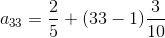
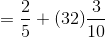


which is not among the choices.
An arithmetic sequence begins as follows:

Give the thirty-second term of this sequence.


Explanation
The 



The initial term in the given sequence is

the common difference is

We are seeking term 
This term is


An arithmetic sequence begins as follows:

Which of the following terms is the first negative term in the sequence?
The one hundred thirteenth term
The one hundred twelfth term
The one hundred eleventh term
The one hundred tenth term
The one hundred fourteenth term
Explanation
The common difference of the sequence is

so the 

To find out the minimum value for which 


The first negative term is the one hundred thirteenth term.
The eleventh and thirteenth terms of an arithmetic sequence are, respectively, 11 and 14. Give its first term.


Explanation
The
Since the eleventh and thirteenth terms are two terms apart, the common difference can be found as follows:


Now, we can set 


The first two terms of an arithmetic sequence are 4 and 9, in that order. Give the one-hundredth term of that sequence.


Explanation
The first term is 

The hundredth term is

The lengths of the sides of ten squares form an arithmetic sequence. One side of the smallest square measures eight inches; one side of the second-smallest square measures one foot.
Give the area of the largest square.
1,936 square inches
484 square inches
2,304 square inches
576 square inches
784 square inches
Explanation
Let 



The arithmetic sequence formula is

The length of a side of the largest square - square 10 - can be found by substituting 

The largest square has sides of length 44 inches, so its area is the square of this, or 